- A call by the editors (and computer scientist Cal Newport) for scientists to “stop, drop, and think” (and the paperback version of Newport’s Slow Productivity has a nice cover that looks very much like Moraine Lake in Banff National Parc!)
- Another call by a Science Po’ sociologist to the (then highly prospective) French government to increase research budget for French universities, which is not particularly original since this is a constant line on all unions’ desiderata, except for the argument that it would make a tuition fees increase more palatable, and to leave more freedom to researchers, with the oft-used argument that “fundamental research may have unexpected implications”. Except that a massive public deficit is going to impose budget squeezes in all spending lines of the Barnier government.
- Worries of Indian and non-Indian demographers about the continued postponement of India’s national census, with the latest one dating from 2011. With strong repercussions on public policies, especially since the administrative data systems are rarely reliable. The article suggests that more than an estimated 100 million inhabitants are excluded from food subsidies as a consequence. This seems like an opportunity to develop open source alternatives that run the census from indirect observations, bypassing the reluctance of the Modi Government to launch the much delayed census. (Which could have been coupled with the electoral process earlier this year.)
- An insight on four female “PhD influencers” from the Universities of Pennsylvania, Exeter, Hertfordshire, and Hong Kong (CUHK). Which has a plus side of exposing the life and interests of a PhD student. And a downside of being a social media product, with the many biases that come along posting to the general public.
- A call for publishing more papers about negative results! Supporting (pre)registration of experiments.
- A positive book review of The MANIAC of Benjamin Labatut around John von Neumann’s life, analysed by Karl Sigmund
- A four-page long comment on the importance of preserving scientific US-China relations, despite the growing suspicion in the US that any scientific collaboration with Chinese institutions will benefit Chinese (State) interests. Without falling for a naive approach to such collaborations, and acknowledging the porous boundaries between fundamental and military research, one should acknowledge the great leap forward accomplished by Chinese universities in the past decade that set their researchers at the forefront of science in many fields.
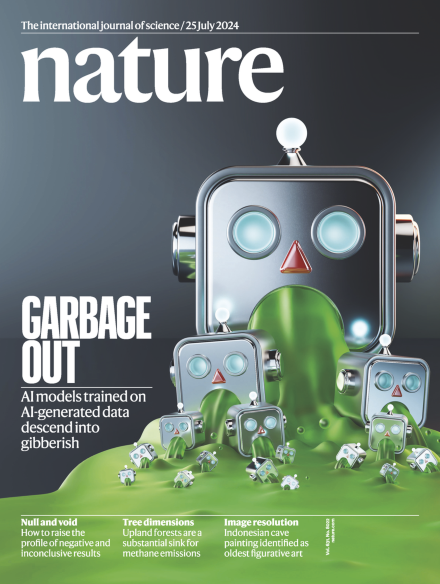
- A paper related with the cover on model collapse in AIs learning from AI-generated data. Just like MCMC learning a proposal from earlier simulations. A natural consequence of over-fitting.
- Another paper on the phase (or quantum) transition of the two-dimensional Ising spin glass (model).
- and the article on predatory conferences I already discussed in August.
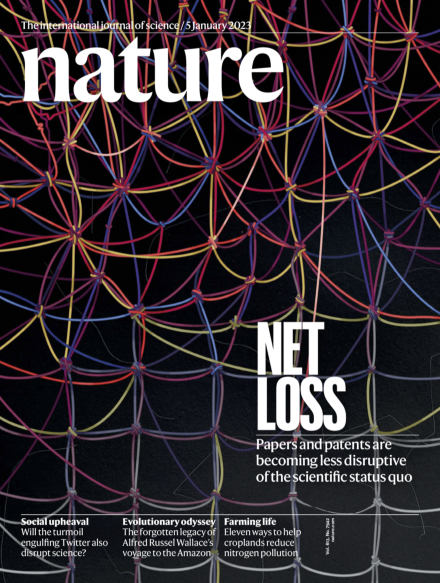 Nature in its 5 Jan issue


