Archive for Charles Stein

inverse probability weighting

Posted in Books, pictures, Running, Statistics, Travel, University life with tags , , , , , , , , , , , , , , , , , , , on May 4, 2026 by xi'an

Quite recently, Jyotishka Datta and Nick Polson published a fairly interesting [imho] paper in The New England Journal of Statistics in Data Science, entitled Inverse Probability Weighting: From Survey Sampling to Evidence Estimation that (obviously) caters to my own interests! They bring three threads together. First, they recall the long debate between using [normalized] Horvitz–Thompson and [self-normalized] Hájek estimators in survey sampling, pointing out that the latter is “usually the better estimator, despite estimation of an a priori known quantity” (citing from Särndal & al., 2003). Which is also my experience with importance sampling, as in this 1995 Note aux Comptes Rendus with George. The mathematical paradox of “estimating” a constant is central to other advances in the area, like noise-contrastive estimation à la Gutmann & Hyvärinen (2005) or the measure estimation of Kong & al. (2003). Even more interestingly, Datta & Polson consider there is a link with the inconsistent Bayesian (counter)example of Larry Wasserman and Jamie Robins, where the censoring probability increases with the value of the parameter of interest, paradox in which Chris Sims also got involved. (I was unaware that he had passed away last month.) And, lo and behold!, with the Stein “paradox” of my PhD years (and beyond).

Their central argument stands with the missing data link between Horvitz-Thompson survey sampling and Monte Carlo integration. (With a reference to our Riemann sum papers with Anne Philippe!, making me realise the authors had recently published an extension on that idea.) This reminds me very much of the missing measure approach of Kong et al. (2003). (Actually the reference appears in the final discussion.) The authors go over several paradoxes like Basu’s circus estimate (1988), Larry’s inconsistent Bayes estimate (2004), where Horvitz–Thompson performs nicely under compactness assumptions, the Bayesian answers (which include nested sampling even though I do not see the connection). Especially Li’s (2010) solution.  The attached numerical experiment displays a consistent underperformance of the Horvitz-Thompson estimator, in contrast with the theory… 

In conclusion, while enjoying very much revisiting so many examples and papers I came across in the past decades, I remain somewhat puzzled by the lack of overall message.


scalable Monte Carlo for Bayesian learning [book review]

Posted in Books, Statistics, University life with tags , , , , , , , , , , , , , , , , , , , , on September 26, 2025 by xi'an

This book by Paul Fearnhead, Christopher Nemeth, Chris Oates, and Chris Sherlock is part of the IMS Monograph series. And published by Cambridge University Press. It covers most recent developments in MCMC methods, namely stochastic gradient MCMC (Chap. 3), non-reversible MCMC (Chap. 4), continuous-time MCMC (Chap. 5), and assessing and improving MCMC (Chap. 6). I find the book remarkable in its attention to rigour and clarity, without falling into overly technical derivations. It is perfectly suited for a graduate course to students with a solid mathematical background. In short, had I considered a new edition of our Monte Carlo Statistical Methods book to incorporate these advances, I could not done such a good job!

The first chapter provides a quick refresher of the background, from Monte Carlo principles, to Markov chains, SDEs, and the kernel “trick” (which requires a dozen pages of exposition). Nonetheless, it contains side remarks of true interest, including some suggestions I had not previously seen, as for instance an unusual introduction of the HMC algorithm as an underdamped Langevin diffusion. Chapter 2 prolongates this recap by covering reversible MCMC algorithms and the attached optimal scalings. This is done in a particularly friendly presentation that I intend to use in my own course. The HMC section is probably the best coverage I have seen on the topic, including most naturally the leapfrog steps.

Chapter 3 gets into stochastic gradient MCMC as an approximate MCMC, with nice arguments and formal convergence bounds. Again quite efficiently, if focussing almost solely on Gaussian settings (but including a neural network example). Similarly, Chapter 4 provides intuitive (if informal) arguments on the worth of non-reversible algorithms that are well-suited to a textbook of this level. This chapter introduces a PDMP sampler like the discrete bouncy particle sampler.

Chapter 5 is a (nicely) monstrous coverage of continuous time MCMC samplers that reaches very recent advances on PDMPs. The focus is on expressing them as limits, in order to derive mixing rates without extreme mathematical steps. (The chapter even includes a mention to the coordinate sampler that my PhD student Wu Changye derived in 2018!) Again a chapter I plan to use when teaching MCM methods, if possibly skipping some of the 66 pages.

Chapter 6 completes the monograph with a presentation of convergence assessment tools and diagnostics, exploiting the kernel trick, as well as convergence bounds that reflect very recent research in that domain. The conclusive section on optimal weights and optimal thinning will presumably be new to most readers. (Making me wonder if a link can be found with our importance Markov chain construct.)

[Disclaimer about potential self-plagiarism as usual: this post or an edited version will eventually appear in my Books Review section in CHANCE.]

simulation as optimization [by kernel gradient descent]

Posted in Books, pictures, Statistics, University life with tags , , , , , , , , , , , , , , , , , , , , , , , , on April 13, 2024 by xi'an

Yesterday, which proved an unseasonal bright, warm, day, I biked (with a new wheel!) to the east of Paris—in the Gare de Lyon district where I lived for three years in the 1980’s—to attend a Mokaplan seminar at INRIA Paris, where Anna Korba (CREST, to which I am also affiliated) talked about sampling through optimization of discrepancies.
This proved a most formative hour as I had not seen this perspective earlier (or possibly had forgotten about it). Except through some of the talks at the Flatiron Institute on Transport, Diffusions, and Sampling last year. Incl. Marilou Gabrié’s and Arnaud Doucet’s.
The concept behind remains attractive to me, at least conceptually, since it consists in approximating the target distribution, known up to a constant (a setting I have always felt standard simulation techniques was not exploiting to the maximum) or through a sample (a setting less convincing since the sample from the target is already there), via a sequence of (particle approximated) distributions when using the discrepancy between the current distribution and the target or gradient thereof to move the particles. (With no randomness in the Kernel Stein Discrepancy Descent algorithm.)
Ana Korba spoke about practically running the algorithm, as well as about convexity properties and some convergence results (with mixed performances for the Stein kernel, as opposed to SVGD). I remain definitely curious about the method like the (ergodic) distribution of the endpoints, the actual gain against an MCMC sample when accounting for computing time, the improvement above the empirical distribution when using a sample from π and its ecdf as the substitute for π, and the meaning of an error estimation in this context.

“exponential convergence (of the KL) for the SVGD gradient flow does not hold whenever π has exponential tails and the derivatives of ∇ log π and k grow at most at a polynomial rate”

on control variates

Posted in Books, Kids, Statistics, University life with tags , , , , , , , , , , , , on May 27, 2023 by xi'an

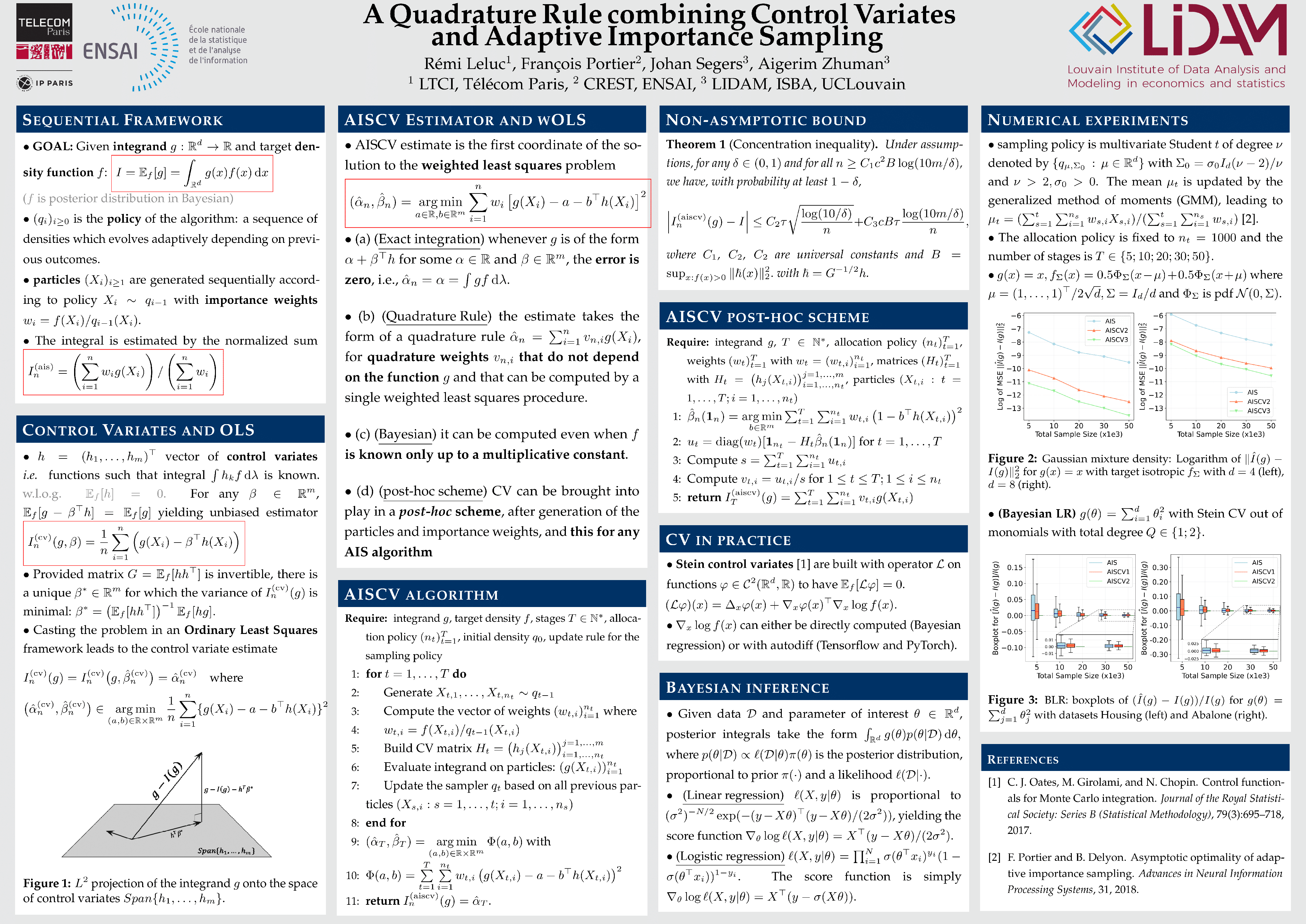
A few months ago, I had to write a thesis evaluation of Rémi Leluc’s PhD, which contained several novel Monte Carlo proposals on control variates and importance techniques. For instance, Leluc et al. (Statistics and Computing, 2021) revisits the concept of control variables by adding a perspective of control variable selection using LASSO. This prior selection is relevant since control variables are not necessarily informative about the objective function being integrated and my experience is that the more variables the less reliable the improvement. The remarkable feature of the results is in obtaining explicit and non-asymptotic bounds.

The author obtains a concentration inequality on the error resulting from the use of control variables, under strict assumptions on the variables. The associated numerical experiment illustrates the difficulties of practically implementing these principles due to the number of parameters to calibrate. I found the example of a capture-recapture experiment on ducks (European Dipper) particularly interesting, not only because we had used it in our book but also because it highlights the dependence of estimates on the dominant measure.

Based on a NeurIPS 2022 poster presentation Chapter 3 is devoted to the use of control variables in sequential Monte Carlo, where a sequence of importance functions is constructed based on previous iterations to improve the approximation of the target distribution. Under relatively strong assumptions of importance functions dominating the target distribution (which could generally be achieved by using an increasing fraction of the data in a partial posterior distribution), of sub-Gaussian tails of an intractable distribution’s residual, a concentration inequality is established for the adaptive control variable estimator.

This chapter uses a different family of control variables, based on a Stein operator introduced in Mira et al. (2016). In the case where the target is a mixture in IRd, one of our benchmarks in Cappé et al. (2008), remarkable gains are obtained for relatively high dimensions. While the computational demands of these improvements are not mentioned, the comparison with an MCMC approach (NUTS) based on the same number of particles demonstrates a clear improvement in Bayesian estimation.

Chapter 4 corresponds to a very recent arXival and presents a very original approach to control variate correction by reproducing the interest rate law through an approximation using the closest neighbor (leave-one-out) method. It requires neither control function nor necessarily additional simulation, except for the evaluation of the integral, which is rather remarkable, forming a kind of parallel with the bootstrap. (Any other approximation of the distribution would also be acceptable if available at the same computational cost.) The thesis aims to establish the convergence of the method when integration is performed by a Voronoi tessellation, which leads to an optimal rate of order n-1-2/d for quadratic error (under conditions of integrand regularity). In the alternative where the integral must be evaluated by Monte Carlo, this optimality disappears, unless a massive amount of simulations are used. Numerical illustrations cover SDEs and a Bayesian hierarchical modeling already used in Oates et al. (2017), with massive gain in both cases.

black box MCMC

Posted in Books, Statistics with tags , , , , , , , , on July 17, 2021 by xi'an

“…back-box methods, despite using no information of the proposal distribution, can actually give better estimation accuracy than the typical importance sampling [methods]…”

Earlier this week I was pointed out to Liu & Lee’s black box importance sampling, published in AISTATS 2017. (which I did not attend). Already found in Briol et al. (2015) and Oates, Girolami, and Chopin (2017), the method starts from Charles Stein‘s “unbiased estimator of the loss” (that was a fundamental tool in my own PhD thesis!), a variation on integration by part:

\mathbb E_p[\nabla\log p(X) f(X)+\nabla f(X)]=0

for differentiable functions f and p cancelling at the boundaries. It also holds for the kernelised extension

\mathbb E_p[k_p(X,x')]=0

for all x’, where the integrand is a 1-d function of an arbitrary kernel k(x,x’) and of the score function ∇log p. This null expectation happens to be a minimum since

\mathbb E_{X,X'\sim q}[k_p(X,X')]\ge 0

and hence importance weights can be obtained by minimising

\sum_{ij} w_i w_j k_p(x_i,x_j)

in w (from the unit simplex), for a sample of iid realisations from a possibly unknown distribution with density q. Liu & Lee show that this approximation converges faster than the standard Monte Carlo speed √n, when using Hilbertian properties of the kernel through control variates. Actually, the same thing happens when using a (leave-one-out) non-parametric kernel estimate of q rather than q. At least in theory.

“…simulating n parallel MCMC chains for m steps, where the length m of the chains can be smaller than what is typically used in MCMC, because it just needs to be large enough to bring the distribution `roughly’ close to the target distribution”

A practical application of the concept is suggested in the above quote. As a corrected weight for interrupted MCMC. Or when using an unadjusted Langevin algorithm. Provided the minimisation of the objective quadratic form is fast enough, the method can thus be used as a benchmark for regular MCMC implementation.