Archive for Isaac Newton

Nature tidbits [10 Sept 2026]

Posted in Books, pictures, Travel, University life with tags , , , , , , , , , , , , , , , , , , , , , , , , , , , , , , , , , , , , , , , , , , , , , , , , , , , , on October 21, 2026 by xi'an

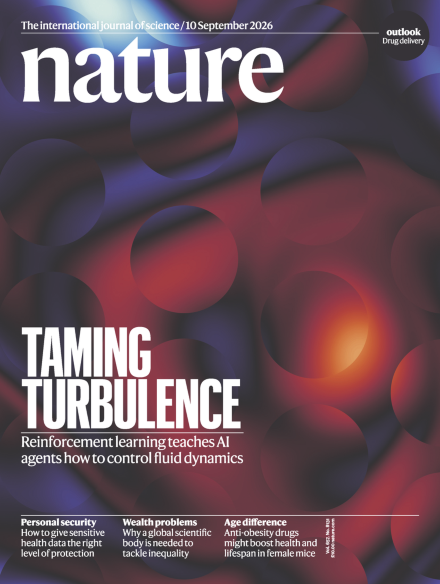
Having left my copy of the 10 September issue of Nature on a suburban train this afternoon (hopefully to the benefit of a fellow passenger!), I had to fall back on the online version. The cover story, Taming turbulence, is about HydroGym, a reinforcement-learning platform where AI agents learn to control turbulent flows. While this has practical consequences, it is also the harbinger of the resolution (?) of the Navier-Stoke Millennium Problem by OpenAI. Covered in the following issue.

Flotsam of interest for me:

  • reporting on a single data point exciting cosmologists (and beyond!), namely one unusual flash recorded in 2023 or 2024 by the LZ detector thru its 10 tonnes liquid xenon basin, which looks like what a weakly interacting massive particle (WIMP!) would produce. This would be a fist in experimentally supporting the dark matter theory. But without reproducibility, ’tis hard to jump to a conclusion. In correlation, a news article on the launch of the Nancy Grace Roman Space Telescope, with two World Views, one on Roman herself as “mother of Hubble”. Promising advances on far, far away celestial bodies thanks to the infrared abilities of said telescope. And again to cosmology.
  • a news feature on “the Einstein test”, checking whether language models trained only on pre-1905 data could rediscover relativity. This is a clever way to separate creativity from regurgitation, if the historical training corpus can indeed be kept clean. And faster than training monkeys to type…
  • an article combining climate and econometric modelling to assess how human-induced climate change has shifted, and will shift, the burden of childhood malaria in Africa. The attribution relies on counterfactual climate simulations, which makes me wonder about the propagation of uncertainty.
  • an article linking US mortgage records from around the Second World War to race and immigration status. It shows that New Deal programmes disproportionately excluded Black borrowers, a nice (if sad) record-linkage exercise.
  • a privacy feature on how UK Biobank was shut down after a data leak and is now imposing new safety measures. It raises the recurrent tension between protecting participants’ privacy and keeping data open to researchers, which connects once more with the membership-inference paper I discussed earlier.
  • an editorial praising the World Bank for publishing and verifying the raw data and code behind its reports. Other agencies should indeed follow suit!
  • a news item on the massive experience of mutating every DNA letter in a viral genome, whose effects the top AI models failed to predict (fail or pass the survival test!). A welcome reality check on AI in biology.

  • two militant comments on the economy, one by Joseph Stiglitz et al. calling for an IPCC-like International Panel on Inequality, and one on a call for measuring growth through all forms of capital, rather than GDP alone. And a great poster (reminding me of Indian movie posters) on the side!
  • an editorial on the comforting aspect of the Ig Nobel prizes, no matter how silly they sound.
  • a book review of The Winding Trail &tc. on the Principia Mathematica and Newton’s disdain for hypotheses (with his famous “hypotheses non fingo” that clashes with the modern scientific approach!), along with his habit of feuding over priority. What is amazing with Newton’s meteor trajectory is he only seriously engage into mathematics during his final undergraduate term at Cambridge, one year before the Great Plague and his revolutionary breakthroughs!

Galton’s 1904 paper in Nature

Posted in Books, Statistics, University life with tags , , , , , , , , , on October 11, 2022 by xi'an

Nature [28 September] posted an editorial apologizing for publishing Galton’s 1904 speech on Eugenics as part of “material that contributed to bias, exclusion and discrimination in research and society”. Apology that I do not find particularly pertinent from an historical viewpoint, given the massive time, academic, and societal distances we stand from this “paper”, which sounds more than a pamphlet than a scientific paper, by current standards. Reading these 1904 Nature articles show no more connection with a modern scientific journal than considering Isaac Newton’s alchemy notes in the early proceedings of the Royal Society.

“The aim of eugenics is to represent each class or sect by its best specimens; that done, to leave them to work out their common civilization in their own way.” F. Galton

Galton’s speech was published in extenso by the American Journal of Sociology, along with discussions from participants of the Sociological Society meeting. This set of discussions is rather illuminating as the views of the 1904 audience are quite heterogeneous, from complete adherence to a eugenic “golden’ future (see the zealous interventions of K. Pearson or B. Shaw] to misgivings about the ability to define the supposed ranking of members of society by worth or intelligence (H.G. Wells), to rejection that moral traits are genetically inherited (Mercier), to protests against the negation of individual freedom induced by a eugenic state (B. Kidd) and to common sense remarks that improvements in living conditions of the working classes were the key factor in improving society. But, overall, there was no disagreement therein on the very notion of races and on the supposed superiority of the Victorian civilization (with an almost complete exclusion of women from the picture), reflecting on the prejudices of the era and it is quite unlikely that this 1904 paper of Galton had any impact on these prejudices.

the mechanical [book review]

Posted in Books, pictures with tags , , , , , , , , , , , , on June 4, 2021 by xi'an

Read this 2015 book by Ian Tregillis with growing excitement as I was first unsure why I had ordered it. It is a mix of the Baroque Cycle and of the Difference engine, with Huygens playing the central role (rather than Newton). The postulate of the story is that he found [in the 1600’s] a way to create robots (or mechanicals, or yet Clakkers) with autonomy, prodigious strength, and unlimited “life” time. Endowing the Netherlands with such an advantage as to become the unique European power. Except for a small population of French people, living in exile in Montréal, renamed as Marseille-in-the-West, where the descendants of Louis XIV were desperately fighting the Dutch robots with their barely sufficient chemical skills… In addition to this appealing alternate history, where the French are arguing about the free will of the machines, and building underground railways to convey rogue mechanicals outside the Dutch empire, partly for being Catholics and hence following the Pope’s doctrine [and partly to try to produce their own robots], where the Pope is also a refugee in Québec, and where New Amsterdam has not turned into New York, but is a thriving colonial city in America, linked to the mother country by mechanical boats and Zeppelin-like airships, the machines are constrained to obey the humans, with the Queen’s wishes at the top of a hierarchy of constraints. And no Asimov’s law to prevent them from being used as weapons, to the French’s sorrow! But their degree of autonomous thought is such that a mere loosening of a component may remove the compulsion and turn them into rogues, i.e, free willed robots. On the converse side, a nefarious guild in charge of a Calvinist faith and of the maintenance of the robots is attempting to extend this control of the Dutch State over some humans. Which makes for a great setting discussing the blurry border between humans and AIs, with both humans and Clakkers bringing their arguments to the game… I am now eagely waiting for the second and third volumes in the series of The Alchemy Wars to arrive in the mail to continue the story!

AIQ [book review]

Posted in Books, Statistics with tags , , , , , , , , , , , , , , , , , , on January 11, 2019 by xi'an

AIQ was my Christmas day read, which I mostly read while the rest of the household was still sleeping. The book, written by two Bayesians, Nick Polson and James Scott, was published before the ISBA meeting last year, but I only bought it on my last trip to Warwick [as a Xmas present]. This is a pleasant book to read, especially while drinking tea by the fire!, well-written and full of facts and anecdotes I did not know or had forgotten (more below). Intended for a general audience, it is also quite light, from a technical side, rather obviously, but also from a philosophical side. While strongly positivist about the potential of AIs for the general good, it cannot be seen as an antidote to the doomlike Superintelligence by Nick Bostrom or the more factual Weapons of Maths Destruction by Cathy O’Neal. (Both commented on the ‘Og.)

Indeed, I find the book quite benevolent and maybe a wee bit too rosy in its assessment of AIs and the discussion on how Facebook and Russian intervention may have significantly to turn the White House Orange is missing [imho] the viral nature of the game, when endless loops of highly targeted posts can cut people from the most basic common sense. While the authors are “optimistic that, given the chance, people can be smart enough”, I do reflect on the sheer fact that the hoax that Hillary Clinton was involved in a child sex ring was ever considered seriously by people. To the point of someone shooting at the pizza restaurant. And I hence am much less optimistic at the ability for a large enough portion of the population, not even the majority, to keep a critical distance from the message carried by AI driven media. Similarly, while Nick and James point out (rather late in the book) that big data (meaning large data) is not necessarily good data for being unrepresentative at the population at large, they do not propose (in the book) highly convincing solutions to battle bias in existing and incoming AIs. Leading to a global worry that AIs may do well for a majority of the population and discriminate against a minority by the same reasoning. As described in Cathy O’Neal‘s book, and elsewhere, proprietary software does not even have to explain why it discriminates. More globally, the business school environment of the authors may have prevented them from stating a worry on the massive power grab by the AI-based companies, which genetically grow with little interest in democracy and states, as shown (again) by the recent election or their systematic fiscal optimisation. Or by the massive recourse to machine learning by Chinese authorities towards a social credit system grade for all citizens.

“La rage de vouloir conclure est une des manies les plus funestes et les plus stériles qui appartiennent à l’humanité. Chaque religion et chaque philosophie a prétendu avoir Dieu à elle, toiser l’infini et connaître la recette du bonheur.” Gustave Flaubert

I did not know about Henrietta Leavitt’s prediction rule for pulsating stars, behind Hubble’s discovery, which sounds like an astronomy dual to Rosalind Franklin’s DNA contribution. The use of Bayes’ rule for locating lost vessels is also found in The Theorem that would not die. Although I would have also mentioned its failure in locating Malaysia Airlines Flight 370. I had also never heard the great expression of “model rust. Nor the above quote from Flaubert. It seems I have recently spotted the story on how a 180⁰ switch in perspective on language understanding by machines brought the massive improvement that we witness today. But I cannot remember where. And I have also read about Newton missing the boat on the precision of the coinage accuracy (was it in Bryson’s book on the Royal Society?!), but with less neutral views on the role of Newton in the matter, as the Laplace of England would have benefited from keeping the lax measures of assessment.

Great to see friendly figures like Luke Bornn and Katherine Heller appearing in the pages. Luke for his work on the statistical analysis of basketball games, Katherine  for her work on predictive analytics in medicine. Reflecting on the missed opportunities represented by the accumulation of data on any patient throughout their life that is as grossly ignored nowadays as it was at Nightingale‘s time. The message of the chapter [on “The Lady with the Lamp”] may again be somewhat over-optimistic: while AI and health companies see clear incentives in developing more encompassing prediction and diagnostic techniques, this will only benefit patients who can afford the ensuing care. Which, given the state of health care systems in the most developed countries, is an decreasing proportion. Not to mention the less developed countries.

Overall, a nice read for the general public, de-dramatising the rise of the machines!, and mixing statistics and machine learning to explain the (human) intelligence behind the AIs. Nothing on the technical side, to be sure, but this was not the intention of the authors.

Whispers underground [book review]

Posted in Books, pictures, Travel with tags , , , , , on December 6, 2014 by xi'an

East London from Tower Bridge, Dec. 2009“Dr. Walid said that normal human variations were wide enough that you’d need samples of hundreds of subjects to test that. Thousands if you wanted a statistically significant answer.
Low sample size—one of the reasons why magic and science are hard to reconcile.”

This is the third volume in the Rivers of London series, brought back from Gainesville, and possibly the least successful (in my opinion). It indeed takes place underground and not only in the Underground and the underground sewers of London. Which is this literary trick that always irks me in fantasy novels, namely the sudden appearance of massive underground complex with unsuspected societies that are large and evolved enough to reach the Industrial Age. (Sorry if this is too much of a spoiler!)

“It was the various probability calculations that stuffed me—they always do. I’d have been a bad scientist.”

Not that everything is bad in this novel: I still like the massive infodump about London, the style and humour, the return of PC Lesley trying to get over the (literal) loss of her face, and the appearance of new characters. But the story itself, revolving about a murder investigation, is rather shallow and the (compulsory?) English policeman versus American cop competition is too contrived to be funny. Most of the major plot is hidden from this volume, unless there are clues I missed. (For instance, one death from a previous volume which seemed to get ignored at that time is finally explained here.) Definitely not the book to read on its own, as it still relates and borrow much from the previous volumes, but presumably one to read nonetheless as the next instalment, Broken homes.