Archive for cover

virtual yeast and real migrants [Nature, 2 July]

Posted in Books, Statistics, Travel, University life with tags , , , , , , , , , , , , , , , , , , , , on November 14, 2026 by xi'an

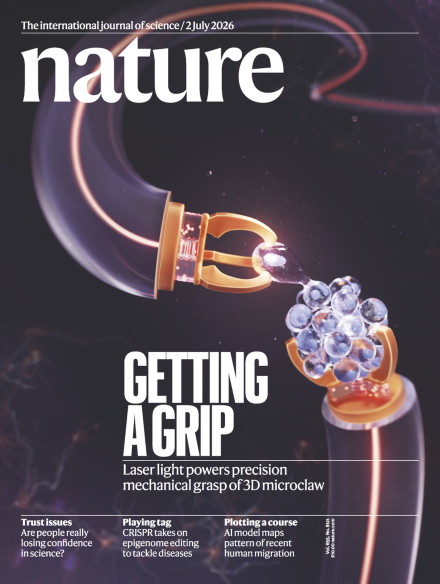
The 2 July issue of Nature—that stayed under a pile of unread journals after my return from Japan—came with (a nice cover about a 38 micrometer claw! and) an article I found quite exciting from a statistical perspective, namely a “deep learning of human migration”, a reconstruction of global migrations in the past decades. It estimates yearly migration flows between 230 countries and territories from 1990 to now, using an ensemble of deep recurrent neural networks fed with 18 geographic, economic, cultural and political covariates (and INSEE data). The headline figure is that global migration went from about 13 million people a year in 2000 to around 35 million in 2023. But the news & views comment questions the ultimate utility of the outcome in identifying new trends and keeping track of (rapidly changing) migration channels. On top of this article:

a feature, backed by an Editorial, goes against the grain of the “trust in science is collapsing” narrative. A large survey, nearly 72,000 people in 68 countries in 2022–23, gives an average trust score of 3.6 out of 5. The cracks are located rather than general. In Britain, trusting science “a lot” fell from 63% in 2020 to 34%, but in the US, confidence in scientists even among Republican-leaning respondents only fell from 85% in 2020 to 65% in 2025, while Democrats barely moved. I liked the point that some studies find that admitting uncertainty makes scientific information look more trustworthy than overconfident statements do. Much less that YouTube and similar platforms were the main source of science information. In the same issue, a World view on scientists acknowledging their own political biases, and a comment with six ways to bring the public into science and policy.)

Then another news piece on “Is AI ruining our skills?”. Unsurprisingly, early evidence says yes. with 70% of US nurses and 77% of US physicians worried about losing skills through over-reliance on AI. One researcher puts it nicely: users perform well because they are “borrowing skills from the AI” without acquiring them. The GPS comparison is made too, and I can vouch for that one personally. Whether students who never derived a Gibbs sampler by hand will ever realise when it fails is a question solved at exam time…

The books & arts section reviews The Political Economy of Rwanda’s Rise by P Behuria  (open access on Cambridge Core). Covering Rwanda’s attempt to rebuild its economy after the 1994 genocide into one of the fastest-growing in Africa as a regional services hub. But the authoritarian nature of Kagane’s regime and its involvement in rebel groups in Eastern Congo may put the brake on this development…

And to conclude on a lighter note, a perspective “Towards the construction of a virtual yeast”. It sounds like a digital twin of S. cerevisiae, build from eight functional modules, each with a dedicated AI tool, and a large language model to coordinate them, with active experiments closing the loop. I wonder whether this virtual yeast could help in my prospective sourdough project, but this will need wait another few years!

game of roses [cover]

Posted in Books, pictures with tags , , , , , , , , on October 10, 2026 by xi'an

un brun flippant [cover]

Posted in Books, Kids with tags , , , , , , on September 8, 2026 by xi'an

left to their own devices

Posted in Books, pictures, Travel with tags , , , , , , , , , , , on July 16, 2026 by xi'an

Nature tidbits [18 June]

Posted in Books, Kids, pictures, Travel with tags , , , , , , , , , , , , , , , , , , , , , , , , , , , , on July 13, 2026 by xi'an


A personal tribune (by a Vatican advisor) on why scientists should learn from the Pope’s AI message, not the first time Nature caters to religious views! Not that his (Leon’s) concerns about unregulated AI and the abdication of States in that matter are misplaced. But it seems unlikely (as the author concedes in his conclusion) that the Catholic Church or his leader will manage to make a dent on the spiraling impact of AIs. As suggested in the next tribune, a coordinated approach at a massive increase of taxes on tech companies (unsurprisingly resisted by the Orange Menace) is more likely to happen. And yet another tribune on AI and math(ematician)s, related to the recent Leiden Declaration on Artificial Intelligence and Mathematics, following several entries in the previous issue.

An introductory (general public) article as to why cancer occurrences in young people is rising so quickly in the US, with no single explanation. Environmental factors are certainly to blame, like the consumption of ultra–processed foods, but the article does not say much, adding to the uncertainty.

A rather unhelpful representation of human migration in 2023, appart from showing a majority of migrations are local (to the continental scale). Connected to an article of 10 June I missed. Partly based on a deep learning model to achieve a country-level granularity.

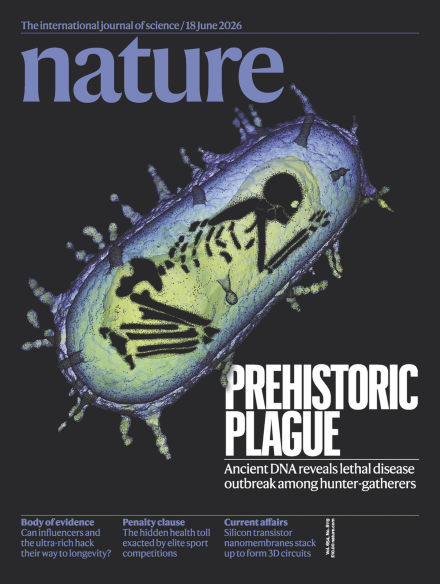
A research article (and the cover) on a plague outbreak near Lake Baikal—over which I could have flown when reading this issue, except that flights to Japan now contour the territories of the invader of Ukraine—that occurred about 5,500 years ago and impacted a community of hunter-gatherers, In a sparsely populated area, marmots being the likely primary vectors, and a close phylogenetic proximity to current strains.