Archive for DeepMind
Doug’s scared…
Posted in Books, Kids, pictures with tags ambigram, ChatGPT, Deep Blue, DeepMind, Douglas Hofstadter, French army, Gödel Escher and Bach, military service, Navy, neural network, Normandy, NYT, The New York Times, youtube on August 1, 2023 by xi'an Following a link from a NYT editorial, I came upon a transcribed interview of Douglas Hofstadter on his fright about the current nature of AI and in particular of the impact of (surprise, surprise!) ChatGPT. When the French translation of Gödel, Escher, Bach came out in 1985, it became an immediate success, I read it, enjoyed it and recommended to my inner circles. To the point of my superior in the Navy (during the year I was drafted in the French Navy) saw the cover (for I was also reading it in the Navy office!), browsed through it and asked me to… reproduce the sculpture (a 3D ambigram) for the logo of his own company (for he moonlighted several days a week at an hologram company he had created). Which proved rather straightforward (but I ignore if the result was ever exploited). While I am now much less reserved about the book, which I feel is quite pretentious and self-congratulary, without delivering a particularly deep message, I can related to my earlier self excitement when faced with a scientific book involving many themes of interest for me, pleasant and easy to read, if sometimes mired in heavily making a point. This is obviously a personal view and others, like the science vulgariser Marcus du Sautoy launched a celebration for the 40 years of the book. (Coincidence: I had a chat & a beer with a former high school teacher of his’ in Normandy a week before writing this post.)
“it almost feels that way, as if we, all we humans, unbeknownst to us, are soon going to be eclipsed, and rightly so, because we’re so imperfect and so fallible.”
“it feels as if the entire human race is going to be eclipsed and left in the dust soon”
The tone of the interview is hilariously super catastrophic, foreseeing the replacement of humans by their “successors” within a few years, nothing less. There is no deep argument in the discussion, only that AIs are now playing chess and Go better than humans, can provide apparently reasonable answers to many questions, at a speed surpassing human faculties, including poetry or coding. Which proves such a reducing modelling of what constitutes a human being and the meaning of consciousness. (The last line of the interview “YouTube transcript cleaned up by GPT-4 & checked against audio” is hilarious, whether it is intended to be so or not.)
nAIture
Posted in Books, Kids, pictures, Statistics with tags AI, Black and Scholes formula, chatbots, ChatGPT, coding, DeepMind, generative model, Nature, paper mills, sorting, stochastic parrots on June 29, 2023 by xi'an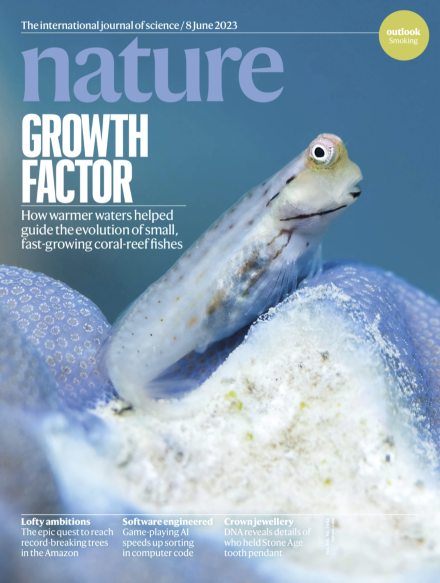
- Why Nature will not allow the use of generative AI in images and videos (until they cannot spot them)
- AI intensifies fight against paper mills (as a further hindrance rather than an ally)
- AI learns to write sorting software on its own, through deep learning (DeepMind’s AlphaCode) for program synthesis with no training data. At a huge learning cost (31 trillion programs were tested for AlphaDev-S!). This is not a new sorting algorithm but rather a more efficient way of programming it.
- an outlier with the Golden jubilee for the Black-Scholes equation (not placing any blame on said formula for the 2008 crash) or for the emergence of disconnected-from-economics high-frequency trading)
- people, not (Google search) algorithms, choose to engage with more partisan news (as the Deep State has not yet managed to infiltrate vaccines with nano chips…!)
- how to code with ChatGPT (with the stupid line that “the tools are not as intelligent as they seem”! Well they are not at all intelligent, just produce random code with Markovian memory, deserving the sobriquet of stochastic parrots and being helped by the fact that most codes available on-line and hence in their learning database is correct)
matrix multiplication [cover]
Posted in Books, pictures, Statistics, University life with tags algorithms, AlphaTensor, cover, deep learning, deep neural network, DeepMind, Google, London, matrix algebra, matrix multiplication, Monte Carlo algorithm, Nature, reinforcement learning, tensor, UK on December 15, 2022 by xi'an
Nature tidbits [the Bayesian brain]
Posted in Statistics with tags ABC, deep learning, DeepMind, desert locust, Harvard University, Human Genetics, Isaac Asimov, memristors, neural network, NeurIPS, p-values, SNPs, UCL, University College London, Vancouver on March 8, 2020 by xi'an


