Archive for bear

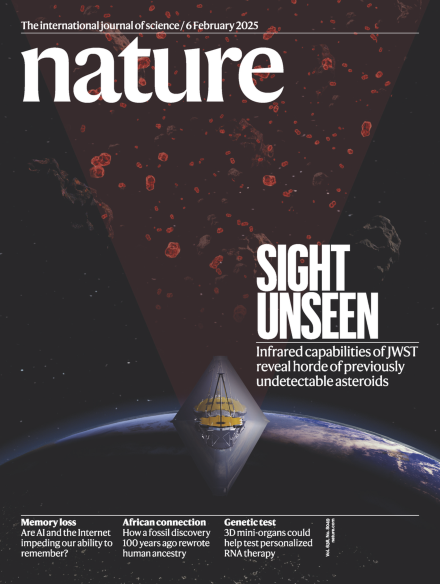
Nature tidbits [06 Feb 2025]

Posted in Statistics with tags , , , , , , , , , , , , , , , , , , , , , , , , , , , , , , , , , , , , , on March 10, 2025 by xi'an

Entries about the scary rise in H5N1 risks of a human transmission, compounded by Trump’s America leaving WHO, hence the US connection with global monitoring and its substantial funding of the organization. Advising against drinking raw milk as a primary precaution. Even camembert?!

A (naïve, imho) call by the presidente of the Union of Concerned Scientists to boost scientific integrity to protect (US) federal research despite the chainsaw massacre unfolding daily in (US) federal agencies. And the disregard of said massacrers for accountability and legal boundaries. And unions, definitely unions.

Also entries (and two Nature collections) on the one hundredth anniversary of the Taung Child fossil uncovering, as the first Australophitecus africanus  that opened the way for the theory that Africa was the birthplace of humanity, along with other extended books reviews. On quantum theory (it’s complicated!, according to Sean Carroll) and Kepler mission (by Jason Steffen). And a show at Cité des Sciences in La Villette about silence that I would love to attend.

A quick assessment of deepseek against its competitors. Mostly praising its open code. And another one on 23andMe losses and trouble,  reflecting the one-shot strategy of the company that cannot sell its analysis more than once (despite repeatedly trying, as I can confirm from their frequent emails). And opening concerns about their data or rather our data. Since there is very little protection in the US for this kind of data, considered out of healthcare.

New challenges of large carnivores in Western Europe, with a rise of wolverines, success story for the Iberian lynx, talks of reintroducing wolves to Scotland (to cull red deer like those who roam Buachaille Mor), degrading setting in France with looser rules for shooting wolves.

Microplastics in the brain, unsurprisingly increasing the chances of clots and surprisingly easily moving into blood vessels and the brain. And, speakiMicroplastics in the brainng of plastic, recycling, at last? Warwick Manufacturing Group (WMG) mentioned as evaluating the life-cycle analysis of a new approach with superheated water. Exposing the elephant in the room, namely that there is very little true recycling going on and that part of the recycled plastic ends up as fuel, hence contributing to pollution. Costs and impact of turning used products into new material are mentioned (and staggering albeit not compared with the initial costs and impact.

And I remain perplexed by the Two-Eyed Seeing Indigenous perspective for neuroscience article. As I do not see the scientific component, besides directions to work with local communities.

a journal of the year of fires

Posted in Books, Kids, Mountains, pictures, Statistics, Travel, University life with tags , , , , , , , , , , , , , , , , , , , , on September 1, 2023 by xi'an

Indeed, the year of the mega-fires in West and East Canada, with Kelowna (and UBC Okanagan where BIRS 23w5106 took place) severely hit. Travelling through BC by car and plane, we saw several wildfire fume clouds, incl. a massive one from the Yellowknife region…

Read a few dozen pages of Gene Wolfe’s The Knight, in the fabulous Bacchus Books and Café of Golden, BC. Despite the positive vibes of the place, I could not engage with the story or the style, which I found quite disappointing given the earlier achievements of the author. There is of course the attempt at recreating an Arthurian tale, with its lack of temporal and logical coherence, but this fails short, in part because the narrator keeps jumping from a pre-teen to a much wiser adult and back. I thus replaced it within the shelf where I had found it, hopefully with no stain from the scone I enjoyed in the same place. A clear advantage of cafés within bookstores (the replacement, not the scone stains!) Also read Angel Six Echo by Robert Appleton, a short sci’fi’ story of the (very) military type, a mix of Warhammer 40k, Scalzi’s Old Man’s War series, Ender’s Game, and a few other space trooper novels. Pleasantly light as I was trying to read a few pages before fazing out after a day of intense activity! Realised as well that Home: Habitat, Range, Niche, Territory was a very very short [almost as short as its long title!] story within the Murderbot Diaries, and not particularly interesting. Still waiting eagerly for the incoming (#8) System Collapse, a genuine novel.

Hiked inside and outside Yoho National Park (Emerald Lake, Mt. Hunter, Mt. Field), with varying success at avoiding the maddening crowd. And the drone of the highway below. Even 900m below. No wildlife encounter apart from the frequent mule deer, the few bighorns lost on Trans Canadian #1,  and the lightning fast chipmunks (except when they come begging for food). Despite bear warnings all around. Most days were above the healthy air quality limits, due to the numerous wildfires in the North-East BC, even though I did not feel any change when running or hiking. Made a night stop in Canmore to catch an early flight in Calgary, the place has gone surprisingly upscale from my earlier visits there!


wood and orphan bears

Posted in Kids, Mountains, pictures, Travel with tags , , , , , , on August 11, 2023 by xi'an


On the trail to Burgess Pass,we passed this wooden structure that had something bearish in it (at least in my short-sighted view!).

And the day after, saw this 21 year old grizzly bear in an orphan bear refuge where he had spent most of his life after his mother was killed by a hunter. Magnificent animal, sadly kept captive his entire life in one hundredth of his natural habitat.

going on a bear [and a whale] hunt

Posted in Mountains, pictures, Travel with tags , , , , , , , , , , , , , , on August 27, 2018 by xi'an


Among many and diverse outdoor activities during our vacations on Vancouver Island, a rather unique trip was to go kayaking near Tofino to try to watch black bears. In a group of three sea kayaks, at dusk, with a fantastic guide. Bears foraging for crabs on the shore at low tide are not unusual but, as it happened, we were quite lucky to spot five different bears over the two hours we paddle along the fjord, including a big one standing on its back legs to catch berries. From a few meters away, this was an incredible sight! [About the title: We’re going on a bear hunt is a classic of children books.]
We were less lucky when whaling out at sea, only spotting a blow on the trip, even though we spotted many seals and a few sea otters. The most exhilarating wildlife experience of the Van trip was however swimming with seals on the northern coast of the island, where on several days one or two seals came to check on me while I was swimming in the ocean in the early morning. (Managing to avoid cold shock and hypothermia by only staying less than 20 minutes in the 17⁰ water.)

Combining Particle MCMC with Rao-Blackwellized Monte Carlo Data Association

Posted in Books, Statistics, University life with tags , , , , , , , , , , , , on October 10, 2014 by xi'an

This recently arXived paper by Juho Kokkala and Simo Särkkä mixes a whole lot of interesting topics, from particle MCMC and Rao-Blackwellisation to particle filters, Kalman filters, and even bear population estimation. The starting setup is the state-space hidden process models where particle filters are of use. And where Andrieu, Doucet and Hollenstein (2010) introduced their particle MCMC algorithms. Rao-Blackwellisation steps have been proposed in this setup in the original paper, as well as in the ensuing discussion, like recycling rejected parameters and associated particles. The beginning of the paper is a review of the literature in this area, in particular of the Rao-Blackwellized Monte Carlo Data Association algorithm developed by Särkkä et al. (2007), of which I was not aware previously. (I alas have not followed closely enough the filtering literature in the past years.) Targets evolve independently according to Gaussian dynamics.

In the description of the model (Section 3), I feel there are prerequisites on the model I did not have (and did not check in Särkkä et al., 2007), like the meaning of targets and measurements: it seems the model assumes each measurement corresponds to a given target. More details or an example would have helped. The extension against the existing appears to be the (major) step of including unknown parameters. Due to my lack of expertise in the domain, I have no notion of the existence of similar proposals in the literature, but handling unknown parameters is definitely of direct relevance for the statistical analysis of such problems!

The simulation experiment based on an Ornstein-Uhlenbeck model is somewhat anticlimactic in that the posterior on the mean reversion rate is essentially the prior, conveniently centred at the true value, while the others remain quite wide. It may be that the experiment was too ambitious in selecting 30 simultaneous targets with only a total of 150 observations. Without highly informative priors, my beotian reaction is to doubt the feasibility of the inference. In the case of the Finnish bear study, the huge discrepancy between priors and posteriors, as well as the significant difference between the forestry expert estimations and the model predictions should be discussed, if not addressed, possibly via a simulation using the posteriors as priors. Or maybe using a hierarchical Bayes model to gather a time-wise coherence in the number of bear families. (I wonder if this technique would apply to the type of data gathered by Mohan Delampady on the West Ghats tigers…)

Overall, I am slightly intrigued by the practice of running MCMC chains in parallel and merging the outcomes with no further processing. This assumes a lot in terms of convergence and mixing on all the chains. However, convergence is never directly addressed in the paper.