Archive for difference engine

AI Narratives [book review]

Posted in Books with tags , , , , , , , , , , , , , , , , , , , , , , , , , , , , , , , , , , , , , , , on June 13, 2025 by xi'an

AI Narratives: A history of imaginative thinking about intelligent machines is a 2020 collective book edited by Stephen Cave, Kanta Dihal, and Sarah Dillon, with about twenty contributing authors, through a series of 16 chapters on the relation between culture (literature, films) and our societal approach to AI, with varying perspectives, some overlap between chapters, a wide range of extrapolation, especially in relation with the oldest books (like Homer’s) and quotes from both books I enjoyed and books I had not heard of, to add to my to-red pile, like Roderick. Predominant place of Blade Runner, of Ĉapek’s Rossum’s Universal Robots, not only for introducing the term, and of Asimov, but also a detailed analysis of the great, thought-provoking, Ann Leckie’s Ancillary Justice. With a realization that Gibson’s Neuromancer had aged quite a lot… For the modern times, very little outside the US-UK realm, as for instance no mention made of Jules Verne or René Barjavel, although Zola makes an appearance when describing workers as automats, neither of the Germanic literature (from the Grimm Brothers onwards), nor of the non-negligible USSR science fiction production, nor yet of the Chinese input, like The three body problem. Other books that could have made it: the Murderbot diaries, and The Alchemy Wars trilogy, for digging into the blurry border between humans and AIs; A Memory Called Empire, for a clever approach to mind uploading, as well as the masterly Never let me go by Ishiguro, both dealing with a future where copies of humans The Amazing Adventures of Kavalier & Clay for the golem, the short story An Unatural Life, for its highly original take on the legal rights of humanoid robots, A Psalm for the Wild-Built because of… tea and Zen monk, obviously!

Among things I learned from AI Narratives, the story of Alan Turing (figuratively) mansplaining Ada Lovelace on her pronouncement that machines cannot be intelligent since they deliver what they are coded for. The mention of automatos in the Illiad. A mention of 1625 Gabriel Naudé Apologie &tc. that excludes magic as irrational, as well as introducing the term androide. The trivia that the creator of the (fraudulent) automaton chess player, Kempelen, also produced in 1791 an authentic if brainless speaking machine. The realisation that E.M Forster also wrote a futuristic novel, The Machine Stops (as well as the precursor of the symbolists, Villiers de l’Isle Adam, with L’Ève Future). Another trivia that cyberpunk first appeared in a 1983 short story by Bruce Bethke. A discussion of the elaborate Culture constructed by Iain Banks, albeit through volumes in the series I hade not read, along with the concept of OCP for outside context problem, akin to Taleb’s Black Swan. The least interesting (and final) chapter in the book is paradoxically the closest to data analysis, when Recchia runs a rather low-tech assessment of a subtitle dataset in relation with AI, if referring to Tufte’s rule of the baselin in the notes (p405).

Definitely enjoyable book, then, even though I mostly skimmed through the chapters during a day-trip to Lille on a Bank (!) holiday. Reading through it made me muse rather belatedly of a parallel between AI scare or adoration, and the non-AI societies, where individuals are (also) part of a structure large enough to miss the larger picture. From building pyramids to being part of the global economy. (This followed mostly from my surprise in seeing Dickens, Trollope, and Zola included in the discussion.)

[Disclaimer about potential self-plagiarism: this post or an edited version will eventually appear in my Books Review section in CHANCE.]

Ada Lovelace Day

Posted in Books, Kids, University life with tags , , , , , , , on October 8, 2024 by xi'an

poems that solve puzzles [book review]

Posted in Books, Kids, University life with tags , , , , , , , , , , , , , , , , , , on January 7, 2021 by xi'an

Upon request, I received this book from Oxford University Press for review. Poems that Solve Puzzles is a nice title and its cover is quite to my linking (for once!). The author is Chris Bleakley, Head of the School of Computer Science at UCD.

“This book is for people that know algorithms are important, but have no idea what they are.”

These is the first sentence of the book and hence I am clearly falling outside the intended audience. When I asked OUP for a review copy, I was more thinking in terms of Robert Sedgewick’s Algorithms, whose first edition still sits on my shelves and which I read from first to last page when it appeared [and was part of my wife’s booklist]. This was (and is) indeed a fantastic book to learn how to build and optimise algorithms and I gain a lot from it (despite remaining a poor programmer!).

Back to poems, this one reads much more like an history of computer science for newbies than a deep entry into the “science of algorithms”, with imho too little on the algorithms themselves and their connections with computer languages and too much emphasis on the pomp and circumstances of computer science (like so-and-so got the ACM A.M. Turing Award in 19… and  retired in 19…). Beside the antique algorithms for finding primes, approximating π, and computing the (fast) Fourier transform (incl. John Tukey), the story moves quickly to the difference engine of Charles Babbage and Ada Lovelace, then to Turing’s machine, and artificial intelligence with the first checkers codes, which already included some learning aspects. Some sections on the ENIAC, John von Neumann and Stan Ulam, with the invention of Monte Carlo methods (but no word on MCMC). A bit of complexity theory (P versus NP) and then Internet, Amazon, Google, Facebook, Netflix… Finishing with neural networks (then and now), the unavoidable AlphaGo, and the incoming cryptocurrencies and quantum computers. All this makes for pleasant (if unsurprising) reading and could possibly captivate a young reader for whom computers are more than a gaming console or a more senior reader who so far stayed wary and away of computers. But I would have enjoyed much more a low-tech discussion on the construction, validation and optimisation of algorithms, namely a much soft(ware) version, as it would have made it much more distinct from the existing offer on the history of computer science.

[Disclaimer about potential self-plagiarism: this post or an edited version of it will eventually appear in my Books Review section in CHANCE.]

false value

Posted in Statistics with tags , , , , , , , , , , , on November 23, 2020 by xi'an

A very pleasant eighth volume in the Rivers of London series after a few so-so episodes! The relentless deadpan of Peter Grant is back full shape, the plot is substantial and gripping, new and well-drawn characters abound, and the story offers an original retelling of the Difference Engine. (Not that I have reservations about Gibbson’s plus Sterling’s 1990 version!) Including mentions of Jacquard’s loom, card fed organ automates, Ada Lovelace and Mary Somerville. Plus providing great satire on Ai companies with a hardly modified “Deep Thought” pastiche. Enjoyable all along and definitely a page turner that I read within three days..! And being strongly immersed in the current era, from the passing away of David Bowie to the dearful impact of Theresa May as home secretary. Presumably missing a heap of references to geek culture and subcultures, apart from Hitchhiker Guide to the Galaxy. And too many quotes to report, but some mentions of stats (“the Red Army had done a statistical analysis with demon traps just as they had with conventional minefields. The conclusions had been the same in both cases.” (p.50) and “Beverley climbed into the bath with a second-hand copy of Statistics for Environmental Science and Management” (p.69), which is a genuine book.) As often the end is a bit murky and a bit precipitated, but not enough to whine about. Recommended (conditional on having read the earliest ones in the series)!

babbage in, babbage out?!

Posted in Books, Kids, Statistics with tags , , , , , , on May 25, 2020 by xi'an

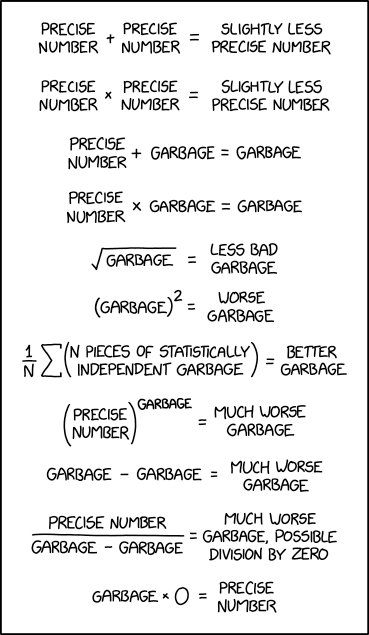
When checking for the origin of “garbage in, garbage out” on Wikipedia, I came upon this citation from Charles Babbage:

“On two occasions I have been asked, “Pray, Mr. Babbage, if you put into the machine wrong figures, will the right answers come out?” … I am not able rightly to apprehend the kind of confusion of ideas that could provoke such a question.”

following earlier quotes from him on this ‘Og.