Archive for antibiotics

Nature tidbits [14 May 2026]

Posted in Books, pictures, Statistics, Travel, University life with tags , , , , , , , , , , , , , , , , , , , , , , , , , , , , on June 21, 2026 by xi'an

Nature dedicated two pages to the dire situation of Iranian scientists and universities under the cumulated impact of US and Israeli bombings, of increased repression from the theocracy and of internet blackouts. Thirty universities were bombed since the beginning of the attacks (among other civilian buildings). Many scientists are detained at the Evin prison, in Tehran, which is also regularly targeted. This situation is highly concerning about the future of Iranian academia, which stood as an exception in the Middle East against all odds.

The same issue covers the opening of a radiation observation centre in Fukushima, where an area of 300 km² remains off limit. While the remainder of the Fukushima region is declared as safe as the whole of Japan, very few people have returned. One of the goals of the institute (F-REI) is to induce more confidence in the scientific validity of the above declaration, but it remains to be seen how effective it will prove. (I intended to hike nearby this summer but plans have changed!)

Still in the 14 May volume, a longer “feature” article on the dangers of AI-based bioweapons. Which seem real but also difficult to counteract. Especially if rogue states are involved and can create AI-controlled robotic labs for the production. The common recommendation that scientists should create adequate guardrails sounds naïve, at best, since generic LLMs are not designed with such guardrails. (It seems to me each article on the topic reaches the Asilomar trigger at some point!) Followed by a less doom-laden article on the use of AI “vibe coding” by scientists, if not of lesser interest. Which relates to the explosive call to LLMs to design or improve codes. (Also impacting our students and courses in a massive way.) The gains are mostly appreciable for those in the know, since newcomers without coding experience are unlikely to spot subtle errors. (Of course, we a.s. faced pre-AI codes with a subtle error that took ages to detect. Or may even still be there!) The issue also contains an “outlook” leaflet [supported by external sources, who assumedly do not influence the contents!] on antimicrobial (incl. antibiotic) resistance. Among the causes are the default use of antibiotics in farming, which again reflect on the difficulty of controlling such practice (banned in the EU, except in some imports!) and the urge to reduce faster meat consumption. And a book review of Canadian anthropologist Samson’s The Sleepless Ape, which offers an interesting theory of evolution thru sleep deprivation! (“The philosophers John Locke and David Hume thought that sleep hindered rationalism and the pursuit of knowledge.”)


ceremonial matcha [Takayama, 11/03/2025]

Posted in pictures, Travel, Wines with tags , , , , , , , , , on July 20, 2025 by xi'an

Nature snapshots

Posted in Books, Mountains, pictures, Travel with tags , , , , , , , , , , , , , , , , , , , , , , , , , on September 15, 2024 by xi'an

Some quick breakfast reads from the 15 August issue of Nature ,

  • the incredible discovery that the massive slabs of Stonehenge were transported from Scotland, 800km North. Reuniting with the Round Table legend that Merlin brought them from Ireland. (Through a Kolmogorov-Smirnov test (!) not rejecting the null that the age distributions of the altar stones and those of the Orcadian Bassin are identical. And kernel density estimates.) With their transportation 4,500 years ago remaining a mystery but like carried out by sea from Northern Scotland or even the Orkney Islands.
  • a debate on whether or not to cap US postdoctoral positions to five years, as considered by the NIH. The intention is to prevent lengthy short-term positions in academia and to force institutions to hire into more permanent jobs. However, if the only proactive step from the NIH is this cap, institutions can proceed by rotating within the perpetually renewed pool of fresh PhD laureates. Leaving the older postdocs no other choice than switching to non-academic jobs when they cannot secure a tenure-track position. (In France, after 6 years on short-term contracts, a scientist’s most recent employer is legally obligated to offer stable employment, which leads to the preventive decision by labs of not hiring postdocs beyond 5 years.)
  • a more precise history of plate tectonics, which our own Jeffreys opposed all his life.
  • the several attempts at overcoming the antibiotic diminishing return in fighting microbial infections. That include generative AI.
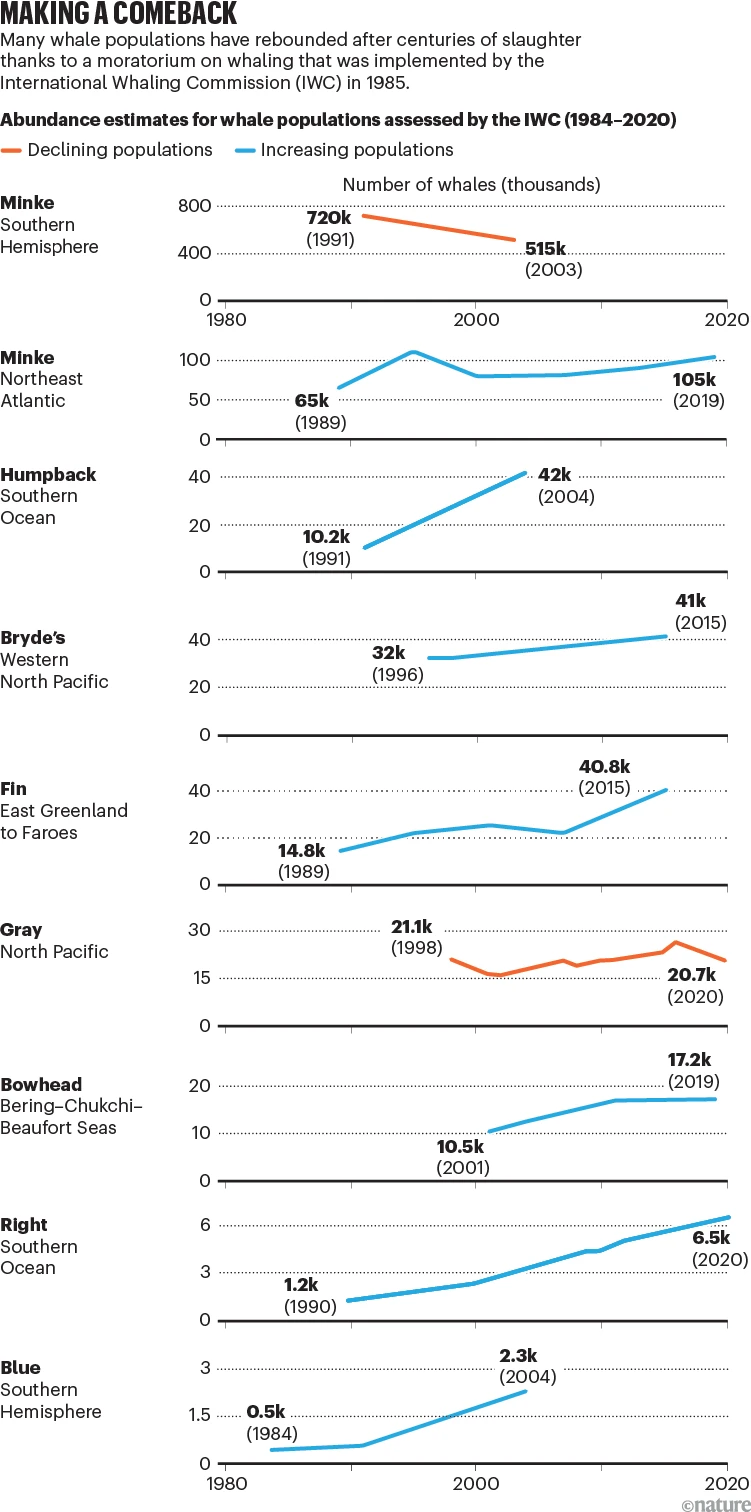
  • a shocking call to close the International Whaling Convention (formerly chaired by one of the authors) and let countries run their whaling, at a time when Japan launched a massive commercial whaling ship and when Peter Watson has been jailed in Greenland! With terrible three point graph “demonstrating” a comeback for most whale species.
  • a novel theory behind the construction of Saqqara pyramids, involving hydraulics as put forward by a Paris institute called Paleotechnic (!)
  • and a scathing book review of Kurzweil’s The Singularity is Nearer (when we merge with AI) [!], which concludes with ” Kurzweil’s understanding of humanity and nature is so bizarrely deficient that his augury is more of a curse than a blessing. His spiritual quest is devoid of spirit. The singularity betrays what is singularly human.” With the reviewer hoping “that we would have reached bullshit escape velocity by” the 2030 horizon predicted by Kurzwel for transhumanist heaven.

fit data to your model [bobologie]

Posted in Kids, Running, Travel with tags , , , , , , , , , , , , on May 29, 2020 by xi'an

A few weeks ago, I contacted my general (and sport) practitioner for a mild issue with hurting toes, as they were indeed hurting and not only during or after my daily runs (!). Since the beginning of lockdown. I thought he would tell me to contact him later and stop running in the meanwhile but instead he told me to come to his office and after a rather cursory glance at said toes started discussing on a rare occurrence of COVID-19 induced frostbite-like toes. He then ordered a blood test which I took the next morn. Right after my (legit and solitary) one hour run. The results of the test were within the “normal” boundaries, except for the D-dimer test which was above the limit and is usually intended for detecting deep venous thrombosis. (As reported on Wikipedia, “a four-fold increase in the D-Dimer protein is a strong indicator of mortality in those suffering from COVID-19.”) This caused my physician to react quickly by prescribing me a cocktail of anticoagulants, corticosteroids and antibiotics. And another test four days later, incl. one for COVID-19. While anticoagulants made sense wrt to the coagulation issues, the corticosteroids were a surprise as they had been earlier pointed out as a potential aggravating cause for younger patients. Including by the French Ministry of Health. I thus asked my daughter for advice, as she had been triaging potential COVID-19 patients in the emergency room for the past month and she was strongly negative about the treatment, both because of the corticosteroids and of the antibiotics. Treatment that was apparently advocated by my practitioner on his own. I thus waited for the second round of blood tests, which returned a lower D-Dimer level and a negative signal for COVID-19. (In the meanwhile, I had spotted a BMJ paper on the possible impact of extended running on the D-Dimer levels and hence waited till the mid-afternoon to take the test!) While this ended up as a non-story, only made more exciting by the lack of competitive events during the lockdown!, I find it interesting that my doctor, who was most reasonably worried about the rising number of COVID-19 among his patients, leaned towards a viral conclusion with little data, as my month-old return to intensive (daily) running was a more likely explanation for sore toes…