Archive for hypergeometric distribution

Bayes in Riddler mode

Posted in Books, Kids, R, Statistics with tags , , , , , on July 7, 2022 by xi'an

A very classical (textbook) question on the Riddler on inferring the contents of an urn from an Hypergeometric experiment:

You have an urn with N  red and white balls, but you have no information about what N might be. You draw n=19 balls at random, without replacement, and you get 8 red balls and 11 white balls. What is your best guess for the original number of balls (red and white) in the urn?

With therefore a likelihood given by

\frac{R!}{(R-8)!}\frac{W!}{(W-11)!}\frac{(R+W-19)!}{(R+W)!}

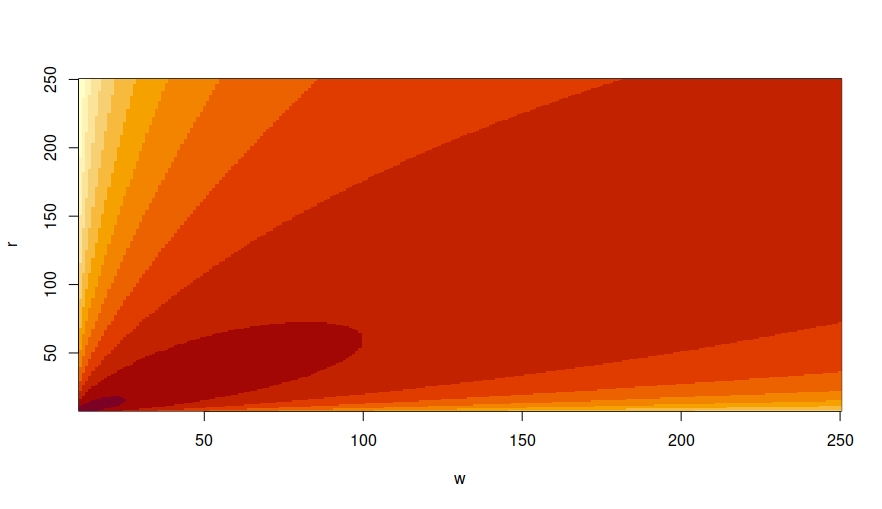
leading to a simple posterior derivation when choosing a 1/RW improper prior. That can be computed for a range of integer values of R and W:

L=function(R,W)lfactorial(R)+lfactorial(W)+
    lfactorial(R+W-19)-lfactorial(R-8)-
    lfactorial(W-11)-lfactorial(R+W)

and produces a posterior mean of 99.1 for R and of 131.2 for W, or a posterior median of 52 for R and 73 for W. And to the above surface for the log-likelihood. Which is unsurprisingly maximal at (8,11). The dependence on the prior is of course significant!

However silly me missed one word in the riddle, namely that R and W were equal… With a proper prior in 1/R², the posterior mean is 42.2 (unstable) and the posterior median 20. While an improper prior in 1/R leads to a posterior mean of 133.7 and a posterior median of 72. However, since the posterior mean increases with the number of values of R for which the posterior is computed, it may be that this mean does not exist!

sampling w/o replacement except when replacing

Posted in Books, Kids, R with tags , , , , , , , on November 3, 2020 by xi'an

Another Riddle(r), considering a box with M myrtle balls and D dandelion balls. Drawing balls without replacement while they stay of the same color as the initial draw, else put back the last ball and repeat the process until all balls are drawn. The funny thing is that, unless M=0 or D=0, the probability to draw a myrtle ball at the end is always ½..! This can be easily checked by simulation (when M=2 and D=8)
r=function()sample(0:1,1,p=c(d,m))
for(t in 1:1e6){
  m=2;d=8
  i=r();m=m-!!i;d=d-!i
  while(!!m*d){
    j=r();i=ifelse(i==j,j,r())
    m=m-!!i;d=d-!i}
  F=F+(m>0)}
F/1e6

Now the proof that the probability is ½ is quite straightforward, for M=1 (or D=1). But I cannot find a quick fix for larger values. I thus reasoned by recursion, with the probability of emptying a given colour first is d!m!/(d+m)!, whatever the colour and whatever d>0,m>0. Hence half a chance to finish with myrtle. Any shorter sequence of a given colour reduces the value of either d or m, at which point we are using the recursion assumption that the probability is ½…

Le Monde puzzle [#1121]

Posted in Books, Kids with tags , , , , on December 17, 2019 by xi'an

A combinatoric puzzle as Le weekly Monde current mathematical puzzle:

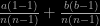
A class of 75<n<100 students is divided at random into two groups of sizes a and b=n-a, respectively, such that the probability that two particular students Ji-ae and Jung-ah have a probability of exactly 1/2 to be in the same group. Find a and n.

(with an original wording mentioning an independent allocation to the group!). Since the probability to be in the same group (under a simple uniform partition distribution) is

\frac{a(1-1)}{n(n-1)}+\frac{b(b-1)}{n(n-1)}

it is sufficient to seek by exhaustion values of (a,b) such that this ratio is equal to ½. The only solution within the right range is then (36,45) (up to the symmetric pair). This can be also found by seeking integer solutions to the second degree polynomial equation, namely

b^\star=\left[ 1+2a\pm\sqrt{1+8a}\right]/2 \in \mathbb N

Riddler collector

Posted in Statistics with tags , , , , , , , on September 22, 2018 by xi'an


Once in a while a fairly standard problem makes it to the Riddler puzzle of the week. Today, it is the coupon collector problem, explained by W. Huber on X validated. (W. Huber happens to be the top contributor to this forum, with over 2000 answers, and the highest reputation closing on 200,000!) With nothing (apparently) unusual: coupons [e.g., collecting cards] come in packs of k=10 with no duplicate, and there are n=100 different coupons. What is the expected number one has to collect before getting all of the n coupons?  W. Huber provides an R code to solve the recurrence on the expectation, obtained by conditioning on the number m of different coupons already collected, e(m,n,k) and hence on the remaining number of collect, with an Hypergeometric distribution for the number of new coupons in the next pack. Returning 25.23 packs on average. As is well-known, the average number of packs to complete one’s collection with the final missing card is expensively large, with more than 5 packs necessary on average. The probability distribution of the required number of packs has actually been computed by Laplace in 1774 (and then again by Euler in 1785).

yet another typo

Posted in Books, Statistics, University life with tags , , on August 21, 2011 by xi'an

An email from Stefan Webb pointed out an embarrassing typo in the Appendix of The Bayesian Choice:

There is a type on page 522 in the definition of the density function of the hypergeometric distribution (A.14). It should read “pN choose x”, not “pn choose x” in the numerator of f since you have reparameterized the standard form with m = pN.

Indeed, the density of the hypergeometric distribution should be

f(x|p)=\dfrac{{pN\choose x}{(1-p)N\choose n-x}}{{N\choose n}}\mathbb{I}_{\{n-(1-p)N,\ldots,pN\}}(x) \mathbb{I}_{\{0,1,\ldots,n\}}(x)

instead of

f(x|p)=\dfrac{{pn\choose x}{(1-p)N\choose n-x}}{{N\choose n}}\mathbb{I}_{\{n-(1-p)N,\ldots,pN\}}(x) \mathbb{I}_{\{0,1,\ldots,n\}}(x)
