Archive for quantum comuting

Nature tidbits

Posted in Books, Kids, Statistics, Travel, University life with tags , , , , , , , , , , , , , , , , , , , , , , , , , , , , , , , , , on June 10, 2024 by xi'an

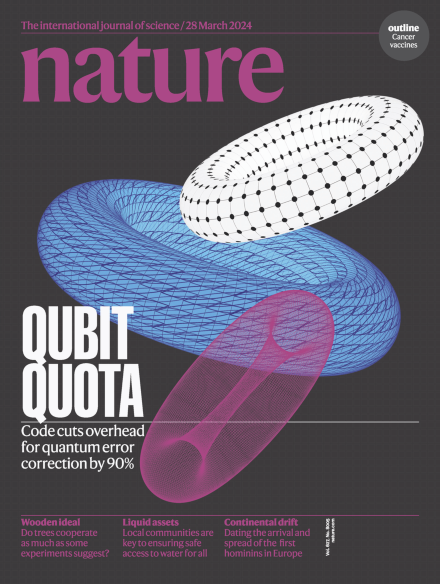
I was quite glad to have taken this 28 March issue of Nature for the train ride to Marseille earlier this month, as it proved full of great entries. Starting with a tribune from a PhD candidate from Ghana unable to speak at a tropical ecology conference in Lisbon for being denied a Schengen visa by the Dutch embassy in Accra, despite providing a serious amount of supporting material. This is a general issue related to international conferences that I plan to include in my presentation in a round table about the future of conference at the ISBA 2024 conference next month. Researchers and students from low-income countries are regularly victims of arbitrary rejections by consular and embassy officers, with little leeway from inviting universities and academic societies for counteracting such arbitrariness. An example came last year when, as part of our Data Science for Social Good program at Warwick, one computer student from Pakistan got denied a visa, while another one with an almost identical profile did receive her visa.

In News in focus, the development of a revolutionary (CAR-T) cancer therapy by  a Munbai company at 1/10 the cost of similar products in the US, with several impressive innovations (and a clinical trial over 33 people). The coverage of Michel Talagrand’s 2024 Abel prize, the deteriorating state of scientific research in Russia, a review on how the Big Bang got its name (hint: it was on BBC 3), and remembering India’s Chipko tree-hugging women of Western Himalayas of 50 years ago. The development of signs for scientific terms to add to the Indian and American sign languages.

There is also an almost sleuthing story on the debates in the ecology community about the theory of “Mother Tree”, introduced by Suzanne Simard, about trees communicating among themselves by underground fungal networks, and thus creating a “wood wide web“.  With mature trees favouring their own kin, a theory that critics in the field deem incompatible with evolutionary theory and more crucially missing supporting evidence. (Arguments from Simard that “the European male society hates the mother tree” concept do not help towards a rational denate. The Guardian now has a podcast about this debate.)

And another story on the (racial and gender) bias of AI image generators. With the conclusion that removing such biases goes through open sourcing. And regulation like the EU’s AI Act. that requires technical documentation on the training datasets. Plus a retrospective on the theory of bird-flight origins, with John Ostrom proposing in 1974 that the evolution to flight was ground-up rather than tree-down.

A cover-paper on IBM error correcting code for quantum computing that only requires each qubit to connect with six others (just like birds in murmuration only keep track of seven neighbours) for an error threshold less than 1%. (With the property that 12 logical qubits can be preserved for 10⁶ cyclces using 288 qubits in total.)

stochastic magnetic bits, simulated annealing and Gibbs sampling

Posted in Statistics with tags , , , , , , , , , on October 17, 2019 by xi'an

A paper by Borders et al. in the 19 September issue of Nature offers an interesting mix of computing and electronics and optimisation. With two preparatory tribunes! One [rather overdone] on Feynman’s quest. As a possible alternative to quantum computers for creating probabilistic bits. And making machine learning (as an optimisation program) more efficient. And another one explaining more clearly what is in the paper. As well as the practical advantage of the approach over quantum computing. As for the paper itself, the part I understood about factorising an integer F via minimising the squared difference between a product of two integers and F and using simulated annealing sounded rather easy, while the part I did not about constructing a semi-conductor implementing this stochastic search sounded too technical (especially in the métro during rush hour). Even after checking the on-line supplementary material. Interestingly, the paper claims for higher efficiency thanks to asynchronicity than a regular Gibbs simulation of Boltzman machines, quoting Roberts and Sahu (1997) without further explanation and possibly out of context (as the latter is not concerned with optimisation).

Nature snapshots [and snide shots]

Posted in Books, pictures, Statistics, Travel, University life with tags , , , , , , , , , , , on October 12, 2017 by xi'an

A very rich issue of Nature I received [late] just before leaving for Warwick with a series of reviews on quantum computing, presenting machine learning as the most like immediate application of this new type of computing. Also including irate letters and an embarassed correction of an editorial published the week before reflecting on the need (or lack thereof) to remove or augment statues of scientists whose methods were unethical, even when eventually producing long lasting advances. (Like the 19th Century gynecologist J. Marion Sims experimenting on female slaves.) And a review of a book on the fascinating topic of Chinese typewriters. And this picture above of a flooded playground that looks like a piece of abstract art thanks to the muddy background.

“Quantum mechanics is well known to produce atypical patterns in data. Classical machine learning methods such as deep neural networks frequently have the feature that they can both recognize statistical patterns in data and produce data that possess the same statistical patterns: they recognize the patterns that they produce. This observation suggests the following hope. If small quantum information processors can produce statistical patterns that are computationally difficult for a classical computer to produce, then perhaps they can also recognize patterns that are equally difficult to recognize classically.” Jacob Biamonte et al., Nature, 14 Sept 2017

One of the review papers on quantum computing is about quantum machine learning. Although like Jon Snow I know nothing about this, I find it rather dull as it spends most of its space on explaining existing methods like PCA and support vector machines. Rather than exploring potential paradigm shifts offered by the exotic nature of quantum computing. Like moving to Bayesian logic that mimics a whole posterior rather than produces estimates or model probabilities. And away from linear representations. (The paper mentions a O(√N) speedup for Bayesian inference in a table, but does not tell more, which may thus be only about MAP estimators for all I know.) I also disagree with the brave new World tone of the above quote or misunderstand its meaning. Since atypical and statistical cannot but clash, “universal deep quantum learners may recognize and classify patterns that classical computers cannot” does not have a proper meaning. The paper contains a vignette about quantum Boltzman machines that finds a minimum entropy approximation to a four state distribution, with comments that seem to indicate an ability to simulate from this system.