Archive for IHES

Nature tidbits [6 Aug 2026]

Posted in Books, pictures, University life with tags , , , , , , , , , , , , , , , , , , , , , , , , , on October 7, 2026 by xi'an

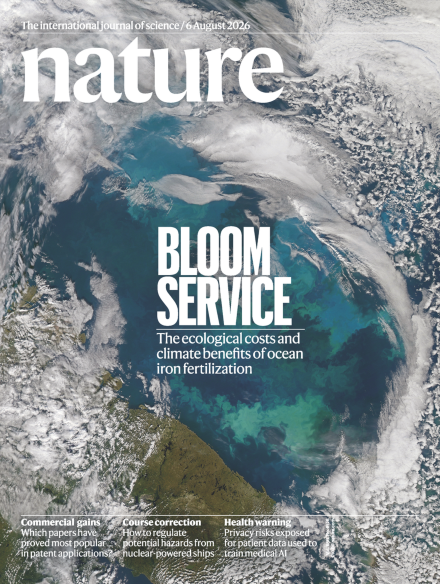
The 6 August issue of Nature arrived after my return from Japan, but it took me a while to catch up, the more because its cover story, Bloom service, about fertilising the oceans with iron as a carbon sink did not appeal much to the geoengineering sceptic in me. Nice pun though. Flotsam of interest for me:

  • an article on GPT-4 (and open-weight models) predicting the outcomes of 70 preregistered US survey experiments, 469 effects and 119,330 participants in total. The predicted treatment effects are highly correlated with the observed ones, about as well as pooled human forecasters do, including studies published after the training cutoff. But the predicted effect sizes are systematically too large, which is not a minor detail for a field still recovering from its replication crisis! Plus a survey of 460 social scientists about using LLMs for pilot testing, and a web app to “forecast” your own experiment’s effect before running it. (I wonder what a prior elicited this way would look like.)
  • a paper on membership inference attacks on medical AI models, showing that patients who differ from the majority are the easiest to identify as part of the training data, which I already discussed here. This fits the long-known issue with differential privacy and outliers.
  • a story on the four 2026 Fields Medals, announced at the ICM in Philadelphia, in fields far, far away:
    • Yu Deng (Chicago), for his work on PDEs, including a rigorous derivation of the Boltzmann equation from hard-sphere dynamics (with Zaher Hani and Xiao Ma), wave kinetic equations, and probabilistic approaches to nonlinear Schrödinger equations.
    • John Pardon (Stony Brook), for symplectic topology and enumerative geometry. He started as an undergraduate by answering a question of Gromov on knot distortion.
    • Jacob Tsimerman (Toronto), for extending techniques within arithmetic and complex algebraic geometry and solving conjectures in this field.
    • Hong Wang (NYU and IHES in Bures-sur-Yvette, almost a colleague!), for Fourier restriction, progress on Falconer’s conjecture and, with Joshua Zahl, the resolution of the Kakeya conjecture in three dimensions.
  • a feature on the scientific papers most cited in patents.
  • a news item on a Science paper by Blasi, Hamilton, Gray and Bowern, estimating that humanity may have spoken tens of thousands of languages between 3,000 and 1,000 years ago. The paper suggests a shift away from nomadic life triggered this diversity before it collapsed. I wonder at how deep the statistical linguistics inferring this rich past from the surviving sample goes. In a sense, the finding is not that surprising, given how isolated small prehistoric communities were, and how quickly a language drifts apart without contact. (I would also like to check how much the estimate depends on the assumed birth-and-death rates of languages, since the lost ones leave no trace to calibrate against…)
  • an editorial on the White House’s “new golden age for science” plan. It argues that such a golden age needs open borders and funding for the social sciences, public health and the humanities, not only AI and engineering. Alas, the now usual Trump.2.0 fare, with an AI funding roll-out in the news pages.
  • an emergency call by WHO director-general Tedros Adhanom Ghebreyesus on why the WHO has never been more needed, and news that the first volunteer received an Ebola vaccine three months into the current outbreak.
  • a forecast that the coming El Niño should be the largest (by a mind-blowing margin) on record, pushing 2027 temperatures to new highs. And already having severe impact on tropical weather.
  • a scary comment on the risks of nuclear-powered merchant ships, in the very issue dated on the anniversary of Hiroshima…

The Guardian on [and on and on] Grothendieck

Posted in Books, Kids, Mountains, University life with tags , , , , , , , , , , , , , on September 11, 2024 by xi'an

A very looong piece in The Guardian of 31 August relates the life and achievements of Grothendieck in a highly romanticized way, hinting at hidden secrets contained in the tens of thousands of pages he wrote during his 26 years of retirement in Lasserre, Pyrénées… (Even when acknowledging that Grothendieck’s life and personality are providing enough fodder for a whole series of novels!)

“Grothendieck’s genius defied his attempts at erasing his own renown. He lurks in the background of one of Cormac McCarthy’s final novels, Stella Maris, as an éminence grise who leads on its psychically disturbed mathematician protagonist.”

With very little about maths, apart the mumbo-jumbo usually associated with non-specialists trying to convey the unique ability of a researcher with images and allegories aplenty! The only factual information is that Huawei sees worth in Grothendieck’s concept of topos (within his general theory of categories) toward future AIs and that they hired French 2002 Fields medalist Laurent Lafforgue to explore this subject (besides not mentioning Huawei creating an algebraic geometry chair at the IHÉS, the very place Grothendieck resigned from due to IHÉS receiving military funds).

“Applied to AI, toposes could allow computers to move beyond the data associated with, say, an apple; the geometric coordinates of how it appears in images, for example, or tagging metadata. Then AI could begin to identify objects more like we do – through a deeper “semantic” understanding of what an apple is. But practical application to create the next generation of “thinking” AI is, according to Lafforgue, some way off.”

The author of the Guardian piece, Phil Hoad, is also very reserved about the ultimate purpose of Huawei in funding this research (and the new Centre Lagrange in the centre of Paris), for its obscure links with the Chinese Government and the Chinese military, a concern also expressed by some French mathematicians who signed a tribune in 2021 calling for a boycott of the Centre… But leaving open the door open on whether or not the unexplored thousands of pages blackened by Grothendieck could contain mathematical gems, rather than esoteric ramblings aggravated by his complete shunning of society. Which sounds quite unlikely.

journée statistique/apprentissage sur un plateau [19/01/18]

Posted in pictures, Statistics, University life with tags , , , , on December 18, 2017 by xi'an

The Grothendieck papers

Posted in Books, Kids, Mountains, pictures, University life with tags , , , , , , , , on December 28, 2016 by xi'an

Running back towards Carnon, along the expressway (!), with pink flamingoes in the distance, June 15, 2012Following the death of the mathematician Alexandre Grothendieck in 2014, his former maths department at the University of Montpellier decided to digitise in very high resolution the 28,000 pages of notes he had left to the department. Under the supervision of Jean-Michel Marin, Head of the said department! However, thanks to the French laws governing succession, those notes cannot be posted on-line without the authorisation of the five children of Grothendieck, who keep a moral right on those notes, even though they were given to the department. Grothendieck’s children want to recover all their father’s notes—which amount to more than 90,000 handwritten pages—presumably towards a bulk sale to a prestigious American university, but the succession is in limbo while the monetary value of those notes is not ascertained. And the digitised notes are stuck in this legal no man’s land as well. It is fairly ironical that those notes are at the centre of a financial conundrum, when Grothendieck’s anarchist principles led him to refuse awards and positions and to lead a recluse and frugal life in an isolated mountain village. And to prohibit the publication of those notes… Jean-Michel remains confident though that a solution can soon be reached between Grothendieck’s children, the University, the IHES, and the French National Library. I hope those notes can be made public, so that anyone could consult them. In paper or digitised format. Even though most of these pages may just be unexploitable. But at least they will be available rather than stuck in a storage for another 25 years.

Another postdoc offer in Paris

Posted in Travel, University life with tags , , , , on November 21, 2011 by xi'an

Here is an offer for a 6 to 12 month postdoc in Paris, with one theme potentially interesting for Og’s readers:

The CARMIN Project, created as part of the call for “laboratories of excellence” of the French Ministry of Higher Education and Research, aims at creating  places where mathematicians can exchange and pool their skills in order to solve  big scientific issues. In the mathematics field, there are indeed a  number of open scientific problems that cannot be solved by a single person. This “mathematical” infrastructure is essential for maintaining excellence in the French mathematical school at the highest international level. (More information)­ ­

PRESENTATION of the PROGRAMM

As part of the LabEx CARMIN, IHES and IHP offer young researchers in mathematics a joint post-doctoral programme for 2012-2013 that will enable candidates selected by the Scientific Committee to combine a research visit at IHES with participation to one of the quaterly IHP thematic programmes for a duration of 6 to 12 months.

CONDITION

• To have obtained a PhD in 2009 or later.
­• To participate in one of the three thematic trimestrial programmes 2012-2013 at IHP:
– 10 September 2012 – 14 December 2012: Conformal Geometry and Kählerian Geometry (M. GURSKY, E. HÉBEY, F. PACARD, J. VIACLOVSKY)
– 7 January – 5 April 2013: Mathematics and Bio-Economics for the Sustainable Management of Biodiversity (M. DE LARA, L. DOYEN)
– 15 April -12 July 2013: Variational and Spectral Methods in Quantum Mechanics (M. ESTEBAN, M. LEWIN)

HOW TO APPLY Each candidate is expected to apply online

• filling out the application form online • and submitting the following documents:

– Curriculum-vitæ
– Publication list
– Research Project
– 2 or 3 recommendation letters to be sent directly to ­candidature-carmin [ã] ihes.fr

APPLICATION DEADLINE : 10 December 10 2011