Archive for parametric bootstrap

mixture models [book review]

Posted in Books, Statistics, University life with tags , , , , , , , , , , , , , , , , , , , , , , , on August 14, 2024 by xi'an

Strangely enough, I became aware of this new book on mixtures through one of these annoying emails “Your work has been cited n times this week“… Mixture Models (Parametric, Semiparametric, and New Directions) by Weixin Yao and Sijia Wang got published by CRC Press earlier this year, within the Monographs on Statistics and Applied Probability green series (#175), and covers across 380 pages most aspects of mixture (and hidden Markov) estimation, if with strong emphasis on maximum likelihood estimation, while the new directions are unsurprisingly those pursued by the authors, namely robust and semi-parametric estimation, as well as model selection by testing.

An early warning about this book review is that I co-edited a Handbook of Mixture Analysis with my friends Sylvia Früwirth-Schnatter and Gilles Celeux a few years ago. I am therefore biased in what I would have included in a new book on the topic, the more because I find the available literature already plentiful, even though the early (1984) book of Titterington et al. that was my entry to the field may have become an historical reference. For instance, Finite Mixtures by McLachlan and Peel (2000) remains relevant, with similar emphasis on maximum likelihood and the EM algorithm, while Sylvia’s Finite Mixture and Markov Switching Models is still a reference to this day.

And an additional warning on me not being a massive fan of semi- and non-parametric estimation in this setting…

Preliminaries that may explain my limited enthusiasm about the book and its limited originality. Not that I found significant errors there (even though “improper priors [do not always] yield improper posteriors” [p.145] as we demonstrated in several papers), however, I had trouble with the uneven pace adopted by the authors that often skim some topics of importance while spending an inconsiderate amount of space on less relevant once. Some items get many bibliographical references, while others do not. For instance, EM receives a lion’s share (see, e..g, Sections 6.6 and 6.7). Or the 12 pages of proof in Chapter 10. Declination of sections into mixtures, mixtures of regressions, multivariate mixtures, hidden Markov models, and so on feels somewhat repetitive. This is particularly the case for the “mixture regression models” chapter.

The book also contains Bayesian entries, with a first introduction (p.105) in the discrete data chapter that precedes the short Bayesian chapter #4 (p.145), the same issue arising for related algorithms like Gibbs (p.107) that “estimate properties of the joint posterior” and MCMC (p.112). Which sort of erases the specificity of a Bayesian approach by reducing it to one item in the toolbox (with the wrong stress on MAP estimates). In this Bayesian chapter, MCMC validation is handled for discrete state spaces while applied in general spaces. The focus is mostly on relabelling for the following label switching chapter, albeit a large collection of methods are compared if not mentioned.

Handing an unknown number of components by hypothesis testing is supported in the next short chapter, although very little is said about reversible jump MCMC. And there is no general discussion on the consistency of these tests, in particular with bootstrap. Or at least on the regularity conditions they request. An puzzling paradox (p.191) is the existence of an unbounded Fisher information of an exponential mixture

\pi\mathcal Exp(1)+(1-\pi)\mathcal Exp(2)

when the weight π is the parameter (and close to 1).

High-dimensional mixtures in Chapter 8 are mostly handled by linear projections in smaller subspaces, which is natural given that they preserve the mixture structure but open a Pandora box of a wide range of proposed methods, again with little comparison available. Except in the R final section opposing several R functions on the same dataset (if unconclusively).

The semi-parametric chapters mention Dirichlet process priors, albeit briefly, but fail to relate to the recent works on using these when inferring about the number of components. Or failing to do so. There is also a very limited connection pointed out with machine learning but little can be gathered from the three page presentation (pp.308-310). These chapters also have significant overlap with the review paper of Xiang et al. (2019) in Statistical Science.

Most chapters end up with an R section, which usually reads as a quick demo of a related R package, like BayesLCA or our own mixtool. Hence not massively helpful beyond pointers to these packages. The numerical illustrations also are unevenly distributed between chapters, from nothing at all to four pages of small font tables on an MSE comparison between more or less robust approaches undertaken by Yu et al. (2020).

The above thus explains why I am not particularly excited about this bibliographical addition to the analysis of mixtures. It does offer a reference for researchers in the field by adding recent references and approaches to the existing books mentioned above, but I could not recommend it as a textbook (as suggested on p.xiii).

[Disclaimer about potential self-plagiarism: this post or an edited version may eventually appear in my Books Review section in CHANCE.]
adjustment of bias and coverage for confidence intervals

Posted in Statistics with tags , , , , , , , , on October 18, 2012 by xi'an

Menéndez, Fan, Garthwaite, and Sisson—whom I heard in Adelaide on that subject—posted yesterday a paper on arXiv about correcting the frequentist coverage of default intervals toward their nominal level. Given such an interval [L(x),U(x)], the correction for proper frequentist coverage is done by parametric bootstrap, i.e. by simulating n replicas of the original sample from the pluggin density f(.|θ*) and deriving the empirical cdf of L(y)-θ*. And of U(y)-θ*. Under the assumption of consistency of the estimate θ*, this ensures convergence (in the original sampled size) of the corrected bounds.

Since ABC is based on the idea that pseudo data can be simulated from f(.|θ) for any value of θ, the concept “naturally” applies to ABC outcomes, as illustrated in the paper by a g-and-k noise MA(1) model. (As noted by the authors, there always is some uncertainty with the consistency of the ABC estimator.) However, there are a few caveats:

  • ABC usually aims at approximating the posterior distribution (given the summary statistics), of which the credible intervals are an inherent constituent. Hence, attempts at recovering a frequentist coverage seem contradictory with the original purpose of the method. Obviously, if ABC is instead seen as an inference method per se, like indirect inference, this objection does not hold.
  • Then, once the (umbilical) link with Bayesian inference is partly severed, there is no particular reason to stick to credible sets for [L(x),U(x)]. A more standard parametric bootstrap approach, based on the bootstrap distribution of θ*, should work as well. This means that a comparison with other frequentist methods like indirect inference could be relevant.
  • At last, and this is also noted by the authors, the method may prove extremely expensive. If the bounds L(x) and U(x) are obtained empirically from an ABC sample, a new ABC computation must be associated with each one of the n replicas of the original sample. It would be interesting to compare the actual coverages of this ABC-corrected method with a more direct parametric bootstrap approach.

Bayesian inference and the parametric bootstrap

Posted in R, Statistics, University life with tags , , , , , , , , on December 16, 2011 by xi'an

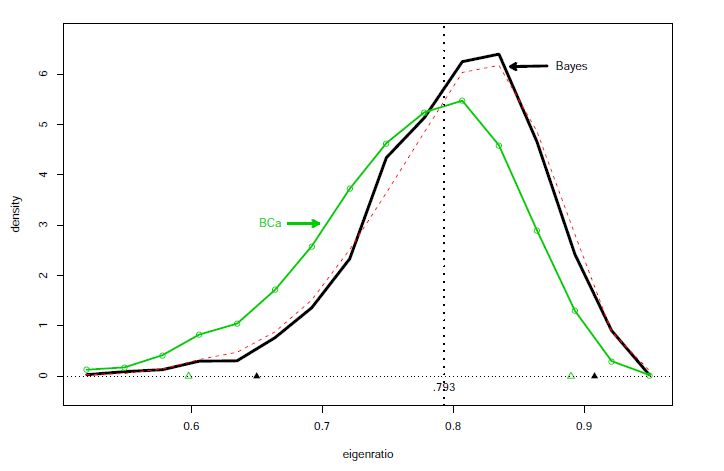
This paper by Brad Efron came to my knowledge when I was looking for references on Bayesian bootstrap to answer a Cross Validated question. After reading it more thoroughly, “Bayesian inference and the parametric bootstrap” puzzles me, which most certainly means I have missed the main point. Indeed, the paper relies on parametric bootstrap—a frequentist approximation technique mostly based on simulation from a plug-in distribution and a robust inferential method estimating distributions from empirical cdfs—to assess (frequentist) coverage properties of Bayesian posteriors. The manuscript mixes a parametric bootstrap simulation output for posterior inference—even though bootstrap produces simulations of estimators while the posterior distribution operates on the parameter space, those  estimator simulations can nonetheless be recycled as parameter simulation by a genuine importance sampling argument—and the coverage properties of Jeffreys posteriors vs. the BCa [which stands for bias-corrected and accelerated, see Efron 1987] confidence density—which truly take place in different spaces. Efron however connects both spaces by taking advantage of the importance sampling connection and defines a corrected BCa prior to make the confidence intervals match. While in my opinion this does not define a prior in the Bayesian sense, since the correction seems to depend on the data. And I see no strong incentive to match the frequentist coverage, because this would furthermore define a new prior for each component of the parameter. This study about the frequentist properties of Bayesian credible intervals reminded me of the recent discussion paper by Don Fraser on the topic, which follows the same argument that Bayesian credible regions are not necessarily good frequentist confidence intervals.

The conclusion of the paper is made of several points, some of which may not be strongly supported by the previous analysis:

  1. “The parametric bootstrap distribution is a favorable starting point for importance sampling computation of Bayes posterior distributions.” [I am not so certain about this point given that the bootstrap is based on a pluggin estimate, hence fails to account for the variability of this estimate, and may thus induce infinite variance behaviour, as in the harmonic mean estimator of Newton and Raftery (1994). Because the tails of the importance density are those of the likelihood, the heavier tails of the posterior induced by the convolution with the prior distribution are likely to lead to this fatal misbehaviour of the importance sampling estimator.]
  2. “This computation is implemented by reweighting the bootstrap replications rather than by drawing observations directly from the posterior distribution as with MCMC.” [Computing the importance ratio requires the availability both of the likelihood function and of the likelihood estimator, which means a setting where Bayesian computations are not particularly hindered and do not necessarily call for advanced MCMC schemes.]
  3. “The necessary weights are easily computed in exponential families for any prior, but are particularly simple starting from Jeffreys invariant prior, in which case they depend only on the deviance difference.” [Always from a computational perspective, the ease of computing the importance weights is mirrored by the ease in handling the posterior distributions.]
  4. “The deviance difference depends asymptotically on the skewness of the family, having a cubic normal form.” [No relevant comment.]
  5. “In our examples, Jeffreys prior yielded posterior distributions not much different than the unweighted bootstrap distribution. This may be unsatisfactory for single parameters of interest in multi-parameter families.” [The frequentist confidence properties of Jeffreys priors have already been examined in the past and be found to be lacking in multidimensional settings. This is an assessment finding Jeffreys priors lacking from a frequentist perspective. However, the use of Jeffreys prior is not justified on this particular ground.]
  6. “Better uninformative priors, such as the Welch and Peers family or reference priors, are closely related to the frequentist BCa reweighting formula.” [The paper only finds proximities in two examples, but it does not assess this relation in a wider generality. Again, this is not particularly relevant from a Bayesian viewpoint.]
  7. “Because of the i.i.d. nature of bootstrap resampling, simple formulas exist for the accuracy of posterior computations as a function of the number B of bootstrap replications. Even with excessive choices of B, computation time was measured in seconds for our examples.” [This is not very surprising. It however assesses Bayesian procedures from a frequentist viewpoint, so this may be lost on both Bayesian and frequentist users…]
  8. “An efficient second-level bootstrap algorithm (“bootstrap-after-bootstrap”) provides estimates for the frequentist accuracy of Bayesian inferences.” [This is completely correct and why bootstrap is such an appealing technique for frequentist inference. I spent the past two weeks teaching non-parametric bootstrap to my R class and the students are now fluent with the concept, even though they are unsure about the meaning of estimation and testing!]
  9. “This can be important in assessing inferences based on formulaic priors, such as those of Jeffreys, rather than on genuine prior experience.” [Again, this is neither very surprising nor particularly appealing to Bayesian users.]

In conclusion, I found the paper quite thought-provoking and stimulating, definitely opening new vistas in a very elegant way. I however remain unconvinced by the simulation aspects from a purely Monte Carlo perspective.