Archive for Dublin

a journal of the chaos⁺⁺⁺ year

Posted in Books, Kids, Mountains, pictures, Travel, Wines with tags , , , , , , , , , , , , , , , , , , , , , , on February 25, 2025 by xi'an

Read a second volume of Caimh McDonnell’s first Dublin trilogy, The Day That Never Comes, which I found a huge disappointment, from mixing too many stories and situations to the slow pace of the scenario, to the annoying childishness of the main characters, to the tired jokes and idiosyncrasies, to the once again unrealistic conclusion. I am not contemplating going through the following tomes. I also read over a weekend the last volume of Pascale Quiviger’s Le Royaume de Pierre d’Angle, Courage, which concludes this (YA?) fantasy novel. A little disappointed by this very long volume, even more than little… Part of the story is very secondary, even useless, and we quickly get tired of the fights between Jacquard and Victoire, as well as of the mistreatment of the entire castle staff by both of them. The lack of realism of the Pierre d’Angle universe is even more glaring in this volume, because of its inability both to provide the resources of a court like Louis XIV’s and to hide rebel orders. The resolution of the Catastrophe is even more disappointing. Both simplistic and incomplete, with aspects remindful of Italo Calvino’s novels, but which don’t stick.

Cooked a huge cabbage curry for my week in Les Houches, with chickpeas whose water (aquafaba) I recycled into the base of a vegan chocolate mousse as earlier visitors had left a box of powdered cocoa in the flat. And cooked morning crêpes there  (with a vengeance!) when the local bakery did not accept credit card payments for a baguette! Also went to a farmers’ market near the workshop hotel to buy sourdough, only to find that the dozens of loaves in the hall were all reserved but for one. But came back with a wild thyme crêpe offered by the baker.

Watched The boy and the heron, a Miyazaki anime on a fantastic quest of an orphaned boy to find a place in his recompose family. The drawings are beautiful but I alas find the story rather simplistic, with the boy’s attitude difficult to analyse and no critical position on the ongoing war (despite the boy’s father’s factory producing domes for Zero fighters).

a journal of the most-chaotic-of-all year

Posted in Books, Kids, Mountains, pictures, Travel with tags , , , , , , , , , , , , , , , , , , , , , , , , , , , , , on January 25, 2025 by xi'an

Read plenty of books during my Indian trip, finishing Translation State, by Ann Leckie. Just brilliant. This is indeed a complex and fascinating book, set in the same universe as the Ancillary books, and it takes some (rewarding) effort to get engaged into the different perspectives on the event, as well as the imprecise genders, but this is ultimately flourishing. (Albeit the three central characters are way too nice and positive!) And the recently rediscovered Londres, by Louis Ferdinand Céline. Ghastly in its exposure of the lowest floors of the human soul . But also with more of a scenario and story tension than Guerre. This second book comes as a sequel to Guerre and is in the same spirit, although the main character, Ferdinand, is less sell-shocked than in the first book. The story is somewhat more constructed and the progression (or regression) has more tension. But the main characteristics of Céline’s style and pessimistic views of humanity remain, with a bleak representation of the collection of crooks, pimps, war profiteers, and desertors that people the book. And Les Eaux de sous le Monde by Stéphane Platteau, an interesting, short, side-story linked to the fantastic Les Sentiers des Astres, if on the light side, at least scenario-wise, as the story centres on a male mage trying to stop a spectre from destroying a convent (or two). Apart from him, all characters are female and some play central enough roles that he would have failed otherwise. And A Man With One of Those Faces, by Caimh McDonnell, a comic detective story, very funny but with a definite suspension of (dis)belief in the resolution of the Razpunzel unsolved mystery and possibly an overdose of Irish-ness. And Guinness! The comic side makes the day, though, along with multi-dimension characters. Part of a rather long series of books and novellas. Finished, painfully, Letter from the Dead, by Jack Gatland, a terrible detective story set in London with caricaturesque characters and situations all the way. Surprisingly a best-seller! (And followed by 21 volumes!)

Harvested and cooked so-called Jerusalem and Chinese artichokes (in French, topinambourg and crosnes, resp.) for Xmath, which didn’t suit everyone at the table. But which I liked, despite the annoying harvesting of crosnes, small and highly dispersed roots. Did not cook anything while India but indulged in the infinite variety of new dishes found in the different hotels & resorts we stayed at.

Chose chaos as the most suited of the horsemen for the coming year, with the number one disruptor (re)entering the White House, wars still raging in Ukraine, Gaza, Lebanon, Yemen, Sudan, …, the lack of a stable majority in the French parliament, and the rise of populism in Europe. And elsewhere.

poems that solve puzzles [book review]

Posted in Books, Kids, University life with tags , , , , , , , , , , , , , , , , , , on January 7, 2021 by xi'an

Upon request, I received this book from Oxford University Press for review. Poems that Solve Puzzles is a nice title and its cover is quite to my linking (for once!). The author is Chris Bleakley, Head of the School of Computer Science at UCD.

“This book is for people that know algorithms are important, but have no idea what they are.”

These is the first sentence of the book and hence I am clearly falling outside the intended audience. When I asked OUP for a review copy, I was more thinking in terms of Robert Sedgewick’s Algorithms, whose first edition still sits on my shelves and which I read from first to last page when it appeared [and was part of my wife’s booklist]. This was (and is) indeed a fantastic book to learn how to build and optimise algorithms and I gain a lot from it (despite remaining a poor programmer!).

Back to poems, this one reads much more like an history of computer science for newbies than a deep entry into the “science of algorithms”, with imho too little on the algorithms themselves and their connections with computer languages and too much emphasis on the pomp and circumstances of computer science (like so-and-so got the ACM A.M. Turing Award in 19… and  retired in 19…). Beside the antique algorithms for finding primes, approximating π, and computing the (fast) Fourier transform (incl. John Tukey), the story moves quickly to the difference engine of Charles Babbage and Ada Lovelace, then to Turing’s machine, and artificial intelligence with the first checkers codes, which already included some learning aspects. Some sections on the ENIAC, John von Neumann and Stan Ulam, with the invention of Monte Carlo methods (but no word on MCMC). A bit of complexity theory (P versus NP) and then Internet, Amazon, Google, Facebook, Netflix… Finishing with neural networks (then and now), the unavoidable AlphaGo, and the incoming cryptocurrencies and quantum computers. All this makes for pleasant (if unsurprising) reading and could possibly captivate a young reader for whom computers are more than a gaming console or a more senior reader who so far stayed wary and away of computers. But I would have enjoyed much more a low-tech discussion on the construction, validation and optimisation of algorithms, namely a much soft(ware) version, as it would have made it much more distinct from the existing offer on the history of computer science.

[Disclaimer about potential self-plagiarism: this post or an edited version of it will eventually appear in my Books Review section in CHANCE.]

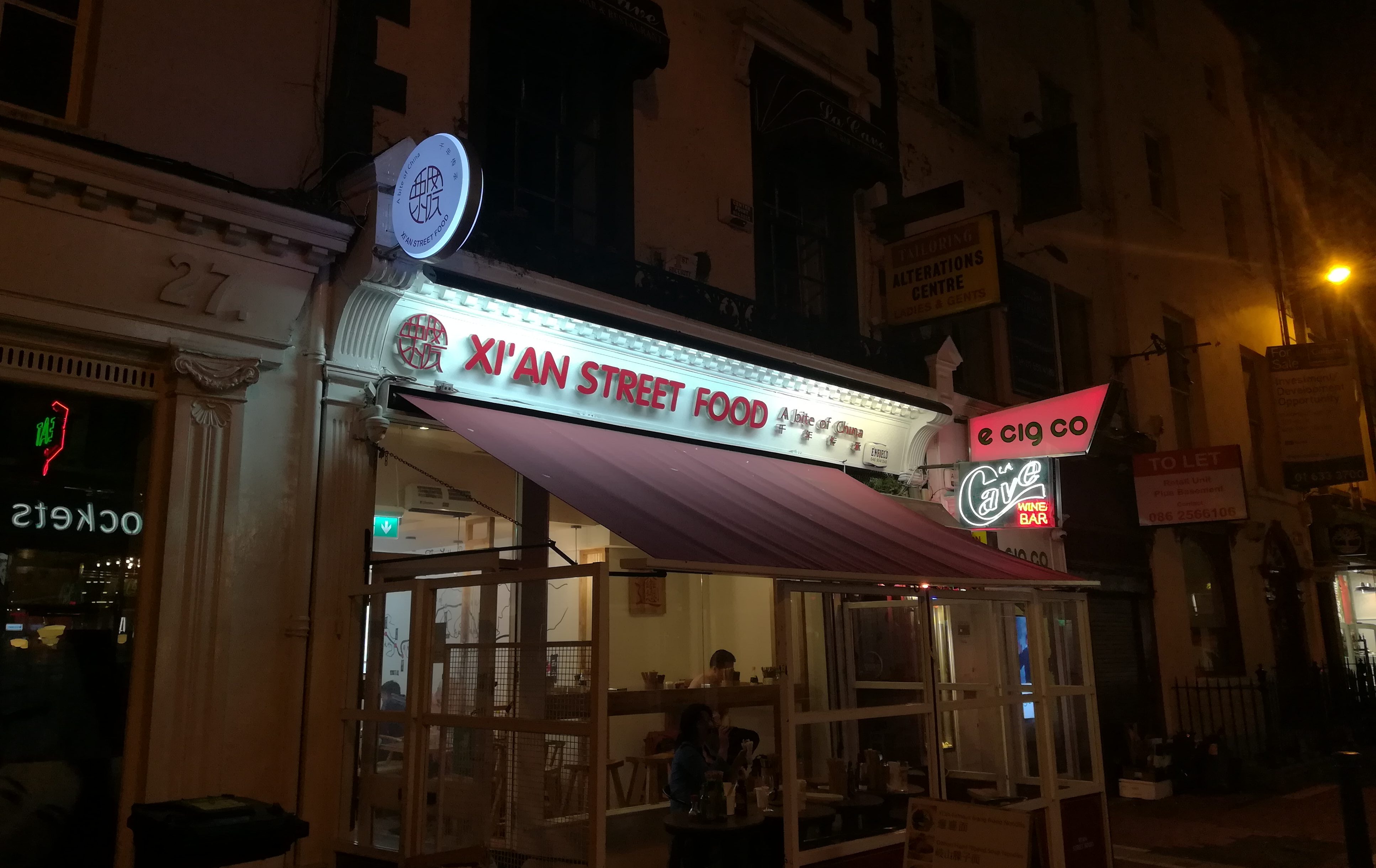
Xi’an street food [jatp]

Posted in pictures, Travel with tags , , , , , , on October 27, 2019 by xi'an

the HMC algorithm meets the exchange algorithm

Posted in Mountains, pictures, Statistics, Travel, University life with tags , , , , , , , , on July 26, 2017 by xi'an

Julien Stoehr (now in Dublin, soon to join us as a new faculty in Paris-Dauphine!), Alan Benson and Nial Friel (both at UCD) arXived last week a paper entitled Noisy HMC for doubly-intractable distributions. Which considers solutions for adapting Hamiltonian Monte Carlo to target densities that involve a missing constant. In the sense of our workshop last year in Warwick. And in the theme pursued by Nial in the past years. The notion is thus to tackle a density π(θ)∞exp(V(X|θ)/Z(θ) when Z(θ) is intractable. In that case the gradient of log Z(θ) can be estimated as the expectation of the gradient of V(X|θ) [as a standard exponential family identity]. And the ratio of the Z(θ)’s appearing in the Metropolis ratio can be derived by Iain Murray’s exchange algorithm, based on simulations from the sampling distribution attached to the parameter in the denominator.

The resulting algorithm proposed by the authors thus uses N simulations of auxiliary variables at each step þ of the leapfrog part, towards an approximation of the gradient term, plus another N simulations for approximating the ratio of the normalising constants Z(θ)/Z(θ’). While justified from an importance sampling perspective, this approximation is quite poor when θ and θ’ differ. A better solution [as shown in the paper] is to take advantage of all leapfrog steps and of associated auxiliary simulations to build a telescopic product of ratios where the parameter values θ and θ’ are much closer. The main difficulty is in drawing a comparison with the exchange algorithm, since the noisy HMC version is computationally more demanding. (A secondary difficulty is in having an approximate algorithm that no longer leaves the target density stationary.)