I spotted this title in the new arXiv postings on Monday. When Is Generalized Bayes Bayesian? A Decision-Theoretic Characterization of Loss-Based Updating by Kenichiro McAlinn & Kōsaku Takanashi is discussing decision-theoretic consequences of generalized Bayes approaches based on losses and show that decisions based on a loss-based posterior coincides with those of ordinary Bayes if and only if the loss is essentially a negative log-likelihood (leading to a belief posterior). This is not very surprising in that, otherwise, there is no Bayesian update delivering the generalised Bayes pseudo-posteriors (which can be traced back to a 2007 result of Catoni). The authors also demonstrate that generalized marginal likelihoods are not delivering evidence for decision posteriors, and thus that Bayes factors are not well-defined in this context, which reminds me of our warning for ABC model choice. However, the reason here is much more mundane, as it is due to the decision posterior failing to identify the normalising constant Z(x). Outside belief posteriors. The paper concludes with a coherence book, which is a table reproduced above.
Archive for decision theory
When Is Generalized Bayes Bayesian?
Posted in Books, Statistics, University life with tags ABC, Bayes factors, Bayesian model choice, coherence, decision theory, generalised Bayesian inference, loss functions, marginal likelihood, normalising constant on February 13, 2026 by xi'anBayesian decision-theory for data privacy [surfin’ the Oce’n, 30 April, INRIA Paris]
Posted in Statistics, University life with tags #ERCSyG, Bayesian decision theory, Bayesian privacy, decision theory, differential privacy, ERC, ERC Synergy Grant, European Research Council, hybrid Monte Carlo, INRIA, INRIA Paris, MCMC, Monte Carlo methods, Ocean, Paris, privacy, seminar, Telecom Paris on April 23, 2025 by xi'an
Abstract
The scientific and economic value of data continues to grow alongside technology advances. New hardware and software developments enable, but often require, larger and more complex datasets to function effectively. As the importance of input data to these systems becomes increasingly recognized, so too does the loss of privacy for data providers. In this context, data privacy emerges as a critical issue for fields such as statistics and machine learning, as well as for scientific and industrial endeavours that rely on sensitive data. We propose a framework for measuring privacy from a Bayesian decision-theoretic perspective. This framework enables the creation of new, purpose-driven privacy principles that are rigorously justified, while also allowing for the assessment of existing privacy definitions through decision theory. We pay particular attention to the privacy of deterministic algorithms, which are overlooked by current privacy standards, and to the privacy of N Monte Carlo samples drawn from an invariant distribution as N goes to infinity. We show that Probabilistic Differential Privacy is a special case of our framework and provide some new interpretations for Differential Privacy as a result.
Estimating means of bounded random variables by betting
Posted in Books, Statistics, University life with tags Abraham Wald, Berlin, betting, ChatGPT, Chernoff method, concentration inequality, confidence intervals, confidence sequence, decision theory, Emile Borel, game theory, Glenn Shafer, Hoeffding, Italian politics, Jean Ville, Jean-Paul Sartre, London, Maurice Fréchet, Read paper, Richard von Mises, Royal Statistical Society, Series B, Simone de Beauvoir, supermartingale on April 9, 2023 by xi'an Ian Waudby-Smith and Aaditya Ramdas are presenting next month a Read Paper to the Royal Statistical Society in London on constructing a conservative confidence interval on the mean of a bounded random variable. Here is an extended abstract from within the paper:
For each m ∈ [0, 1], we set up a “fair” multi-round game of statistician
against nature whose payoff rules are such that if the true mean happened
to equal m, then the statistician can neither gain nor lose wealth in
expectation (their wealth in the m-th game is a nonnegative martingale),
but if the mean is not m, then it is possible to bet smartly and make
money. Each round involves the statistician making a bet on the next
observation, nature revealing the observation and giving the appropriate
(positive or negative) payoff to the statistician. The statistician then plays
all these games (one for each m) in parallel, starting each with one unit of
wealth, and possibly using a different, adaptive, betting strategy in each.
The 1 − α confidence set at time t consists of all m 2 [0, 1] such that the
statistician’s money in the corresponding game has not crossed 1/α. The
true mean μ will be in this set with high probability.
I read the paper on the flight back from Venice and was impressed by its universality, especially for a non-asymptotic method, while finding the expository style somewhat unusual for Series B, with notions late into being defined if at all defined. As an aside, I also enjoyed the historical connection to Jean Ville‘s 1939 PhD thesis (examined by Borel, Fréchet—his advisor—and Garnier) on a critical examination of [von Mises’] Kollektive. (The story by Glenn Shafer of Ville’s life till the war is remarkable, with the de Beauvoir-Sartre couple making a surprising and rather unglorious appearance!). Himself inspired by a meeting with Wald while in Berlin. The paper remains quite allusive about Ville‘s contribution, though, while arguing about its advance respective to Ville’s work… The confidence intervals (and sequences) depend on a supermartingale construction of the form

which allows for a universal coverage guarantee of the derived intervals (and can optimised in λ). As I am getting confused by that point about the overall purpose of the analysis, besides providing an efficient confidence construction, and am lacking in background about martingales, betting, and sequential testing, I will not contribute to the discussion. Especially since ChatGPT cannot help me much, with its main “criticisms” (which I managed to receive while in Italy, despite the Italian Government banning the chabot!)
However, there are also some potential limitations and challenges to this approach. One limitation is that the accuracy of the method is dependent on the quality of the prior distribution used to set the odds. If the prior distribution is poorly chosen, the resulting estimates may be inaccurate. Additionally, the method may not work well for more complex or high-dimensional problems, where there may not be a clear and intuitive way to set up the betting framework.
and
Another potential consequence is that the use of a betting framework could raise ethical concerns. For example, if the bets are placed on sensitive or controversial topics, such as medical research or political outcomes, there may be concerns about the potential for manipulation or bias in the betting markets. Additionally, the use of betting as a method for scientific or policy decision-making may raise questions about the appropriate role of gambling in these contexts.
being totally off the radar… (No prior involved, no real-life consequence for betting, no gambling.)
statistics for making decisions [book review]
Posted in Books, Statistics with tags Bayesian hypothesis testing, Bayesian paradigm, book review, client, CRC Press, decision making, decision theory, elicitat, fiducial inference, frequentist inference, Neyman-Pearson tests, testing of hypotheses, textbook on March 7, 2022 by xi'an I bought this book [or more precisely received it from CRC Press as a ({prospective} book) review reward] as I was interested in the author’s perspectives on actual decision making (and unaware of the earlier Statistical Decision Theory book he had written in 2013). It is intended for a postgraduate semester course and “not for a beginner in statistics”. Exercises with solutions are included in each chapter (with some R codes in the solutions). From Chapter 4 onwards, the “Further reading suggestions” are primarily referring to papers and books written by the author, as these chapters are based on his earlier papers.
“I regard hypothesis testing as a distraction from and a barrier to good statistical practice. Its ritualised application should be resisted from the position of strength, by being well acquainted with all its theoretical and practical aspects. I very much hope (…) that the right place for hypothesis testing is in a museum, next to the steam engine.”
The first chapter exposes the shortcomings of hypothesis testing for conducting decision making, in particular by ignoring the consequences of the decisions. A perspective with which I agree, but I fear the subsequent developments found in the book remain too formalised to be appealing, reverting to the over-simplification found in Neyman-Pearson theory. The second chapter is somewhat superfluous for a book assuming a prior exposure to statistics, with a quick exposition of the frequentist, Bayesian, and … fiducial paradigms. With estimators being first defined without referring to a specific loss function. And I find the presentation of the fiducial approach rather shaky (if usual). Esp. when considering fiducial perspective to be used as default Bayes in the subsequent chapters. I also do not understand the notation (p.31)

outside of a Bayesian (or fiducial?) framework. (I did not spot typos aside from the traditional “the the” duplicates, with at least six occurences!)
The aforementioned subsequent chapters are not particularly enticing as they cater to artificial loss functions and engage into detailed derivations that do not seem essential. At times they appear to be nothing more than simple calculus exercises. The very construction of the loss function, which I deem critical to implement statistical decision theory, is mostly bypassed. The overall setting is also frighteningly unidimensional. In the parameter, in the statistic, and in the decision. Covariates only appear in the final chapter which appears to have very little connection with decision making in that the loss function there is the standard quadratic loss, used to achieve the optimal composition of estimators, rather than selecting the best model. The book is also missing in practical or realistic illustrations.
“With a bit of immodesty and a tinge of obsession, I would like to refer to the principal theme of this book as a paradigm, ascribing to it as much importance and distinction as to the frequentist and Bayesian paradigms”
The book concludes with a short postscript (pp.247-249) reproducing the introducing paragraphs about the ill-suited nature of hypothesis testing for decision-making. Which would have been better supported by a stronger engagement into elicitating loss functions and quantifying the consequences of actions from the clients…
[Disclaimer about potential self-plagiarism: this post or an edited version will eventually appear in my Book Review section in CHANCE.]
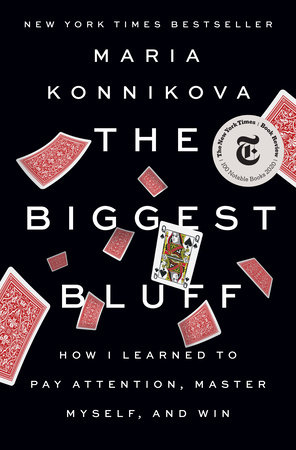
the biggest bluff [not a book review]
Posted in Books with tags betting, book review, CHANCE, data, decision theory, game, game theory, Nature, not a book review, NYT, poker, psychology on August 14, 2020 by xi'an