Archive for tempering
even faster HMC by learning leapfrog scale offline [online]
Posted in Books, Statistics, University life with tags Hamiltonian Monte Carlo, HMC, leapfrog integrator, No-U-Turn sampler, NUTS, population Monte Carlo, Statistics & Computing, tempering on September 24, 2026 by xi'an
faster HMC by learning
Posted in Books, Kids, Statistics, University life with tags algorithm, conformal Hamiltonian dynamics, eHMC, Hamiltonian Monte Carlo, HMC, leapfrog integrator, mirror descent, No-U-Turn sampler, NUTS, PhD thesis, population Monte Carlo, publication fees, revision, Scholarly Open Access, Shanghai, Springer Nature, Statistics & Computing, tempering, Università Ca' Foscari Venezia on September 23, 2026 by xi'an Just received the good news that our paper Faster Hamiltonian Monte Carlo by Learning Leapfrog Scale by Wu Changye (吴昌烨), Pierre Pudlo, Julien Stoehr and myself, got accepted in Statistics & Computing! This is great in its own, but further concludes a story that started with Changye’s PhD thesis at Paris Dauphine in 2018, with a revision request from Statistics & Computing that stalled with Changye’s departing for industry in Shanghai and eventually resumed thanks to Julien’s massive investment in coding and improving the learning mechanism. It may also conclude my story with Statistics & Computing, where I am supposed to be the historically most prolific author (?), given the move by Springer to a cash-flow model on 01 January, 2027…
connection between tempering & entropic mirror descent
Posted in Books, pictures, Running, Statistics, Travel, University life with tags ABC, Approximate Bayesian computation, chain-driven bicycle, Edward Langley Fardon, entropy, Fisher-Rao geometry, John Kemp Starley, Kenilworth, mirror descent, National Cycle Networks Sustrans, One World ABC Seminar, penny-farthing, Rover Safety Bicycle, sculpture, sculptures, sequential Monte Carlo, SMC, sunrise, tempering, University of Warwick, Warwickshire, Wasserstein distance, webinar on April 30, 2024 by xi'an  The next One World ABC webinar is this Thursday, the 2nd May, at 9am UK time, with Francesca Crucinio (King’s College London, formerly CREST and even more formerly Warwick) presenting
“A connection between Tempering and Entropic Mirror Descent”.
a joint work with Nicolas Chopin and Anna Korba (both from CREST) whose abstract follows:
This work explores the connections between tempering (for Sequential Monte Carlo; SMC) and entropic mirror descent to sample from a target probability distribution whose unnormalized density is known. We establish that tempering SMC corresponds to entropic mirror descent applied to the reverse Kullback-Leibler (KL) divergence and obtain convergence rates for the tempering iterates. Our result motivates the tempering iterates from an optimization point of view, showing that tempering can be seen as a descent scheme of the KL divergence with respect to the Fisher-Rao geometry, in contrast to Langevin dynamics that perform descent of the KL with respect to the Wasserstein-2 geometry. We exploit the connection between tempering and mirror descent iterates to justify common practices in SMC and derive adaptive tempering rules that improve over other alternative benchmarks in the literature.
parallel tempering on optimised paths
Posted in Statistics with tags astrostatistics, Bayesian optimisation, Bézier curves, black holes, British Columbia, Burrard Inlet, Canada, Gaussian mixture, imaging, parallel tempering, splines, tempering, UBC, University of British Columbia, Vancouver, Vancouver Island on May 20, 2021 by xi'an
Saifuddin Syed, Vittorio Romaniello, Trevor Campbell, and Alexandre Bouchard-Côté, whom I met and discussed with on my “last” trip to UBC, on December 2019, just arXived a paper on parallel tempering (PT), making the choice of tempering path an optimisation problem. They address the touchy issue of designing a sequence of tempered targets when the starting distribution π⁰, eg the prior, and the final distribution π¹, eg the posterior, are hugely different, eg almost singular.
“…theoretical analysis of reversible variants of PT has shown that adding too many intermediate chains can actually deteriorate performance (…) [while] on non reversible regime adding more chains is guaranteed to improve performances.”
The above applies to geometric combinations of π⁰ and π¹. Which “suffers from an arbitrarily suboptimal global communication barrier“, according to the authors (although the counterexample is not completely convincing since π⁰ and π¹ share the same variance). They propose a more non-linear form of tempering with constraints on the dependence of the powers on the temperature t∈(0,1). Defining the global communication barrier as an average over temperatures of the rejection rate, the path characteristics (e.g., the coefficients of a spline function) can then be optimised in terms of this objective. And the temperature schedule is derived from the fact that the non-asymptotic round trip rate is maximized when the rejection rates are all equal. (As a side item, the technique exposed in the earlier tempering paper by Syed et al. was recently exploited for a night high resolution imaging of a black hole from the M87 galaxy.)
computational statistics and molecular simulation [18w5023]
Posted in pictures, Statistics, Travel, University life with tags 18w5023, Banff, Banff International Research Station for Mathematical Innovation, BIRS, bouncy particle sampler, Casa Matemática Oaxaca, CMO, computational statistics, Donsker-Varadhan, eigenvalue, local scaling, Mars, Mexico, molecular dynamics, Monte Alban, Monte Carlo Statistical Methods, optimal acceptance rate, PDMP, spectroscopy, tempering, Université Paris Dauphine, workshop, Zapotec civilization, Zig-Zag on November 14, 2018 by xi'an On Day 2, Carsten Hartmann used a representation of the log cumulant as solution to a minimisation problem over a collection of importance functions (by the Vonsker-Varadhan principle), with links to X entropy and optimal control, a theme also considered by Alain Dunmus when considering the uncorrected discretised Langevin diffusion with a decreasing sequence of discretisation scale factors (Jordan, Kinderlehrer and Otto) in the spirit of convex regularisation à la Rockafellar. Also representing ULA as an inexact gradient descent algorithm. Murray Pollock (Warwick) presented a new technique called fusion to simulate from products of d densities, as in scalable MCMC (but not only). With an (early) starting and startling remark that when simulating one realisation from each density in the product and waiting for all of them to be equal means simulating from the product, in a strong link to the (A)BC fundamentals. This is of course impractical and Murray proposes to follow d Brownian bridges all ending up in the average of these simulations, constructing an acceptance probability that is computable and validating the output.
The second “hand-on” lecture was given by Gareth Roberts (Warwick) on the many aspects of scaling MCMC algorithms, which started with the famous 0.234 acceptance rate paper in 1996. While I was aware of some of these results (!), the overall picture was impressive, including a notion of complexity I had not seen before. And a last section on PDMPs where Gareth presented very recent on the different scales of convergence of Zigzag and bouncy particle samplers, mostly to the advantage of Zigzag. In the afternoon, Jeremy Heng presented a continuous time version of simulated tempering by adding a drift to the Langevin diffusion with time-varying energy, which must be solution to the Liouville pde
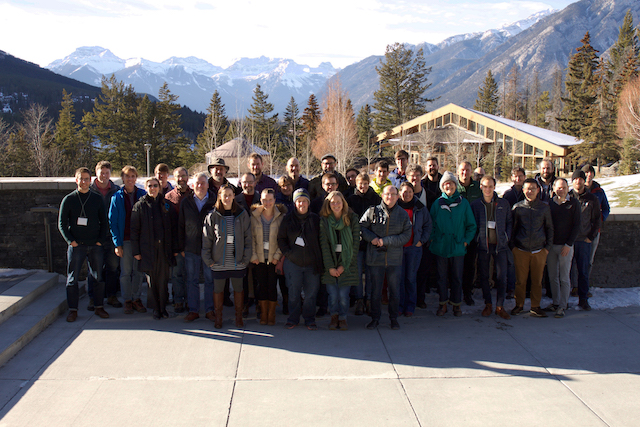
And I remembered today that there is currently and in parallel another BIRS workshop on statistical model selection [and a lot of overlap with our themes] taking place in Banff! With snow already there! Unfair or rather #unfair, as someone much too well-known would whine..! Not that I am in a position to complain about the great conditions here in Oaxaca (except for having to truly worry about stray dogs rather than conceptually about bears makes running more of a challenge, if not the altitude since both places are about the same).