 This semester, I—as a teacher—came across two cases of heavily reliance on AI by master students, mostly for coding purposes, to which I had rather surprisingly not been exposed before. (Except for this plagiarised thesis two years ago that essentially rewrote existing papers with synonyms and for which we had to get to the disciplinary committee!) One project made a massive advance within two days, with hundreds of lines of beautiful python code, and reasonable output, but with my student unable to explain the code or the method behind… And anther case homeworks involving coding came back with extremely clean codes as well. Meaning they could not be graded and we had to switch to another type of evaluation. Oh well, welcome ol’me into the new age (just for a few years!)
Archive for teaching
fAIrst contAIct
Posted in Books, Kids, pictures, Statistics, University life with tags ChatGPT, coding, debugging, discipline, master project, plagiarism, Python, R, teaching, Université Paris Dauphine, University of Warwick on November 12, 2025 by xi'anoops there it goes again
Posted in Kids, pictures, Statistics, University life with tags amazon associates, Cauchy-Schwarz inequality, Cramer-Rao lower bound, customer service, drawing tablet, drivers, Huion, teaching, undergraduates on February 16, 2024 by xi'an
Monte Carlo swindles
Posted in Statistics with tags Basu's theorem, exam, John Tukey, Monte Carlo approximations, Monte Carlo swindle, Rao-Blackwell theorem, Rao-Blackwellisation, teaching, The American Statistician, undergraduates on April 2, 2023 by xi'an While reading Boos and Hugues-Olivier’s 1998 American Statistician paper on the applications of Basu’s theorem I can across the notion of Monte Carlo swindles. Where a reduced variance can be achieved without the corresponding increase in Monte Carlo budget. For instance, approximating the variance of the median statistic Μ for a Normal location family can be sped up by considering that

by Basu’s theorem. However, when reading the originating 1973 paper by Gross (although the notion is presumably due to Tukey), the argument boils down to Rao-Blackwellisation (without the Rao-Blackwell theorem being mentioned). The related 1985 American Statistician paper by Johnstone and Velleman exploits a latent variable representation. It also makes the connection with the control variate approach, noticing the appeal of using the score function as a (standard) control and (unusual) swindle, since its expectation is zero. I am surprised at uncovering this notion only now… Possibly because the method only applies in special settings.
A side remark from the same 1998 paper, namely that the enticing decomposition
![\mathbb E[(X/Y)^k] = \mathbb E[X^k] \big/ \mathbb E[Y^k]](https://s0.wp.com/latex.php?latex=%5Cmathbb+E%5B%28X%2FY%29%5Ek%5D+%3D+%5Cmathbb+E%5BX%5Ek%5D+%5Cbig%2F+%5Cmathbb+E%5BY%5Ek%5D&bg=000000&fg=B0B0B0&s=0&c=20201002)
when X/Y and Y are independent, should be kept out of reach from my undergraduates at all costs, as they would quickly get rid of the assumption!!!
ABC in Warwick [Arena, Blended, Committed]
Posted in Kids, University life with tags curriculum, online lectures, pedagogy, screenshot, teaching, UCL, University of Warwick on February 20, 2022 by xi'an
1 / duh?!
Posted in Books, R, Statistics, University life with tags cross validated, gamma distribution, inverse Gamma distribution, Monte Carlo, Moschopoulos distribution, simulation, teaching, unconscious statistician on September 28, 2021 by xi'an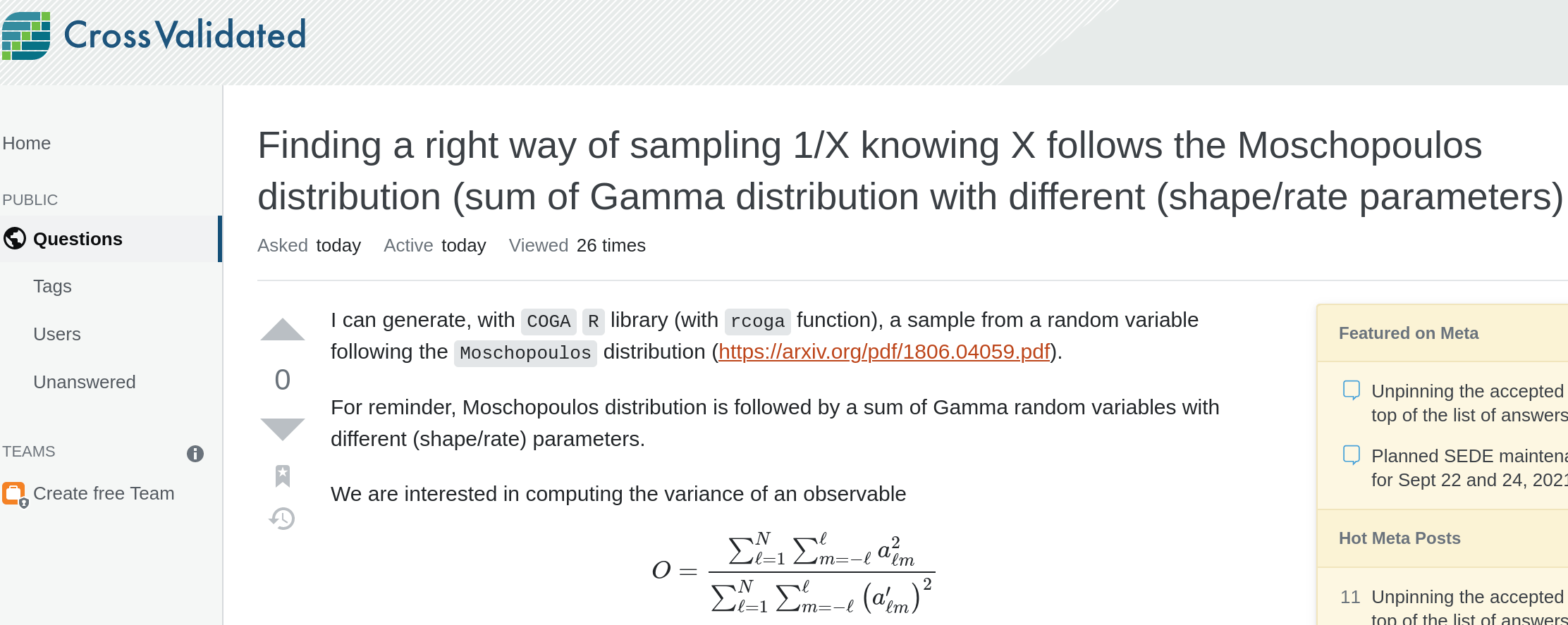 An interesting case on X validated of someone puzzled by the simulation (and variance) of the random variable 1/X when being able to simulate X. And being surprised at the variance of the ratio being way larger than the variances of both numerator and denominator.


