Archive for Lonely Planet

Nature snapshots

Posted in Books, Kids, Mountains, pictures, Travel with tags , , , , , , , , , , , , , , , , , , , , , , , on September 19, 2024 by xi'an

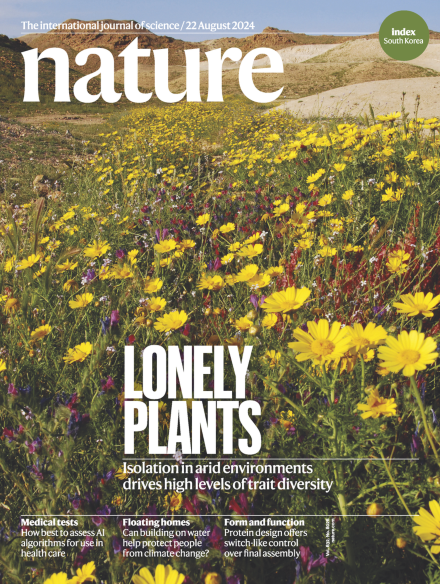
Some quick breakfast reads from the 22 August issue of Nature, beyond the nice pun in the cover title (which reads like Lonely Planet at first glance!) capturing a rare blooming of plants in the drylands of the Judaean Desert in 2015, discussing the higher diversity of plants in dry environments,

  • a tribune about the declining number of junior researchers in South Korea (with a supplementary Nature Index on its remarkable achievements), due to lower birth rates. The government is trying to make postdoc positions more attractive, to attract international students and postdocs. It has also signed with the EU to become an associate member of the Horizon Europe program, hence potentially benefitting of ERC grants.
  • looking for the hottest temperature compatible with humans, alas soon in a theatre near you… (With a heatwave chamber that was driven from Brisbane to Sydney!) I did not understand, though, how the limit of 31⁰C as the minimal temperature at which a healthy, young person would die after six hours of exposure. But agreed with the immediate benefits of skin-wetting, which I use almost constantly on hot days and nights.
  • the false good idea of wood pellets, reminding me of a freezing August in Christchurch back in 2005!, as pellets (and other biomass energy) generate more carbon than coal, favour deforestation, impacts the health of communities surrounding facilities, and takes decades to reach neutral outcomes.
  • another possibly false good idea, floating and sustainable settlements in coastal regions threatened by sea rises. Not only floating cities are expensive to build, but they are more exposed to extreme weather events, compete with the preservation of wetlands and mangroves, and cannot function without adapted infrastructure, from water and sewage treatment to means of transportation, and enough nearby services.
  • the ERROR project that pays for spotting mistakes in published papers, developed by the Universities of Bern and Leipzig. ERROR stands for Estimating the Reliability and Robustness of Research. At 2,500 Swiss francs per paper, this is hardly sustainable…
  • the problem of artificial neural networks losing plasticity in continual-learning settings and a potential solution via back-propagation.


Lonely Planet guide to Croatia (book review)

Posted in Books, Kids, Mountains, pictures, Running, Travel with tags , on August 31, 2013 by xi'an

IMG_0809I have always been a fan of Lonely Planet guides , ever since my wife bought her China edition for a backpacking trip in 1986.  (Although I did not join her, I nonetheless read part of the guide.) For instance, the guide to Rajasthan I bought last winter was great as well. It is thus a great disappointment to find that the guide to Croatia is not on par with those other guides…

IMG_1076To some extent, it feels like the authors wrote the recommendations from tourist brochures; every place is “charming”, or “spectacular despite the crowds” (and crowds there are!), hotel rooms are mostly “comfy” (mileage highly varies!) and “clean”, and restaurants are “genuine” and “frequented by locals” (not!). To the point of making me wonder how many of those places they actually visited. For instance, the authors consider the pizzeria Jupiter in Pula to be delivering the highest Italian quality of dough: definitely not the case. (They do point out that Pula is rather ordinary, though, which is the case.) The guide also stress the excellent quality of the vulture centre in Beli, a peninsula at the far north of the island of Cres. We drove there and found the place had been closed, with no trace of vultures around (the little town was obviously full of tourist cars, creating a humongous traffic jam as the tiny streets did not allow for crossing cars). We tried one of the paths mentioned in the guide but it had visibly been abandoned long enough for the markings to vanish. We had a similar experience in Lubenice, although we did spot one vulture in the distance. In Zadar, which, incidentally, is a very nice enclosed city, the tourist invasion “yet to come” has actually occurred and the main street is as packed as the waterfront in Split or the small streets of Trogir. I am afraid the guide understates the density of the 500,000 tourists packed over the few hundred kilometres of the Croatian coastline… The description of the Plitvice Lakes National Park (found in the guide) is focussing on the wrong spot: the park itself has no degree of freedom, one simply has to follow the path along with the thousands of tourists around (where I spotted a group of German girls who were next to us in the Slovenia jam mentioned below!). What is missing from the guide are indications on alternate hiking routes outside the official path, as the park itself does not provide them (and the maps we got are not reliable…) This may a completely unreasonable expectation from any guide but I am not getting useful information from reading about secret coves and deserted pathways if I cannot get access to them without a local! A last illustration is Split where we had our worst housing experience (not the guide’s fault!). A first restaurant, Konoba Trattoria Bajamont, had a highly recommended mark in the guide as an authentic place with low prices: it was just the opposite, mostly clueless temporary servers and bland food at a high price. A second restaurant, Boban, was indeed excellent but indicated at the wrong address on the guide‘s map…

IMG_1144Overall, I was also highly disappointed by the prices indicated therein (ok, it was the 2011 edition but most prices seemed to have doubled or even tripled!). It is certainly the case that Lonely Planet guides are originally written for backpackers, so the lack of indications on driving and parking conditions can be excused, even though it did not help with the experience (crossing Slovenia was an excruciating long mess on both ways, while it took us a while to gather that Zadar had its long terms parkings outside the old city, one of them free).  And an even longer while to make sense of Split anarchic parking habits. (The guide mentions that the new highways reduce the travel time to Italy, I dread to envision how it was beforehand.)