Archive for unbiased MCMC

ChatGPT’ed Monte Carlo exam

Posted in Books, Kids, R, Statistics, University life with tags , , , , , , , , , , on January 22, 2026 by xi'an

This semester I was teaching a graduate course on Monte Carlo methods at Paris Dauphine and I decided to experiment how helpful ChatGPT would prove in writing the final exam. Given my earlier poor impressions, I did not have great expectations and ended up definitely impressed! In total it took me about as long as if I had written the exam by myself, since I went through many iterations, but the outcome was well-suited for my students (or at least for what I expected from my students). The starting point was providing ChatGPT with the articles of Giles on multi-level Monte Carlo and of Jacob et al on unbiased MCMC, and the instruction to turn them into a two-hour exam. Iterations were necessary to break the questions into enough items and to reach the level of mathematical formalism I wanted. Plus add extra questions with R coding. And given the booklet format of the exam, I had to work on the LaTeX formatting (if not on the solution sheet, which spotted a missing assumption in one of my questions). Still a positive experiment I am likely to repeat for the (few) remaining exams I will have to produce!

coupling-based approach to f-divergences diagnostics for MCMC

Posted in Books, Statistics, Travel, University life with tags , , , , , , , , , , , , , , , , , on October 27, 2025 by xi'an

Adrien Corenflos (University of Warwick) and Hai-Dang Dau (NUS) just arXived their paper on MCMC diagnostics that Adrien told me about last month, while in Warwick.

“This [f-divergence] bound is clearly suboptimal since it does not vary in t and does not take into account the mixing of the Markov chain. We present a scheme where the weights are ‘harmonized’ as the Markov chain progresses, reflecting its mixing through the notion of coupling.”

They start by opposing the classical ergodic average and embarrassingly parallel estimates obtained by N parallel chains culled of their B initial values, to couplings used in standard diagnoses. Opting for the parallel perspective, maybe rekindling the diagnostic war of the early 1990s! The evaluation tool in the paper is based on f-divergences, like the χ² divergence which naturally relates to the effective sample size when considering weighted atomic measures. When consistent, these weighted approximations produce upper bounds on the f-divergence, with exact convergence in case of independence.

In my opinion the most exciting part of the paper stands with the ability to modify these weights along MCMC iterations, since the naïve sequential importance sampling argument I also use in class keeps them constant! The trick is to (be able to) couple randomly chosen parallel chains, with the weights being averaged at each coupling event. The resulting algorithm preserves expectation (in the importance sampling sense) and consistency (in the particle sense). Furthermore, the f-divergence bound based on the weights can only decrease between iterations, which reminds me of interleaving. And exponential convergence of the weights to uniform ones (under the strong assumption of a uniformly lower bounded probability of coupling). The paper concludes with interesting remarks on perfect sampling, Rao-Blackwellisation, control variates, and backward sampling.

A long-standing gap exists between the theoretical analysis of Markov chain Monte Carlo convergence, which is often based on statistical divergences, and the diagnostics used in practice. We introduce the first general convergence diagnostics for Markov chain Monte Carlo based on any f χ² -divergence, allowing users to directly monitor, among others, the Kullback–Leibler and the divergences as well as the Hellinger and the total variation distances. Our first key contribution is a coupling-based ‘weight harmonization’ scheme that produces a direct, computable, and consistent weighting of interacting Markov chains with respect to their target distribution. The second key contribution is to show how such consistent weightings of empirical measures can be used to provide upper bounds to f -divergences in general. We prove that these bounds are guaranteed to tighten over time and converge to zero as the chains approach stationarity, providing a concrete diagnostic.

BayesComp 2025.2

Posted in Kids, pictures, Statistics, Travel, University life with tags , , , , , , , , , , , , , , , , , , , , , , , , , , , , , , , , , , , , , , on June 19, 2025 by xi'an


The main BayesComp²⁵ conference started with Pierre Jacob’s plenary talk on his recent advances on coupling for unbiased MCMC—currently ERC grantee on that topic—.  Raising lazy questions like using a different target or transition kernel for the second chain in the coupling, connecting the Poisson equation and control variates, handling the signed issue with the unbiased approximations. Interestingly, they obtain an unbiased estimator of the asymptotic variance of the unbiased estimator. And a correction for self-normalised importance sampling, which has some connections with our 1996 (?) pinball sampler. Also an evaluation of the median of means, rather than the average of means, which is a thing I had been (lazily) contemplating for a while  (On the greedy side, as I was writing my recovery exam for my Monte Carlo course, I realised the results Pierre presented could be somewhat recycled into exam problems!)

My first parallel session was on gradient-based methods with a talk by Francesca Crucinio on proximal particle Langevin algorithms (similar to the one she gave in PariSanté last year), a talk by Zhihao Wang on stereographic multiple try Metropolis(-Rosenbluth-Teller) that unsurprisingly recovers ergodicity thanks to the compactness of the ball. For which I wonder why a Normal proposal makes complete sense since one could consider a mover after the projection instead and why iid rather than repelling multiple proposals are used… The last speaker was just out from the plane from California, Siddharth Vishwanath who spoke about repelling-attracting HMC. With very nice animations of HMC, if reaching the main point of using both negative and positive frictions a few minutes before the session finished. The method preserves volume and potential, if not energy.

Speaking of which (energy), I find myself struggling with my less than 6 hours of sleep since arrival during the first afternoon session, despite a fiery hot spot lunch, which means in plainer terms that I alas dozed in and out of the talks. The second session saw Jack Jewson exposing in deeper details the exact PDMP algorithm for Gibbs measures  Jeremias Knoblauch mentioned yesterday. And Jonathan Huggins as well, using Gaussian processes as proxies for expected likelihoods, with lower guarantees than pseudo-marginal versions. In a mildly connected way, Robin Ryder went through the resolution of the ecological inference challenge they produce with Nicolas Chopin and Théo Valdoire (all authors with whom I am connected, Théo being a brillant student of our MASH Master last year and now in Harvard, hopefully till the end of his PhD!)

On the extra-academic curriculum, I had a yummy dinner in the Maxwell Hawker (street) food centre, incl. Xiao Long Bao that cooled down fast enough to avoid the usual scalding effect, plus rojak a mixed fruit and vegetable fried in a peanut sauce that I had never tasted before, popiah (ditto), chili noodles, and an appam with durian deepfried balls as a fabulous and unexpected dessert.

what a party!

Posted in pictures, Statistics, Travel, University life, Wines with tags , , , , , , , , , , , , , , on September 13, 2021 by xi'an

We ended up having a terrific b’day party last Thursday after noon, with about 30 friends listening in Institut Henri Poincaré to Florence, Pierre, and Sylvia giving lectures on my favourite themes, namely ABC, MCMC, and mixture inference. Incl. subtle allusions to my many idiosyncrasies in three different flavours!  And a limited number of anecdotes, incl. the unavoidable Cancún glasses disaster! We later headed to a small Ethiopian restaurant located on the other side of the Panthéon, rue de l’Ecole Polytechnique (rather than on the nearby rue Laplace!), which was going to be too tiny for us, especially in these COVID times, until the sky cleared up and the restaurant set enough tables in the small street to enjoy their injeras and wots till almost midnight. The most exciting episode of the evening came when someone tried to steal some of our bags that had been stored in a back room and when Tony spotted the outlier and chased him till the thief dropped the bags..! Thanks to Tony for saving the evening and our computers!!! To Éric, Jean-Michel and Judith for organising this 9/9 event (after twisting my arm just a wee bit). And to all my friends who joined the party, some from far away…

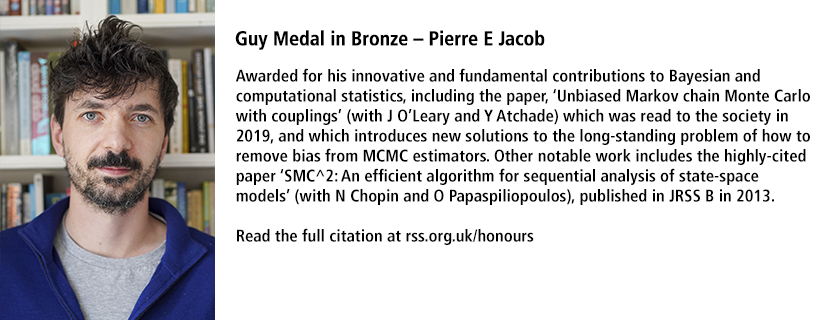
congrats, Pierre!!!

Posted in Statistics with tags , , , , , , , , , on March 3, 2021 by xi'an