
Strolling through the Oregon Conference Centre on 5 Aug, I am as always amazed at how the JSM conference centres have the ability to swallow in thousands of participants without giving an impression of overcrowding! (And appreciating the moderate air conditioning, which for once does not require wearing a fleece indoors!), I must admit that my first impressions of the city itself have been rather poor, as I was (unsuccessfully) seeking an after-hour grocery near the conference centre, I walked through run-down areas and kept passing homeless people, most in a sorry state. And hearing throughout the night, And again this morning in the warehouse maze I jogged through before hitting the Willamette River path, which goes uninterrupted for miles. And showed me an unexpected spot, the Kevin Duckworth dock, where swimming the Willamette is feasible. Hopefully attempting a morn swim before I leave Portland.

I attended the quantum computing session, with a rather light introduction without bringing much light on the nature of qubits for storage and computing. In particular, the role of the complex coefficients of the 0 and 1 states. Then my friend Brani Vidakovic gave us an hand-on demonstration (almost hand-on as the conference facilities were unable to let a code run live!, eons away from quantum performances!!). Using Qiskit and Anaconda. He pointed out that measuring a qubit is destroying its quantum nature, the very equivalent of Schrôdinger’s cat. But does not make it clear whether or not the qubit later returns to a random entity, since frequency stabilisation is assumed, witness the histograms displayed by Brani. or a Nature paper of last year.
Went to a (poorly attended) privacy panel session next. With a defence of the value of differential privacy (Jordan Awan, Purdue) somewhat connected with our own (Ocean) work, although utility not understood in a decision-theoretic sense. And privacy remaining in an one-suits-all sense. With Michael Hawes from the US Census Bureau introducing more dimensions than mere DP (coarsening, suppression, swapping, &tc.), with legal aspects (Title 13) of disclosure risk. With the positive (for me) notion of providing a meaningful assessment of disclosure, with some records being more vulnerable than others. And another one on the cumulative disclosure risk over time. If short in quantitative entries. With Valbona Bejleri (USDA NASS, with a Census of their own) on cell suppressions and metrics for assessing disclosure, eg Shannon’s information entropy. And with Gary Howarth (Privacy Engineering Program, NIST). whose point remained rather unclear to me, like the apparently obvious point that adding features increase dispersion between populations. Although presenting tools for convincing experts and actors of the efficiency of privacy protection techniques.
Which continued (sort of) on the afternoon with a synthetic data for preserving privacy panel session. With Bradley Malin (Vanderbilt U) on the dangers of (Nature Communication paper of 2022). And Harrison Quick using a posterior predictive to achieve differential privacy, albeit considering the posterior predictive as the statistical analysis outcome does not seem the right focus (and recoup my earlier criticism of differential privacy requiring bending one’s prior beliefs). Indeed, as a Bayesian aiming at inference rather than merely at not releasing raw data, I would use synthetic data generated from that posterior predictive to return a posterior on the parameters of interest. And Joshua Snoke (RAND) with cautionary warnings. Like producing “invalid” inference because the reliance on a specific model (but isn’t that the case for most of statistics?). And Roee Gutman (Brown U), discussing the special case of record linkage. More into the difficulties in creating synthetic data. (Like the issue with missingness.) Somehow disappointing in not reaching a more statistical and quantitative perspective, eg by sticking to a Bayesian perspective the whole way.
On a non-technical side, I am surprised at hardly anyone adopting the bring-your-own-container policy in the OCC cafés, or outside, given the large number of attendees carrying one or several liquid containers.
 While we did not try to attend any of the Paris 2024 Olympics events, primarily for being in the Pacific Northwest during the Olympics (in not in Olympic National Park!), being back in Paris and tickets being widely available and looking forward attending an event in the Grand Palais, we found tickets for the taekwondo K44 finals, in the light(er than me) categories. With no prior exposure to taekwondo.
 The location was fabulous, indeed, with a full stadium built inside and surprisingly good views from the back seats. (And too much air conditioning!) The rounds were also most interesting, with a wide range of fighting styles, if not always exciting as some ended up with very few points and a lot of referees’ paste&cuts of glued opponents. As in fencing, it was also difficult to understand why some punches scored and others did not. Two games ended up with the judges’ ruling, one rather clearly picking the dominant fighter (but with the looser refusing to shake hands with the winner!), and the other much less so. The only remaining French athlete was badly injured and got eliminated in the first round.
 Another great moment was the bronze medal of Zakia Khudadadi, part of the Refugee Paralympics Team, who is an Afghan athlete evacuated to France when the Taliban took power in 2021. She had already competed at the Tokyo 2020 Olympics, a week after her escape from Hell. (Her coach seen carrying her on the picture is Rio 2016 silver medallist Haby Niare from France.) She joins female boxer Cindy Ngamba who won the first-ever medal for the Olympic Refugee Team a few weeks earlier.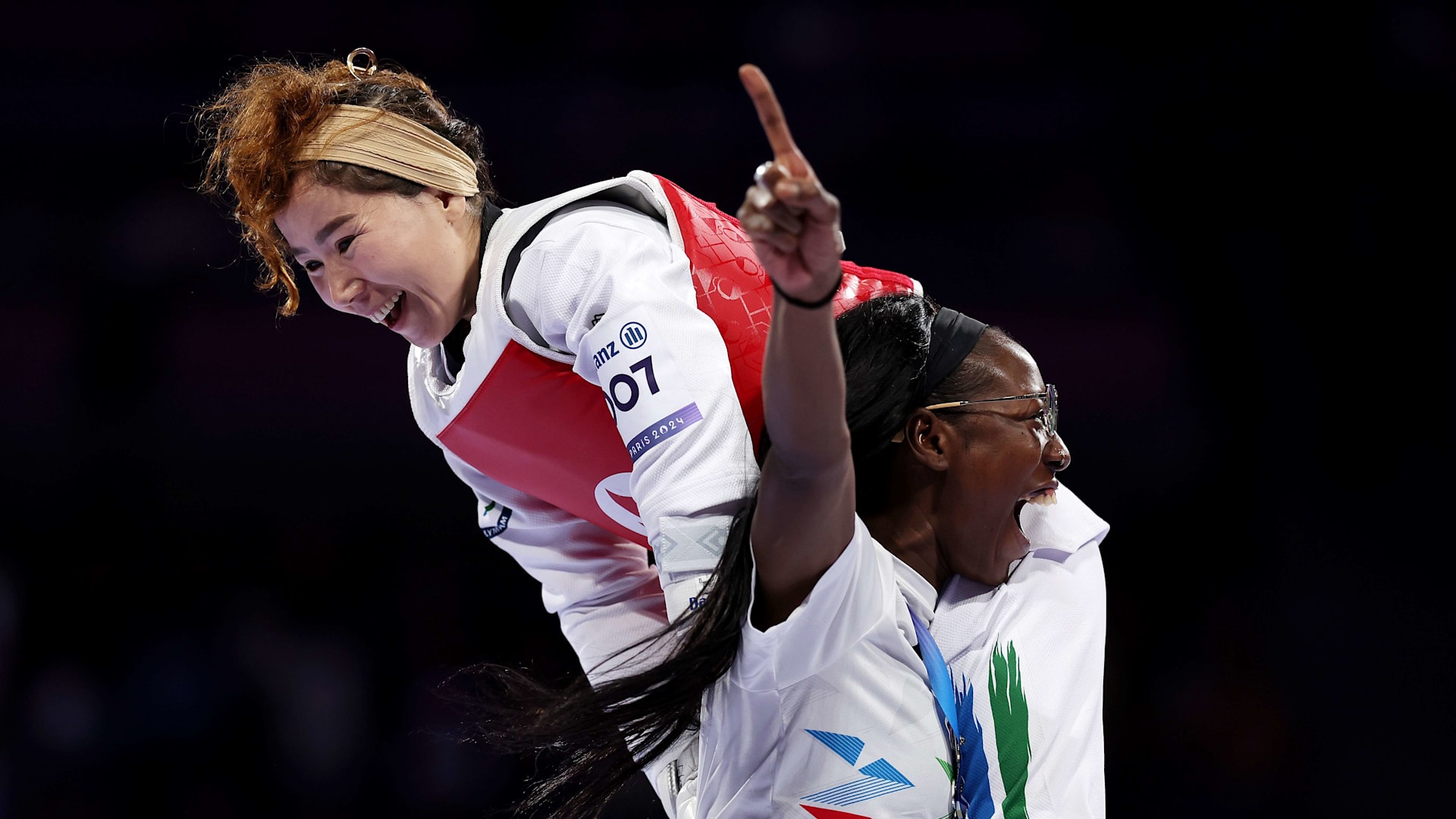
 The medal ceremony was somewhat low key (esp. from the back seats) but I discovered there taekwondo rules produce two bronze medals, one coming from repêchages. And heard the Peruvian anthem for the first time, thanks to the victory of (Tokyo gold medallist) Leonor Angelica Espinoza Carranza. All in all, this was a great afternoon at the Paralympics, with an unexpectedly efficient organisation, no queues!, cheerful volunteers all over and rather laid-back police officers (in large numbers).


