
Archive for population genetics
admixtures [xkcd]
Posted in Books, Kids, University life with tags admixture, most recent common ancestor, population genetics, webcomic, xkcd on July 28, 2026 by xi'an
The Norse Code
Posted in Books, pictures, University life with tags admixture, ancestry, Celtic myths, coalescent, cover, DNA helix, European populations, genomic history, medieval Europe, Nature, population genetics, Scandinavia, Scandinavian ancestry, simulation, The Norse Farce, Twigstats, vikings on February 3, 2025 by xi'an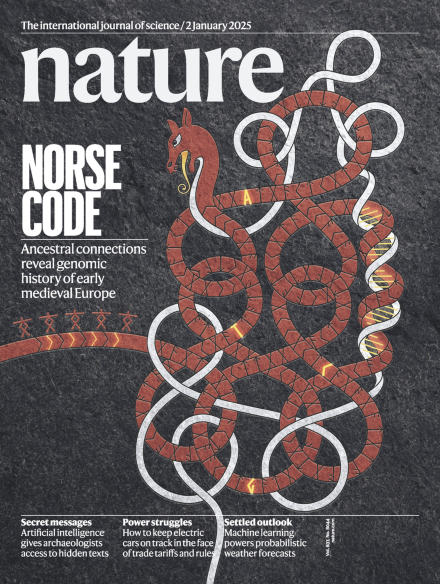
early peer review
Posted in Books, Statistics, University life with tags Alan Turing, Bayesians, Charles Darwin, eulogy, Francis Galton, geophysics, Harold Jeffreys, history of statistics, John Burdon Sanderson Haldane, Nature, Philosophical Transactions of the Royal Society, population genetics, refereeing, Royal Society on December 15, 2024 by xi'an
“For a 1950 paper that discussed ‘anisotropic elastic continuum’ by mathematician James Oldroyd, geophysicist Harold Jeffreys wrote: `Knowing the author, I have confidence that the analysis is correct.’”
(albeit identified as a geophysicist) and Haldane
“A negative review [of Alan Turing’s 1951 paper] by scientist J.B.S. Haldane states: `I consider that the whole non-mathematical part should be re-written.’ A more positive opinion came from physicist Charles Galton Darwin, who said: `This paper is well worth printing, because it will convey to the biologist the possibilities of mathematical morphology.’ Still, Darwin criticized the proposed use of a “digital computer” to simulate wave theory. “The machinery is far too heavy for such a simple purpose,” Darwin argued.”
and Haldane again
“In a 1943 review by Haldane of a paper on the fecundity of Drosophila flies, the reviewer suggested cutting figures and tables, some of the discussion and, bizarrely, a short eulogy of a fly biologist.”
a journal of the plaid [shirt] year [#2]
Posted in Books, Kids, Mountains, pictures, Running, Travel, University life with tags abortion, Biometrika, black bear, book review, books, cheesemonger, COVID-19, Daniel Defoe, Darwin, Deet, homecooking, ISBA 2022, Japan, Journal of the Plague Year, Kawabata, Kouign-Aman, Kouign-Amann, Lac-Saint-Jean, Montréal, pandemics, Parc National de la Mauricie, population genetics, Québec, rental bike, sunrise, universal basic income on August 3, 2022 by xi'an Read Kawabata’s Sound of the Mountain, which I also found in a Montréal bookstore. At first, I thought it was connected to the masterpiece House of Sleeping Beauties, which I read eons ago, as dreams are also central to that (mostly) domestic and familial story, but this was quite another, more personal, and poignant reflection on aging and the irreversibility of time. As well as an unsuspected window into immediate post-war Japan. (With the realisation that abortion was completely acceptable then.) Also spotted Greg Bear’s Darwin’s Children in my Canadian cabin, which I started and finished later with a Kindle version. As I was unaware of a sequel to the fabulous Darwin’s Radio. Overall, I was almost as enthusiastic about it as I was with the first book, but obviously suffering from an academic bias as the author engages into speculative population genetics, which may prove too much for non-academics… (Imho, the end is wasted, though.) And (binge) read January Fifteenth on the flight back (leaving too early to sleep!), which is a short novel whose only speculative aspect is the move (by the US Government) to a universal basic income (UBI) for all individuals, and the consequences on several women’s live. This was indeed a very quick read, presumably due to the high proportion of dialogues, with (variably) interesting characters that avoid a direct take on the concept, but somewhat charicaturesque nonetheless. The implementation of the scheme is rather vaguely described: January 15 is the calendar day people pick their yearly UBI and they have to do it in person to avoid been coerced or scammed into transferring it to someone else. As someone rather interested in this societal propsal, this book did not modify my views on the concept or on its practical aspects, but shed light on some potential consequences of (one version of) it.
 Had a great time in a Lac-Saint-Jean cabin, with direct access to the lake. Albeit requiring the emergency purchase of a neoprene swimming suit, as the temperature of the lake was rather low for extended swimming without it. But otherwise, having a swell time every morning, often running and swimming and biking. Before hiking. (The last week, farther south, next to a much smaller lake I could easily cross, did not require the suit!) Also appreciated very much the almost flat véliroute des Bleuets (blueberries) that run all around the lake (even though some sections are alas shared with cars). Has for instance an uninterrupted 15K connection to the nearest (genuine) bakery+cheese-mongery!
  Made an attempt at kouign amann, but using the wrong type of both flour and cassonade, plus an unknown oven and the poor substitute of baking soda for yeast predictably failed the experiment, even though the outcome was eatable (and eaten within a few days).
 As usual (!), did not spot much wildlife, beyond groundhogs, pikas, squirrels, beavers and muskrats in our rental’s lake, moose tracks here and there, and a few Virginia deer in the Mauricie National Park. (Which made me realise that national and regional [Québec] parks co-existed in the area.) Had a few traditional hikes, reconnecting with Deet to keep mosquitoes and black flies at bay.
Watched nothing at all! In part due to my wife often borrowing my laptop for its Netflix connection, in part due to my early sleep caused by earlier rise, as light comes before 5am in this part of Québec we were staying, which made an ideal opportunity for very early run, swim, and… Biometrika editing!
Naturally amazed at non-identifiability
Posted in Books, Statistics, University life with tags Akaike's criterion, birth-and-death process, extant timetrees, identifiability, missing species problem, Nature, Ockham's razor, phylogeny, PNAS, population genetics, speciation rate, Steve Fienberg on May 27, 2020 by xi'an A Nature paper by Stilianos Louca and Matthew W. Pennell, Extant time trees are consistent with a myriad of diversification histories, comes to the extraordinary conclusion that birth-&-death evolutionary models cannot distinguish between several scenarios given the available data! Namely, stem ages and daughter lineage ages cannot identify the speciation rate function λ(.), the extinction rate function μ(.) and the sampling fraction ρ inherently defining the deterministic ODE leading to the number of species predicted at any point τ in time, N(τ). The Nature paper does not seem to make a point beyond the obvious and I am rather perplexed at why it got published [and even highlighted]. A while ago, under the leadership of Steve, PNAS decided to include statistician reviewers for papers relying on statistical arguments. It could time for Nature to move there as well.
“We thus conclude that two birth-death models are congruent if and only if they have the same rp and the same λp at some time point in the present or past.” [S.1.1, p.4]
Or, stated otherwise, that a tree structured dataset made of branch lengths are not enough to identify two functions that parameterise the model. The likelihood looks like

where E(.) is the probability to survive to the present and ψ(s,t) the probability to survive and be sampled between times s and t. Sort of. Both functions depending on functions λ(.) and μ(.). (When the stem age is unknown, the likelihood changes a wee bit, but with no changes in the qualitative conclusions. Another way to write this likelihood is in term of the speciation rate λp

where Λp is the integrated rate, but which shares the same characteristic of being unable to identify the functions λ(.) and μ(.). While this sounds quite obvious the paper (or rather the supplementary material) goes into fairly extensive mode, including “abstract” algebra to define congruence.
“…we explain why model selection methods based on parsimony or “Occam’s razor”, such as the Akaike Information Criterion and the Bayesian Information Criterion that penalize excessive parameters, generally cannot resolve the identifiability issue…” [S.2, p15]
As illustrated by the above quote, the supplementary material also includes a section about statistical model selections techniques failing to capture the issue, section that seems superfluous or even absurd once the fact that the likelihood is constant across a congruence class has been stated.


