Archive for image generator

Nature tidbits [28 Aug 25]

Posted in Books, Kids, pictures, Travel, University life with tags , , , , , , , , , , , , , , , , , , , , , , , , on September 24, 2025 by xi'an

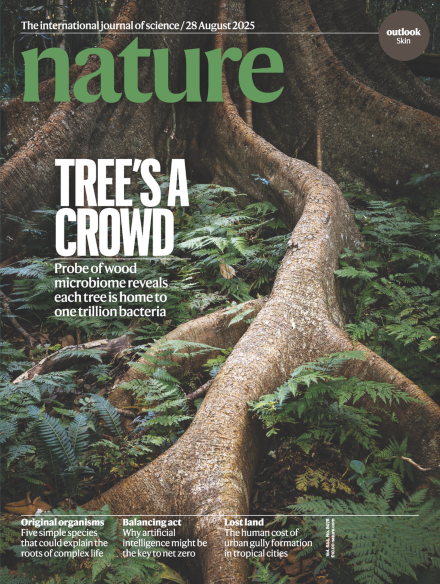
A nice cover (and a used pun) on the cover of this issue of Nature. That (reminded of trees from the Guadeloupean rainforest and) which refers to the rich microbiomes found in trees, with a partition between sapwood and heartwood. Along

  • an editorial call for “hazardous” research, namely the relevance of studies on urban gullies that endanger surrounding populations and have unpredictable dynamics, albeit scientists alone cannot provide solutions.
  • a Columbian study on how the microbial communities acting during the fermentation of cocoa and could be controlled towards finer chocolat).
  • the alas now usual articles on the impacts of Trump.2.0 on science and academia, with US Minister of Health Kennedy launching a call for finding the environmental cause of autism. When most researchers blame primarily genetics and associate the rise in cases with a rise in detection and awareness. And pointed out at the earlier drop in NIH funds for autism research, the overall balance being negative.
  • plus a useful debunking of five quantum theory myths! Along with the story of a 2020 Science paper by Vaitiekėnas et al. on Majoranas that raised enough questions for Science to publish an expression of concern, now lifted after the publication of a long correction.
  • (a video of) rappelling robots diving into a lava tube!!
  • a Verne-esque proposal to create a lunar biodepository, a (dubious imho) mix between Noah’s Ark and the (unscientific) faith in cryogeny
  • a more sobering call for more frequent data inputs (forcing datasets) to calibrate climate models, with no mention made of statistics or machine learning…
  • an operative “mind-reading” device… with a protection password (and a 74% efficiency)!
  • two research articles on AI unification of cognitive theories.
  • Another one on the (revolutionary) construction of an optical encoder-decoder network towards generating images.
Nature tidbits

Posted in Books, Kids, Statistics, Travel, University life with tags , , , , , , , , , , , , , , , , , , , , , , , , , , , , , , , , , on June 10, 2024 by xi'an

I was quite glad to have taken this 28 March issue of Nature for the train ride to Marseille earlier this month, as it proved full of great entries. Starting with a tribune from a PhD candidate from Ghana unable to speak at a tropical ecology conference in Lisbon for being denied a Schengen visa by the Dutch embassy in Accra, despite providing a serious amount of supporting material. This is a general issue related to international conferences that I plan to include in my presentation in a round table about the future of conference at the ISBA 2024 conference next month. Researchers and students from low-income countries are regularly victims of arbitrary rejections by consular and embassy officers, with little leeway from inviting universities and academic societies for counteracting such arbitrariness. An example came last year when, as part of our Data Science for Social Good program at Warwick, one computer student from Pakistan got denied a visa, while another one with an almost identical profile did receive her visa.

In News in focus, the development of a revolutionary (CAR-T) cancer therapy by  a Munbai company at 1/10 the cost of similar products in the US, with several impressive innovations (and a clinical trial over 33 people). The coverage of Michel Talagrand’s 2024 Abel prize, the deteriorating state of scientific research in Russia, a review on how the Big Bang got its name (hint: it was on BBC 3), and remembering India’s Chipko tree-hugging women of Western Himalayas of 50 years ago. The development of signs for scientific terms to add to the Indian and American sign languages.

There is also an almost sleuthing story on the debates in the ecology community about the theory of “Mother Tree”, introduced by Suzanne Simard, about trees communicating among themselves by underground fungal networks, and thus creating a “wood wide web“.  With mature trees favouring their own kin, a theory that critics in the field deem incompatible with evolutionary theory and more crucially missing supporting evidence. (Arguments from Simard that “the European male society hates the mother tree” concept do not help towards a rational denate. The Guardian now has a podcast about this debate.)

And another story on the (racial and gender) bias of AI image generators. With the conclusion that removing such biases goes through open sourcing. And regulation like the EU’s AI Act. that requires technical documentation on the training datasets. Plus a retrospective on the theory of bird-flight origins, with John Ostrom proposing in 1974 that the evolution to flight was ground-up rather than tree-down.

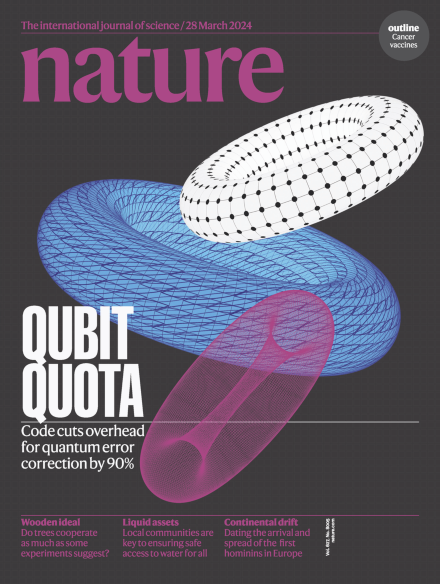
A cover-paper on IBM error correcting code for quantum computing that only requires each qubit to connect with six others (just like birds in murmuration only keep track of seven neighbours) for an error threshold less than 1%. (With the property that 12 logical qubits can be preserved for 10⁶ cyclces using 288 qubits in total.)