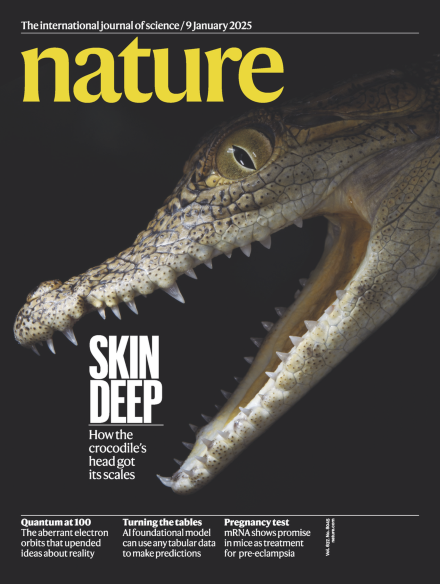
– yet another 100th anniversary!, namely the founding paper of Heisenberg’s quantum mechanics paper in Zeitschrift für Physik, written on the Instagrammable island of Heligoland. With celebrations at the UNESCO in Paris, Anaheim (CA), Kumasi (Ghana), and Salvador de Bahia (Brazil)!;
– some bird species decorating their nest with shed snakeskins, to frighten predators;
– climate predictions for Trump 2.0, albeit the only certainty being it will get worse and worse (and only the beginning of a flow of articles on the Trumpian attacks on science and scientists);
– the curious plight of the open access journal elife loosing its impact factor after getting too open for Clarivate and then seeing submission from China falter;
– the first European cities from 6000 years ago being found in Ukraine (and Romania) within the Cucuteni-Trypillia culture, with apparently an equalitarian structure with no temple or elite, although the lack of written documents (besides beautiful clay figures whose style evolved over the period);
- an AI tool that interprets spreadsheets (which I would find most useful, given my distaste of said spreadsheets!);
and how to help lab workers facing substance disorders. And break
Also
– a quick report on a Physics Review Letters paper about simulating elections results to spot whether or not margins of victory were properly distributed, having a distribution (for the scaled margins) mostly depending on voter turnout, with a universal shape! The concept behind this analysis is one of universality borrowed from statistical physics. (The fit does not work for the Ethiopian election of 2010 and the Belarus elections during 2004–2019, no wonder!);
- an awakening that the huge majority of bacteria that have never been studied, or at least figured in a published paper;
-
yet again another paper about testing AI for human-level intelligence, plus another one on handling AI hallucinations in LLM;
– another book review of David Spiegelhalter’s Art of Uncertainty, by Yongyi Min, a statistician from the UN Statistics Division;
- the obituary of Jimmy Carter, a nuclear physics engineer who fought (for peace, human rights and) for the eradication of the Guinea worm disease, which could possibly happen anytime soon, with 13 human cases reported in 2024 (provisional) and 14 in 2023 (unless the Agent Orange cut enough funding to impact this as well), following a book review of You must stand up, by Amanda Becker, covering fighting for abortion rights across US regions;
creating a DNA base for identifying children kidnapped during a conflict, as for the 20,000 Ukrainian children forcibly deported to Russia over the past three years;
a substantial survey article on neuromorphic computing (submitted in 2023!), about new forms of computing based on hardware/software co-design;
with more technologies to watch in 2025, and another long article (and the cover) on the strong impact of small-scale fisheries on sustainable development.


