Archive for Bayesian asymptotics

deep Bayes factor

Posted in Books, pictures, Statistics, University life with tags , , , , , , , , , , , , , , , , on August 8, 2024 by xi'an

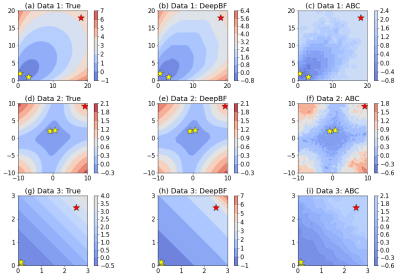
A recently arXived paper proposes an alternative approach to computing Bayes factors via deep learning, Deep Bayes Factors written by Jungeum Kim (presenting her work at JSM this very morning) and Veronika Ročková (whom I have known from her PhD years and whose COPSS Award we very gladly celebrated yesterday!). Which is obviously of interest to me, given my repeated visits to the challenge.

“we introduce Deep Bayes Factor (DeepBF), a neural classifier trained on simulated datasets to learn a mapping whose functional constitutes a Bayes factor estimator.”

Their approach is directly connected with various classification approaches to ABF, incl. the mythical inverse logistic version of Geyer (1994) and noise contrastive estimation of Gutmann and Hyvärinen (2010) (as well as our forested version). Which is called the likelihood-ratio trick here.

“Viewing the Bayes factor through the lens of binary classification aligns with Pudlo et al. (2016), who recast ABC model selection as a classification problem. They employ random forests to select a model by a majority vote. Instead, we focus on binary classification where the purpose is to learn marginal likelihood ratios.  Contrary to the method in Pudlo et al. (2016), our strategy circumvents a secondary learning phase for gauging model posterior estimates, delivering results in only one stage.”

The authors‘ solution stands with learning a classifier from simulated data from both models (and a basic log ratio utility), along iterations updating D from the gradient of the utility, the associated Bayes factor being the ratio D/(1-D) derived from the estimated classifier. There is a cost in producing new samples from the (same) predictives at each iteration (and I wonder if some recycling would be helpful, as well as reducing the sample size for the simpler model). In one of the remarks, the authors point out that “in the effort to see the best ABC performance, we intentionally use the full data Y as a summary statistic”, a remark that I find surprising given the overall consensus that the Bayes factor itself [when based on the full data] is close to optimal.

The method is overall consistent (in the data size n) under classical Bayesian asymptotics, sometimes even when the Bayes factor estimator is inconsistent, naturally expands to pseudo Bayes factors like intrinsic and fractional Bayes factors, also mileage varies in terms of numerical stability.

In the Bayesian model criticism section, the notion of opposing the actual dataset to a simulated one relates very much to Geyer’s (1994) solution. As well as to GANs, as noted in the paper. I did not look closely at the numerical comparisons in the experimental section, but they sound rich enough.

Masterclass in Bayesian Asymptotics, Université Paris Dauphine, 18-22 March 2024

Posted in Books, pictures, Statistics, Travel, University life with tags , , , , , , , , , , , , , , , , , , , , on December 8, 2023 by xi'an

On the week of 18-22 March 2024, Judith Rousseau (Paris Dauphine & Oxford) will teach a Masterclass on Bayesian asymptotics. The masterclass takes place in Paris (on the PariSanté Campus) and consists of morning lectures and afternoon labs. Attendance is free with compulsory registration before 11 March (since the building is not accessible without prior registration).

The plan of the course is as follows

Part I: Parametric models
In this part, well- and mis-specified models will be considered.
– Asymptotic posterior distribution: asymptotic normality of the posterior,  penalization induced by the prior and the Bernstein von – Mises theorem. Regular and nonregular models will be treated.
– marginal likelihood and consistency of Bayes factors/model selection approaches.
– Empirical Bayes methods: asymptotic posterior distribution for parametric empirical Bayes methods.

Part II: Nonparametric and semiparametric models
– Posterior consistency and posterior convergence rates: statistical loss functions using the theory initiated by L. Schwartz and developed by Ghosal and Van der Vaart, results on less standard or well behaved losses.
– semiparametric Bernstein von Mises theorems.
– nonparametric Bernstein von Mises theorems and Uncertainty quantification.
– Stepping away from pure Bayes approaches: generalized Bayes, one step posteriors and cut posteriors.

2023 Workshop in honour of Professors Donald Poskitt and Gael Martin

Posted in Statistics, University life with tags , , , , , , , , , , , , on November 29, 2023 by xi'an

the mysterious disappearance of the Leiden statistics group

Posted in Books, pictures, Statistics, University life with tags , , , , , , , on July 14, 2021 by xi'an

I was forwarded an article from Mare, the journal of the University of Leiden (Universiteit Leiden), a weekly newspaper written by an independent team of professional journalists. Entitled “Fraude, verdwenen evaluaties en een verziekt klimaat: hoe de beste statistiekgroep van Nederland uiteenviel” (Fraud, lost evaluations and a sickening climate: how the best statistics group in the Netherlands fell apart), it tells (through Google translate) the appalling story of how an investigation on mishandled student course evaluations led to the disintegration of the World-renowned Leiden statistics group,  with the departure of a large fraction of its members, including its head, Aad van der Vaart, a giant in mathematical statistics, author of deep, reference, books like Asymptotic Statistics and  Fundamentals of Nonparametric Bayesian Inference, an ERC advanced grant recipient, and now professor at TU Delft… While I am not at all acquainted with the specifics, reading the article makes the chain of events sound like chaos propagation, when the suspicious disappearance of student evaluation forms about a statistics course leads to a re-evaluation round, itself put under scrutiny by the University, then to a recruitment freeze of prospective statistician appointments by the (pure math) successor of Aad, as well as increasing harassment of the statisticians in the  Mathematisch Instituut, and eventually to the exile of most of them. Wat een verspilling!

mathematical theory of Bayesian statistics [book review]

Posted in Books, Statistics, Travel, University life with tags , , , , , , , , , , on May 6, 2021 by xi'an

I came by chance (and not by CHANCE) upon this 2018 CRC Press book by Sumio Watanabe and ordered it myself to gather which material it really covered. As the back-cover blurb was not particularly clear and the title sounded quite general. After reading it, I found out that this is a mathematical treatise on some aspects of Bayesian information criteria, in particular on the Widely Applicable Information Criterion (WAIC) that was introduced by the author in 2010. The result is a rather technical and highly focussed book with little motivation or intuition surrounding the mathematical results, which may make the reading arduous for readers. Some background on mathematical statistics and Bayesian inference is clearly preferable and the book cannot be used as a textbook for most audiences, as opposed to eg An Introduction to Bayesian Analysis by J.K. Ghosh et al. or even more to Principles of Uncertainty by J. Kadane. In connection with this remark the exercises found in the book are closer to the delivery of additional material than to textbook-style exercises.

“posterior distributions are often far from any normal distribution, showing that Bayesian estimation gives the more accurate inference than other estimation methods.”

The overall setting is one where both the sampling and the prior distributions are different from respective “true” distributions. Requiring a tool to assess the discrepancy when utilising a specific pair of such distributions. Especially when the posterior distribution cannot be approximated by a Normal distribution. (Lindley’s paradox makes an interesting incognito incursion on p.238.) The WAIC is supported for the determination of the “true” model, in opposition to AIC and DIC, incl. on a mixture example that reminded me of our eight versions of DIC paper. In the “Basic Bayesian Theory” chapter (§3), the “basic theorem of Bayesian statistics” (p.85) states that the various losses related with WAIC can be expressed as second-order Taylor expansions of some cumulant generating functions, with order o(n⁻¹), “even if the posterior distribution cannot be approximated by any normal distribution” (p.87). With the intuition that

“if a log density ratio function has a relatively finite variance then the generalization loss, the cross validation loss, the training loss and WAIC have the same asymptotic behaviors.”

Obviously, these “basic” aspects should come as a surprise to a fair percentage of Bayesians (in the sense of not being particularly basic). Myself included. Chapter 4 exposes why, for regular models, the posterior distribution accumulates in an ε neighbourhood of the optimal parameter at a speed O(n2/5). With the normalised partition function being of order n-d/2 in the neighbourhood and exponentially negligible outside. A consequence of this regular asymptotic theory is that all above losses are asymptotically equivalent to the negative log likelihood plus similar order n⁻¹ terms that can be ordered. Chapters 5 and 6 deal with “standard” [the likelihood ratio is a multi-index power of the parameter ω] and general posterior distributions that can be written as mixtures of standard distributions,  with expressions of the above losses in terms of new universal constants. Again, a rather remote concern of mine. The book also includes a chapter (§7) on MCMC, with a rather involved proof that a Metropolis algorithm satisfies detailed balance (p.210). The Gibbs sampling section contains an extensive example on a two-dimensional two-component unit-variance Normal mixture, with an unusual perspective on the posterior, which is considered as “singular” when the true means are close. (Label switching or the absence thereof is not mentioned.) In terms of approximating the normalising constant (or free energy), the only method discussed there is path sampling, with a cryptic remark about harmonic mean estimators (not identified as such). In a final knapsack chapter (§9),  Bayes factors (confusedly denoted as L(x)) are shown to be most powerful tests in a Bayesian sense when comparing hypotheses without prior weights on said hypotheses, while posterior probability ratios are the natural statistics for comparing models with prior weights on said models. (With Lindley’s paradox making another appearance, still incognito!) And a  notion of phase transition for hyperparameters is introduced, with the meaning of a radical change of behaviour at a critical value of said hyperparameter. For instance, for a simple normal- mixture outlier model, the critical value of the Beta hyperparameter is α=2. Which is a wee bit of a surprise when considering Rousseau and Mengersen (2011) since their bound for consistency was α=d/2.

In conclusion, this is quite an original perspective on Bayesian models, covering the somewhat unusual (and potentially controversial) issue of misspecified priors and centered on the use of information criteria. I find the book could have benefited from further editing as I noticed many typos and somewhat unusual sentences (at least unusual to me).

[Disclaimer about potential self-plagiarism: this post or an edited version should eventually appear in my Books Review section in CHANCE.]