Archive for Banff National Park

Nature tidbits [and garbage out]

Posted in Books, Kids, Mountains, pictures, Travel, University life with tags , , , , , , , , , , , , , , , , , , , , , , , , , on October 25, 2024 by xi'an

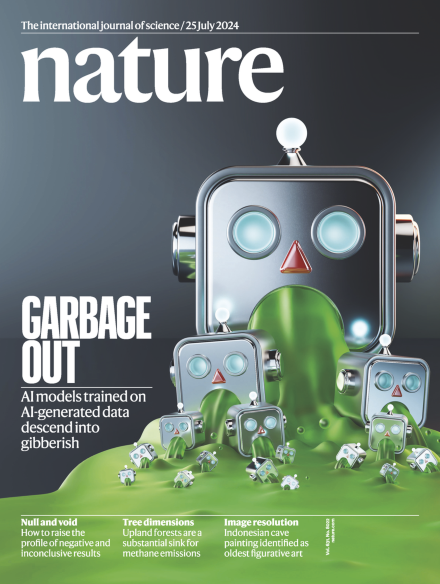
Many bits of interest in the 25 July issue of Nature that stayed under a pile of journals for PNW reasons! Even though the cover is rather off-putting…

  • A call by the editors (and computer scientist Cal Newport) for scientists to “stop, drop, and think” (and the paperback version of Newport’s Slow Productivity has a nice cover that looks very much like Moraine Lake in Banff National Parc!)
  • Another call by a Science Po’ sociologist to the (then highly prospective) French government to increase research budget for French universities, which is not particularly original since this is a constant line on all unions’ desiderata, except for the argument that it would make a tuition fees increase more palatable, and to leave more freedom to researchers, with the oft-used argument that “fundamental research may have unexpected implications”. Except that a massive public deficit is going to impose budget squeezes in all spending lines of the Barnier government.
  • Worries of Indian and non-Indian demographers about the continued postponement of India’s national census, with the latest one dating from 2011. With strong repercussions on public policies, especially since the administrative data systems are rarely reliable. The article suggests that more than an estimated 100 million inhabitants are excluded from food subsidies as a consequence. This seems like an opportunity to develop open source alternatives that run the census from indirect observations, bypassing the reluctance of the Modi Government to launch the much delayed census. (Which could have been coupled with the electoral process earlier this year.)
  • An insight on four female “PhD influencers” from the Universities of Pennsylvania, Exeter, Hertfordshire, and Hong Kong (CUHK). Which has a plus side of exposing the life and interests of a PhD student. And a downside of being a social media product, with the many biases that come along posting to the general public.
  • A call for publishing more papers about negative results! Supporting (pre)registration of experiments.
  • A positive book review of The MANIAC of Benjamin Labatut around John von Neumann’s life, analysed by Karl Sigmund
  • A four-page long comment on the importance of preserving scientific US-China relations, despite the growing suspicion in the US that any scientific collaboration with Chinese institutions will benefit Chinese (State) interests. Without falling for a naive approach to such collaborations, and acknowledging the porous boundaries between fundamental and military research, one should acknowledge the great leap forward accomplished by Chinese universities in the past decade that set their researchers at the forefront of science in many fields.
  • A paper related with the cover on model collapse in AIs learning from AI-generated data. Just like MCMC learning a proposal from earlier simulations. A natural consequence of over-fitting.
  • Another paper on the phase (or quantum) transition of the two-dimensional Ising spin glass (model).
  • and the article on predatory conferences I already discussed in August.

a journal of the year of fires

Posted in Books, Kids, Mountains, pictures, Statistics, Travel, University life with tags , , , , , , , , , , , , , , , , , , , , on September 1, 2023 by xi'an

Indeed, the year of the mega-fires in West and East Canada, with Kelowna (and UBC Okanagan where BIRS 23w5106 took place) severely hit. Travelling through BC by car and plane, we saw several wildfire fume clouds, incl. a massive one from the Yellowknife region…

Read a few dozen pages of Gene Wolfe’s The Knight, in the fabulous Bacchus Books and Café of Golden, BC. Despite the positive vibes of the place, I could not engage with the story or the style, which I found quite disappointing given the earlier achievements of the author. There is of course the attempt at recreating an Arthurian tale, with its lack of temporal and logical coherence, but this fails short, in part because the narrator keeps jumping from a pre-teen to a much wiser adult and back. I thus replaced it within the shelf where I had found it, hopefully with no stain from the scone I enjoyed in the same place. A clear advantage of cafés within bookstores (the replacement, not the scone stains!) Also read Angel Six Echo by Robert Appleton, a short sci’fi’ story of the (very) military type, a mix of Warhammer 40k, Scalzi’s Old Man’s War series, Ender’s Game, and a few other space trooper novels. Pleasantly light as I was trying to read a few pages before fazing out after a day of intense activity! Realised as well that Home: Habitat, Range, Niche, Territory was a very very short [almost as short as its long title!] story within the Murderbot Diaries, and not particularly interesting. Still waiting eagerly for the incoming (#8) System Collapse, a genuine novel.

Hiked inside and outside Yoho National Park (Emerald Lake, Mt. Hunter, Mt. Field), with varying success at avoiding the maddening crowd. And the drone of the highway below. Even 900m below. No wildlife encounter apart from the frequent mule deer, the few bighorns lost on Trans Canadian #1,  and the lightning fast chipmunks (except when they come begging for food). Despite bear warnings all around. Most days were above the healthy air quality limits, due to the numerous wildfires in the North-East BC, even though I did not feel any change when running or hiking. Made a night stop in Canmore to catch an early flight in Calgary, the place has gone surprisingly upscale from my earlier visits there!


classic postcard [jatp]

Posted in Statistics with tags , , , , , , , , , on August 13, 2023 by xi'an

Measuring abundance [book review]

Posted in Books, Statistics with tags , , , , , , , , , , , , on January 27, 2022 by xi'an

This 2020 book, Measuring Abundance:  Methods for the Estimation of Population Size and Species Richness was written by Graham Upton, retired professor of applied statistics, for the Data in the Wild series published by Pelagic Publishing, a publishing company based in Exeter.

“Measuring the abundance of individuals and the diversity of species are core components of most ecological research projects and conservation monitoring. This book brings together in one place, for the first time, the methods used to estimate the abundance of individuals in nature.”

Its purpose is to provide a collection of statistical methods for measuring animal abundance or lack thereof. There are four parts: a primer on statistical methods, going no further than maximum likelihood estimation and bootstrap. The term Bayesian only occurs once, in connection with the (a-Bayesian) BIC. (I first spotted a second entry, until I realised this was not a typo and the example truly was about Bawean warty pigs!) The second part is about stationary (or static) individuals, such as trees, and it mostly exposes different recognised ways of sampling, with a focus on minimising the surveyor’s effort. Examples include forestry sampling (with a chainsaw method!) and underwater sampling. There is very little statistics involved in this part apart from the rare appearance of a MLE with an asymptotic confidence interval. There is also very little about misspecified models, except for the occasional warning that the estimates may prove completely wrong. The third part is about mobile individuals, with capture-recapture methods receiving the lion’s share (!). No lion was actually involved in the studies used as examples (but there were grizzly bears from Yellowstone and Banff National Parks). Given the huge variety of capture-recapture models, very little input is found within the book as the practical aspects are delegated to R software like the RMark and mra packages. Very little is written on using covariates or spatial features in such models, mostly dedicated to printed output from R packages with AIC as the sole standard for comparing models. I did not know of distance methods (Chapter 8), which are less invasive counting methods. They however seem to rely on a particular model of missing on individuals as the distance increases. The last section is about estimating the number of species. With again a model assumption that may prove wrong. With the inclusion of diversity measures,

The contents of the book are really down to earth and intended for field data gatherers. For instance, “drive slowly and steadily at 20 mph with headlights and hazard lights on ” (p.91) or “Before starting to record, allow fish time to acclimatize to the presence of divers” (p.91). It is unclear to me how useful the book would prove to be for general statisticians, apart from revealing the huge diversity of methods actually employed in the field. To either build upon these or expose students to their reassessment. More advanced books are McCrea and Morgan (2014), Buckland et al. (2016) and the most recent Seber and Schofield (2019).

[Disclaimer about potential self-plagiarism: this post or an edited version will eventually appear in my Book Review section in CHANCE.]

the curious incident of the goose in the picture [17w5036]

Posted in Statistics with tags , , , , , , , on March 2, 2017 by xi'an