
 Read (in French) L’Anomalie (2020 Prix Goncourt) with difficulties as the time travel paradox behind the story is extremely shallow and uninteresting, with caricatures of mathematicians and of about any other category in guise of characters. Lazy writing at its worst, floors below a standard Paasilinna. On a whim, decided to read Le Grand Meaulnes (in French) which I had not fully read as a teenager, but was remembering as a “classic” I should have read. Ended up being highly disappointed by the book, except for its literary style and the insights on the daily life of in the French countryside before World War I (during whose first days the author, Alain Fournier, was killed in action). Indeed, the setting is puzzlingly fantastic, with the highlight of a costumed and doomed wedding in a remote castle that Meaulnes stumble upon, but with no clear intention and on such a scale as to be completely implausible for a small rural community, plus other glaring inconsistencies like getting lost in one’s own vicinity and reuniting some characters at the end against all odds and logic. Maybe I should have read it as a teenager! I am still bemused it was ranked in the top 101 French favourite novel list… unless readers share the same phantom memory as I of the book being a “must-read”, rather than of the book itself. As a side story, the edition I read dates from 1967 (number 1000 in Livre de Poche!) and looks its age, presumably one of the few books we had at home, courtesy of a family member with duplicates in her library, just like my version of David Copperfield. printed in 1965.
Cooked more of the seasonal vegetables, had oysters with no consequence (despite the current contamination scare on Atlantic and Channel fields, due to heavy rains saturating the nearby sewage systems), and celebrated our son’s 30th birthday (!) in a nice, friendly, and tiny 8ième restaurant with enough Italian roots they did not blink when I asked for an (off-menu) affogato! Which they made with a miso ice cream, surprisingly well-suited to the espresso. The dishes were all pleasantly surprising, with one of the best sweetbread preparation I have ever eaten. Great meal before a (rather arctic!) stroll to the Musée Guimet.


Watched The Night Agent delivering a moderately convincing conspiracy hunt at the core of the US government with improbable escapes and unlikely hunches and obvious red herrings, but an interesting couple of evil killers. Watchable on a lazy, wet weekend, maybe. Also had a go at Leave the World Behind poor and shallow, adapted from a 2020 bestseller with the same title by Rumaan Alam, heavy going, poor characters, poor actors, unbearable music. Only positive point for being included here, its connection with the (horsemen of the) Apocalypse.
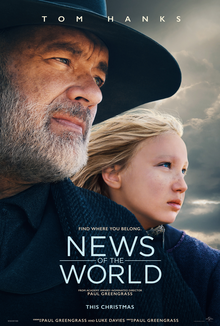
 er than the rest of the story (and is there any chance a shotgun cartridge filled by coins (of the right diameter!) can fly true to its target?!) The choice of depicting Kiowa Indians as silent spectres walking away may be artistically motivated but it does not carry much weight, just like Hank in the movie is not making much progress in denunciation of slavery and genocide, besides keeping his own decency.

