Archive for mRNA

Nature tidbits [21 Aug 2025]

Posted in Books, pictures, University life with tags , , , , , , , , , , , , , , , , on October 16, 2025 by xi'an

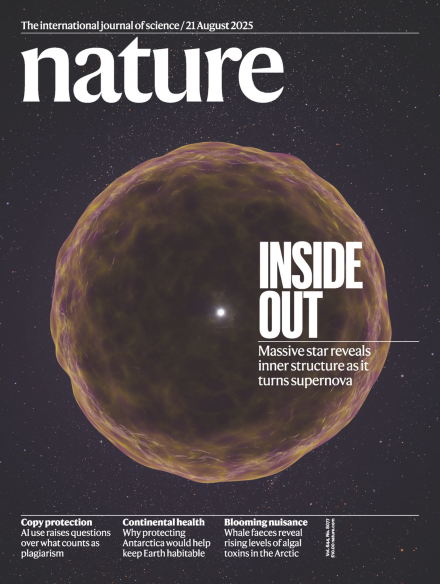
The cover of this Nature issue is a fake!, being an artist’s rendering of a supernova (2021yfj) before it exploded, with the core exhibited as rich in silicon and sulfur. (The heaviest element in stars is iron, resulting from the fusion of the above. When the iron mass exceeds a limit, the star collapse into a neutron star or a black hole.)

On the Trump 2.0 administration’s attack-on-science front, an editorial exposes the irresponsibility of cancelling grants for mRNA studies (which Trump 1.0 supported during the COVID crisis). And a longer article points out the radical switch in managing federal grants, committees moving from scientists to political appointees, searching for “anti-American values”… And another one on the backlash following the report from said administration about climate change and global warming. (As blogged recently.)

At a more conceptual (and international) level, an article questions the usual stand on declining birth rates as being problematic. While acknowledging that public incentives have a highly variable mileage, the article remains vague on how supporting an ageing population while keeping an homogeneous welfare support will prove feasible. A second socio-economic article muses about the lack of a downward curve in the cost of electric cars, despite the drop in battery costs, pointing out the inefficiency of state support that creates profit bubbles for the manufacturers. Stricter policies on combustion vehicles similarly seem inefficient, given the violent reactions of car owners (as in the Gilets Jaunes revolt). The EU has alas recently backed down on its goal of prohibiting new combustion engines by 2035.

In shark contrast, a review paper document the rising probability of a climate catastrophe induced by the melting Antarctica, which could prove of a higher magnitude than the melting Arctic. (Even though the introduction article is rather confusing, mixing this issue with the pollution brought by Antarctic tourism and mentioning indigenous populations that do not exist on the 7th Continent).

And on the (weekly) AI front, the announcement of the downloadable gpt-oss from OpenAI, which I plan to check. And the debate on whether or not AI generated papers can plagiarise, again a poorly focussed article mostly missing the issues of the scientific worth of such papers (and the basic fact that they 100% plagiarise the literature dataset they learned from!).


OWABI@BioInference2025 [29 May]

Posted in Mountains, Statistics, Travel, University life with tags , , , , , , , , , , , , , , on May 13, 2025 by xi'an

The next OWABI webinar is going to be quite special, consisting of two selected talks livestreamed from BioInference 2025, a conference on mathematical modelling and inference on (broadly speaking) biological system, taking place in Bardonecchia, Piedmont. The talks will take place on 29 May, 11am CEST (10am BST). The talks will be streamed on the OWABI MS Team Channel as usual.

1st OWABI Talk: 10-10.30am UK time

Speaker: Andrew Golightly (Durham University)

Title: Accelerating Bayesian inference for stochastic epidemic models using incidence data

Abstract: This work considers the case of performing Bayesian inference for stochastic epidemic compartment models, using incomplete time course data consisting of incidence counts that are either the number of new infections or removals in time intervals of fixed length. The most natural Markov jump process representation of the model is eschewed for reasons of computational efficiency, and replaced by a stochastic differential equation representation. This is further approximated to give a tractable Gaussian process, that is, the linear noise approximation (LNA). Unless the observation model linking the LNA to data is both linear and Gaussian, the observed data likelihood remains intractable. Unlike previous approaches that use the LNA in this setting, two approaches for marginalising over the latent process are considered: a correlated pseudo-marginal method and analytic marginalisation via a Gaussian approximation of the noise model. These approaches are compared using synthetic data with the best performing method applied to real data consisting of removal incidence of Oak Processionary moth nests in Richmond Park, London.

2nd OWABI Talk: 10.30-11am

Speaker: Henrik Häggström (Chalmers University)

Title: Simulation-based inference for stochastic nonlinear mixed-effects models with applications in systems biology

Abstract: We propose a novel methodology for Bayesian inference in hierarchical mixed-effects models. By building on our work, we construct a simulation-based inference (SBI) framework that is highly scalable, where amortized approximations to the likelihood and the parameters posterior are first obtained, and these are rapidly refined for each individual dataset, to ultimately approximate the parameters posterior across many individuals. Unlike the current state-of-art SBI methods, which use neural networks, our approximations are expressed via Gaussian mixture models, leading to easily trainable, parsimonious yet expressive surrogate models of both the likelihood function and the posterior distribution. The methodology is exemplified via stochastic differential equation mixed-effects models to describe translation kinetics after mRNA transfection, however the methodology is general and can accommodate other types of stochastic and deterministic models. We compare our approximate inference with exact pseudomarginal inference and show that our methodology is fast and competitive.

stops making sense [cover

Posted in Books, pictures with tags , , , , , , , on February 22, 2023 by xi'an