Archive for detailed balance

Natural quantum MCMC

Posted in Books, Statistics, University life with tags , , , , , , , , , , , on November 10, 2025 by xi'an

Quite unexpectedly, I opened Nature of 16 October 2025 only to realise it featured a paper by Chi-Fang Chen et al. on a valid MCMC algorithm for quantum computing. The motivation is for simulating quantum multi-body physics, with details that escape me. The paper claims this is the first valid quantum MCMC quantum thermal simulation, with further application similar to the MCMC revolution in Bayesian inference. (An earlier proposal by Davies in 1974 cannot be implemented for many-bodies problems.)

“Although early proposals for simulating thermalization directly considered simulating the global system–bath Hamiltonian evolution, more tractable approaches use a master equation, or Lindbladian, to capture the effect of a large bath on the small system using a continuous-time Markovian process. However, previous approaches inherited issues of the prototypical Davies generator, which worked well in quantum optics but has unphysical features in noncommuting many-body systems because of the exponentially small level spacing. Our nature-inspired algorithm takes precisely the form of a Lindbladian, inherits the locality from the physical model, exactly satisfies detailed balance and resembles the interactions we expect from weak coupling to a Markovian thermal bath.”

The setup is one of a continuous-time quantum Markov chain (or Lindbladian) over a finite set of configurations. The arguments for validating the algorithm (into a completely spelled out theorem!) involve quantum detailed balance (illustrated by the above cartoon) and locality (which I understand as a form of Markovianity in the updating rule). The transition attached to the algorithm however remains incomprehensible to me, involving a Fourier transform of a Hermitian jump operator (both notions escaping me in this context).  And the illustration on an Ising model does not seem particularly quantum related, albeit the “Pauli operators” may be unrelated with the original spin binaries… There is also no MCMC reject step.

“Detailed balance (…) gives a coherent Gibbs sampler, in which we prepare the purified Gibbs state by a natural adiabatic path parametrized by the inverse temperature β. Of course, the purified Gibbs state reduces to the (mixed) Gibbs state once we trace out the purifying replica system, but the purification opens doors to advanced quantum algorithmic tools, such as verification (for example, through the swap test or measuring the energy of the parent Hamiltonian) or faster mean estimation.”

If I understand correctly the above “Gibbs sampler” relates to the Gibbs distribution as in the original 1984 paper of Geman and Geman! It may thus be that the current paper is similarly annunciating a new era in scientific computing, although I remain in the dark as to how to link it with a practical problem.

trialing a Porsch[o]e

Posted in Mountains, pictures, Running, Travel with tags , , , , , , , , , , , , , , on December 5, 2024 by xi'an

The running shoe company Hoka (One One) is known *among runners at least) for its oversized soles that allow more cushion than competitors. (It was created in Annecy, French Alps, for local trailers, before being bought by an American group. The name of the brand means flying on Earth in Maori.) I had never tried any of their shoes, primarily due to the cost of the fastest ones, but in the days after Marseille-Cassis,  I saw an add mentioning a free return after a 30 day trial and thus decided on testing a (pricey) competition model, the Cielo X1. Advertised as the fastest in their collection (with no mention made of any car brand!)I received the package a few days prior to my Boulogne half-marathon.

The shoe is highly unusual (for me), in that its soles are far from flat and make walking with then unpleasant. (When I travelled to Boulogne, I had to jog to keep my [detailed] balance!) The design is intended for (aggressive) forefoot attack, followed by a bounce from the talon created by a massive carbon plate. The upper part is also original, with a light but tight slipper that stabilises the foot inside the shoe. When I first tried them (the day they arrived), I was most puzzled and did a first short 8km run to check I could at all run with them. And realised that even without trying, I was running at a higher pace, especially downhill. The next day, I pushed a bit harder on my 10km route and noticed the same improvement, hence got confident that I should use them for the Boulogne half-marathon. Post-race, I remain convinced them helped in keeping a below 4mn pace, if not enormously (with a 90 second gain compared with 2023), as my muscles started protesting about half-way. But the end of the race was not as dreadful as usual, possibly thanks to the shoes, possibly thanks to a higher training volume. Will I keep the shoes? At that price, I am afraid not! But this was a great experience (and I will keep looking for sales in the coming months).

transformation MCMC

Posted in Books, pictures, Statistics, Travel, University life with tags , , , , , , , on January 3, 2022 by xi'an

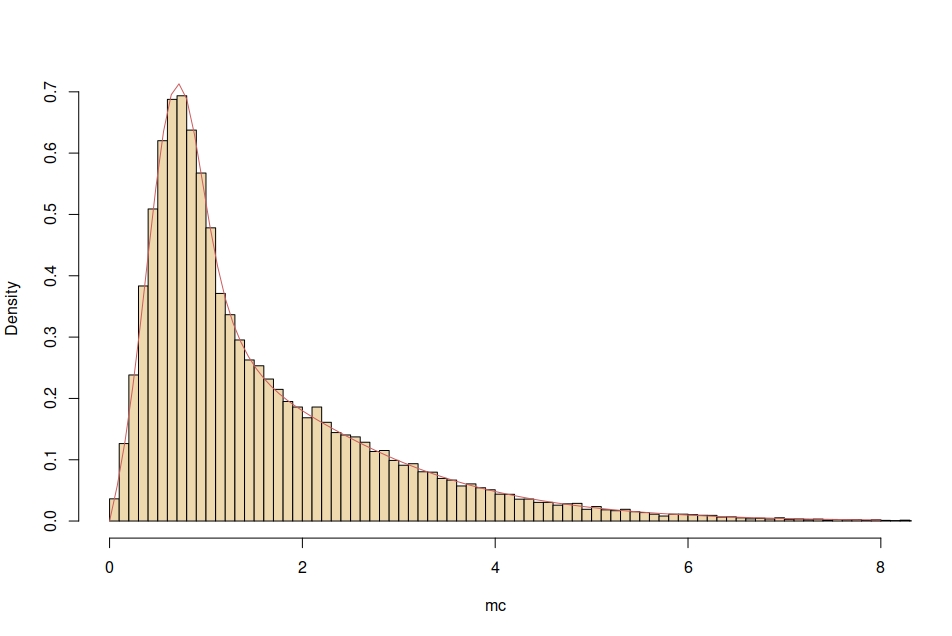
For reasons too long to describe here, I recently came across a 2013 paper by Dutta and Bhattacharya (from ISI Kolkata) entitled MCMC based on deterministic transforms, which sounded a bit dubious until I realised the deterministic label apply to the choice of the transformation and not to the Metropolis-Hastings proposal… The core of the proposed method is to make a proposal that simultaneously considers a move and its inverse, namely from x to either x’=T(x,ε) or x”=T⁻¹(x,ε) , where ε is an independent random noise, possibly degenerated to a manifold of lesser dimension. Due to the symmetry the acceptance probability is then a ratio of the target, multiplied by the x-Jacobian of T (as in reversible jump). I tried the method on a mixture of Gamma distributions target (in red) with an Exponential scale change and the resulting sample indeed fitted said target.

The authors even make an argument in favour of a unidimensional noise, although this amounts to running an implicit Gibbs sampler. Argument based on a reduced simulation cost for ε, albeit the full dimensional transform x’=T(x,ε) still requires to be computed. And as noted in the paper this also requires checking for irreducibility. The claim for higher efficiency found therein is thus mostly unsubstantiated…

“The detailed balance requirement also demands that, given x, the regions covered by the forward and the backward transformations are disjoint.”

The above statement is also surprising in that the generic detailed balance condition does not impose such a restriction.


bandits for doubly intractable posteriors

Posted in Statistics with tags , , , , , , , , on April 17, 2019 by xi'an

Last Friday, Guanyang Wang arXived a paper on the use of multi-armed bandits (hence the reference to the three bandits) to handle intractable normalising constants. The bandit compares or mixes Møller et al. (2006) auxiliary variable solution with Murray et al. (2006) exchange algorithm. Which are both special cases of pseudo-marginal MCMC algorithms. In both cases, the auxiliary variables produce an unbiased estimator of the ratio of the constants. Rather than the ratio of two unbiased estimators as in the more standard pseudo-marginal MCMC. The current paper tries to compare the two approaches based on the variance of the ratio estimate, but cannot derive a general ordering. The multi-armed bandit algorithm exploits both estimators of the acceptance ratio to pick the one that is almost the largest, almost because there is a correction for validating the step by detailed balance. The bandit acceptance probability is the maximum [over the methods] of the minimum [over the time directions] of the original acceptance ratio. While this appears to be valid, note that the resulting algorithm implies four times as many auxiliary variates as the original ones, which makes me wonder at the gain when compared with a parallel implementation of these methods, coupled at random times. (The fundamental difficulty of simulating from likelihoods with an unknown normalising constant remains, see p.4.)

slice sampling revisited

Posted in Books, pictures, Statistics with tags , , , , , , , , on April 15, 2016 by xi'an

Figure 1 (c.) Neal, 2003Thanks to an X validated question, I re-read Radford Neal’s 2003 Slice sampling paper. Which is an Annals of Statistics discussion paper, and rightly so. While I was involved in the editorial processing of this massive paper (!), I had only vague memories left about it. Slice sampling has this appealing feature of being the equivalent of random walk Metropolis-Hastings for Gibbs sampling, without the drawback of setting a scale for the moves.

“These slice sampling methods can adaptively change the scale of changes made, which makes them easier to tune than Metropolis methods and also avoids problems that arise when the appropriate scale of changes varies over the distribution  (…) Slice sampling methods that improve sampling by suppressing random walks can also be constructed.” (p.706)

One major theme in the paper is fighting random walk behaviour, of which Radford is a strong proponent. Even at the present time, I am a bit surprised by this feature as component-wise slice sampling is exhibiting clear features of a random walk, exploring the subgraph of the target by random vertical and horizontal moves. Hence facing the potential drawback of backtracking to previously visited places.

“A Markov chain consisting solely of overrelaxed updates might not be ergodic.” (p.729)

Overrelaxation is presented as a mean to avoid the random walk behaviour by removing rejections. The proposal is actually deterministic projecting the current value to the “other side” of the approximate slice. If it stays within the slice it is accepted. This “reflection principle” [in that it takes the symmetric wrt the centre of the slice] is also connected with antithetic sampling in that it induces rather negative correlation between the successive simulations. The last methodological section covers reflective slice sampling, which appears as a slice version of Hamiltonian Monte Carlo (HMC). Given the difficulty in implementing exact HMC (reflected in the later literature), it is no wonder that Radford proposes an approximation scheme that is valid if somewhat involved.

“We can show invariance of this distribution by showing (…) detailed balance, which for a uniform distribution reduces to showing that the probability density for x¹ to be selected as the next state, given that the current state is x0, is the same as the probability density for x⁰ to be the next state, given that x¹ is the current state, for any states x⁰ and x¹ within [the slice] S.” (p.718)

In direct connection with the X validated question there is a whole section of the paper on implementing single-variable slice sampling that I had completely forgotten, with a collection of practical implementations when the slice

S={x; u < f(x) }

cannot be computed in an exact manner. Like the “stepping out” procedure. The resulting set (interval) where the uniform simulation in x takes place may well miss some connected component(s) of the slice. This quote may sound like a strange argument in that the move may well leave a part of the slice off and still satisfy this condition. Not really since it states that it must hold for any pair of states within S… The very positive side of this section is to allow for slice sampling in cases where the inversion of u < f(x) is intractable. Hence with a strong practical implication. The multivariate extension of the approximation procedure is more (potentially) fraught with danger in that it may fell victim to a curse of dimension, in that the box for the uniform simulation of x may be much too large when compared with the true slice (or slice of the slice). I had more of a memory of the “trail of crumbs” idea, mostly because of the name I am afraid!, which links with delayed rejection, as indicated in the paper, but seems awfully delicate to calibrate.