Archive for bouncy particle sampler

scalable Monte Carlo for Bayesian learning [book review]

Posted in Books, Statistics, University life with tags , , , , , , , , , , , , , , , , , , , , on September 26, 2025 by xi'an

This book by Paul Fearnhead, Christopher Nemeth, Chris Oates, and Chris Sherlock is part of the IMS Monograph series. And published by Cambridge University Press. It covers most recent developments in MCMC methods, namely stochastic gradient MCMC (Chap. 3), non-reversible MCMC (Chap. 4), continuous-time MCMC (Chap. 5), and assessing and improving MCMC (Chap. 6). I find the book remarkable in its attention to rigour and clarity, without falling into overly technical derivations. It is perfectly suited for a graduate course to students with a solid mathematical background. In short, had I considered a new edition of our Monte Carlo Statistical Methods book to incorporate these advances, I could not done such a good job!

The first chapter provides a quick refresher of the background, from Monte Carlo principles, to Markov chains, SDEs, and the kernel “trick” (which requires a dozen pages of exposition). Nonetheless, it contains side remarks of true interest, including some suggestions I had not previously seen, as for instance an unusual introduction of the HMC algorithm as an underdamped Langevin diffusion. Chapter 2 prolongates this recap by covering reversible MCMC algorithms and the attached optimal scalings. This is done in a particularly friendly presentation that I intend to use in my own course. The HMC section is probably the best coverage I have seen on the topic, including most naturally the leapfrog steps.

Chapter 3 gets into stochastic gradient MCMC as an approximate MCMC, with nice arguments and formal convergence bounds. Again quite efficiently, if focussing almost solely on Gaussian settings (but including a neural network example). Similarly, Chapter 4 provides intuitive (if informal) arguments on the worth of non-reversible algorithms that are well-suited to a textbook of this level. This chapter introduces a PDMP sampler like the discrete bouncy particle sampler.

Chapter 5 is a (nicely) monstrous coverage of continuous time MCMC samplers that reaches very recent advances on PDMPs. The focus is on expressing them as limits, in order to derive mixing rates without extreme mathematical steps. (The chapter even includes a mention to the coordinate sampler that my PhD student Wu Changye derived in 2018!) Again a chapter I plan to use when teaching MCM methods, if possibly skipping some of the 66 pages.

Chapter 6 completes the monograph with a presentation of convergence assessment tools and diagnostics, exploiting the kernel trick, as well as convergence bounds that reflect very recent research in that domain. The conclusive section on optimal weights and optimal thinning will presumably be new to most readers. (Making me wonder if a link can be found with our importance Markov chain construct.)

[Disclaimer about potential self-plagiarism as usual: this post or an edited version will eventually appear in my Books Review section in CHANCE.]

Alexandre Bouchard-Côté, 2004 CRM-SSC Prize in Statistics winner

Posted in Statistics with tags , , , , , , , , , , , , , , , on May 18, 2024 by xi'an

practical PDMP

Posted in Books, Statistics, University life with tags , , , , , , , , , , , on December 9, 2021 by xi'an

While in Warwick, last month, I attended a reading group on PDMPs where Filippo Pagani talked about practical PDMP, connected with a recent arXival by Bertazzi, Bierkens and Dobson. The central question when implementing PDMP is to find a realistic way of solving

\int_0^\tau \lambda(x+tv,v)\text dt = \epsilon\quad\epsilon\sim\mathcal Exp(1)

to decide on the stopping time (when the process ceases to be deterministic). The usual approach is to use Poisson thinning by finding an upper bound on λ, but this is either difficult or potentially inefficient (and sometimes both).

“finding a sharp bound M(s) [for Poisson thinning] can be an extremely challenging problem in most practical settings (…) In order to overcome this problem, we introduce discretisation schemes for PDMPs which make their
approximate simulation possible.”

Some of the solutions proposed in Bertazzi et al. are relying on

  1. using a frozen (fixed) λ
  2. discretising time and the integral (first order scheme)
  3. allowing for more than a jump over a time interval (higher order schemes)
  4. going through control variates (when gradient is Lipschitz and Hessian bounded, with known constants) as it produces a linear rate λ
  5. subsampling (at least for Zig Zag)

with theoretical guarantees that the approximations are convergent, as the time step goes to zero. They (almost obviously) remain model dependent solutions (with illustrations for the Zig Zag and bouncy particle versions), with little worse case scenarios, but this is an extended investigation into making PDMPs more manageable!

BayesComp’20

Posted in Books, pictures, Statistics, Travel, University life with tags , , , , , , , , , , , , , , , , , , , , , on January 10, 2020 by xi'an

First, I really have to congratulate my friend Jim Hobert for a great organisation of the meeting adopting my favourite minimalist principles (no name tag, no “goodies” apart from the conference schedule, no official talks). Without any pretense at objectivity, I also appreciated very much the range of topics and the sweet frustration of having to choose between two or three sessions each time. Here are some notes taken during some talks (with no implicit implication for the talks no mentioned, re. above frustration! as well as very short nights making sudden lapse in concentration highly likely).

On Day 1, Paul Fearnhead’s inaugural plenary talk was on continuous time Monte Carlo methods, mostly bouncy particle and zig-zag samplers, with a detailed explanation on the simulation of the switching times which likely brought the audience up to speed even if they had never heard of them. And an opening on PDMPs used as equivalents to reversible jump MCMC, reminding me of the continuous time (point process) solutions of Matthew Stephens for mixture inference (and of Preston, Ripley, Møller).

The same morn I heard of highly efficient techniques to handle very large matrices and p>n variables selections by Akihiko Nishimura and Ruth Baker on a delayed acceptance ABC, using a cheap proxy model. Somewhat different from indirect inference. I found the reliance on ESS somewhat puzzling given the intractability of the likelihood (and the low reliability of the frequency estimate) and the lack of connection with the “real” posterior. At the same ABC session, Umberto Picchini spoke on a joint work with Richard Everitt (Warwick) on linking ABC and pseudo-marginal MCMC by bootstrap. Actually, the notion of ABC likelihood was already proposed as pseudo-marginal ABC by Anthony Lee, Christophe Andrieu and Arnaud Doucet in the discussion of Fearnhead and Prangle (2012) but I wonder at the focus of being unbiased when the quantity is not the truth, i.e. the “real” likelihood. It would seem more appropriate to attempt better kernel estimates on the distribution of the summary itself. The same session also involved David Frazier who linked our work on ABC for misspecified models and an on-going investigation of synthetic likelihood.

Later, there was a surprise occurrence of the Bernoulli factory in a talk by Radu Herbei on Gaussian process priors with accept-reject algorithms, leading to exact MCMC, although the computing implementation remains uncertain. And several discussions during the poster session, incl. one on the planning of a 2021 workshop in Oaxaca centred on objective Bayes advances as we received acceptance of our proposal by BIRS today!

On Day 2, David Blei gave a plenary introduction to variational Bayes inference and latent Dirichlet allocations, somewhat too introductory for my taste although other participants enjoyed this exposition. He also mentioned a recent JASA paper on the frequentist consistency of variational Bayes that I should check. Speaking later with PhD students, they really enjoyed this opening on an area they did not know that well.

A talk by Kengo Kamatani (whom I visited last summer) on improved ergodicity rates for heavy tailed targets and Crank-NIcholson modifications to the random walk proposal (which uses an AR(1) representation instead of the random walk). With the clever idea of adding the scale of the proposal as an extra parameter with a prior of its own. Gaining one order of magnitude in the convergence speed (i.e. from d to 1 and from d² to d, where d is the dimension), which is quite impressive (and just published in JAP).Veronica Rockova linked Bayesian variable selection and machine learning via ABC, with conditions on the prior for model consistency. And a novel approach using part of the data to learn an ABC partial posterior, which reminded me of the partial  Bayes factors of the 1990’s although it is presumably unrelated. And a replacement of the original rejection ABC via multi-armed bandits, where each variable is represented by an arm, called ABC Bayesian forests. Recalling the simulation trick behind Thompson’s approach, reproduced for the inclusion or exclusion of variates and producing a fixed estimate for the (marginal) inclusion probabilities, which makes it sound like a prior-feeback form of empirical Bayes. Followed by a talk of Gregor Kastner on MCMC handling of large time series with specific priors and a massive number of parameters.

The afternoon also had a wealth of exciting talks and missed opportunities (in the other sessions!). Which ended up with a strong if unintended French bias since I listened to Christophe Andrieu, Gabriel Stolz, Umut Simsekli, and Manon Michel on different continuous time processes, with Umut linking GANs, multidimensional optimal transport, sliced-Wasserstein, generative models, and new stochastic differential equations. Manon Michel gave a highly intuitive talk on creating non-reversibility, getting rid of refreshment rates in PDMPs to kill any form of reversibility.

computational statistics and molecular simulation [18w5023]

Posted in pictures, Statistics, Travel, University life with tags , , , , , , , , , , , , , , , , , , , , , , , on November 14, 2018 by xi'an

On Day 2, Carsten Hartmann used a representation of the log cumulant as solution to a minimisation problem over a collection of importance functions (by the Vonsker-Varadhan principle), with links to X entropy and optimal control, a theme also considered by Alain Dunmus when considering the uncorrected discretised Langevin diffusion with a decreasing sequence of discretisation scale factors (Jordan, Kinderlehrer and Otto) in the spirit of convex regularisation à la Rockafellar. Also representing ULA as an inexact gradient descent algorithm. Murray Pollock (Warwick) presented a new technique called fusion to simulate from products of d densities, as in scalable MCMC (but not only). With an (early) starting and startling remark that when simulating one realisation from each density in the product and waiting for all of them to be equal means simulating from the product, in a strong link to the (A)BC fundamentals. This is of course impractical and Murray proposes to follow d Brownian bridges all ending up in the average of these simulations, constructing an acceptance probability that is computable and validating the output.

The second “hand-on” lecture was given by Gareth Roberts (Warwick) on the many aspects of scaling MCMC algorithms, which started with the famous 0.234 acceptance rate paper in 1996. While I was aware of some of these results (!), the overall picture was impressive, including a notion of complexity I had not seen before. And a last section on PDMPs where Gareth presented very recent on the different scales of convergence of Zigzag and bouncy particle samplers, mostly to the advantage of Zigzag.In the afternoon, Jeremy Heng presented a continuous time version of simulated tempering by adding a drift to the Langevin diffusion with time-varying energy, which must be solution to the Liouville pde \text{div} \pi_t f = \partial_t \pi_t. Which connects to a flow transport problem when solving the pde under additional conditions. Unclear to me was the creation of the infinite sequence. This talk was very much at the interface in the spirit of the workshop! (Maybe surprisingly complex when considering the endpoint goal of simulating from a given target.) Jonathan Weare’s talk was about quantum chemistry which translated into finding eigenvalues of an operator. Turning in to a change of basis in a inhumanly large space (10¹⁸⁰ dimensions!). Matt Moore presented the work on Raman spectroscopy he did while a postdoc at Warwick, with an SMC based classification of the peaks of a spectrum (to be used on Mars?) and Alessandra Iacobucci (Dauphine) showed us the unexpected thermal features exhibited by simulations of chains of rotors subjected to both thermal and mechanical forcings, which we never discussed in Dauphine beyond joking on her many batch jobs running on our cluster!

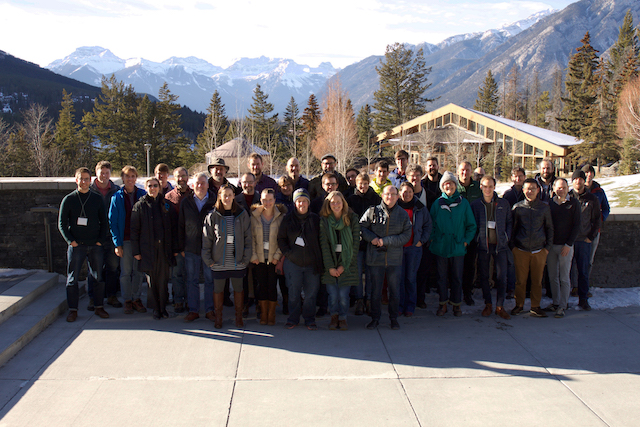
And I remembered today that there is currently and in parallel another BIRS workshop on statistical model selection [and a lot of overlap with our themes] taking place in Banff! With snow already there! Unfair or rather #unfair, as someone much too well-known would whine..! Not that I am in a position to complain about the great conditions here in Oaxaca (except for having to truly worry about stray dogs rather than conceptually about bears makes running more of a challenge, if not the altitude since both places are about the same).