Archive for Series

Hugo Awards finalists 2026

Posted in Books, Kids with tags , , , , , , , on May 9, 2026 by xi'an

Here are the 2026 Hugo Awards finalists, with winners to be announced on 30 August at LAcon V. Since I registered for selecting the awards, I did get the Hugo Voter Packet (with full ebooks, some audiobooks, if not movies, or TV scripts) and hence be able to read at least some of them. Before or after the deadline in August.. Here are some categories:

Best Novel

  • A Drop of Corruption by Robert Jackson Bennett (Del Rey; Hodderscape) [sequel to The Tainted Cup]
  • Death of the Author by Nnedi Okorafor (William Morrow; Gollancz)
  • Shroud by Adrian Tchaikovsky (Tor UK; Orbit US)
  • The Everlasting by Alix E. Harrow (Tor US; Tor UK)
  • The Incandescent by Emily Tesh (Tor US; Orbit UK)
  • The Raven Scholar by Antonia Hodgson (Orbit US; Hodderscape)

Best Novella

  • Automatic Noodle by Annalee Newitz (Tordotcom)
  • Cinder House by Freya Marske (Tordotcom; Tor UK)
  • Murder by Memory by Olivia Waite (Tordotcom)
  • The River Has Roots by Amal El-Mohtar (Tordotcom; Arcadia UK)
  • The Summer War by Naomi Novik (Del Rey US; Del Rey UK)
  • What Stalks the Deep by T. Kingfisher (Nightfire; Titan UK) [a constant in the nomination lists!]

Best Novelette

  • “Kaiju Agonistes” by Scott Lynch (Uncanny Magazine, Issue 62)
  • “Never Eaten Vegetables” by H.H. Pak (Clarkesworld, Issue 220)
  • “Rapport: Friendship, Solidarity, Communion, Empathy” by Martha Wells (Reactor, July 10, 2025)
  • “The Girl That My Mother Is Leaving Me For” by Cameron Reed (Reactor, April 2, 2025)
  • “The Millay Illusion” by Sarah Pinsker (Uncanny Magazine, Issue 67)
  • “When He Calls Your Name” by Catherynne M. Valente (Uncanny Magazine, Issue 65)

Best Short Story

  • “10 Visions of the Future; or, Self-Care for the End of Days” by Samantha Mills (Uncanny Magazine, Issue 63)
  • “In My Country” by Thomas Ha (Clarkesworld, Issue 223)
  • “Laser Eyes Ain’t Everything” by Effie Seiberg (Diabolical Plots, May 16, 2025)
  • “Missing Helen” by Tia Tashiro (Clarkesworld, Issue 226)
  • “Six People to Revise You” by J.R. Dawson (Uncanny Magazine, Issue 62)
  • “Wire Mother” by Isabel J. Kim (Clarkesworld, Issue 229)

Best Series

  • Emily Wilde by Heather Fawcett (Del Rey US; Orbit UK)
  • October Daye by Seanan McGuire (Tor US; DAW)
  • Old Man’s War by John Scalzi (Tor US; Tor UK) [read some of these!]
  • The Chronicles of Osreth by Katherine Addison (Tor US; Solaris UK; Subterranean)
  • The Craft Wars by Max Gladstone (Tor; Tordotcom) [read the first one, did not like it that much]
  • White Space by Elizabeth Bear (Saga Press; Gollancz)

top 10 genre books of the 21st Century [so far]

Posted in Books with tags , , , , , , , , on December 4, 2024 by xi'an

On Reactor, the on-line magazine run by the publishing company Tor, the frequent contributor Jo Walton was asked to put forward her ten favourite by genre. Here are some lists that X my reading habits, if almost none my favourites: to wit,

for series

for fantasy

and for science-fiction

missing, imho, e.g., Neal Stephenson’s Anathem, K.J. Parker’s Sixteen Ways to Defend a Walled City, Martha Wells’ Murderbot series, Jaworski’s Gagner la Guerre, Anne Leckie’s  Ancillary Justice series, Joe Abercrombie’s The Heroes, and some others. But since lists are personal, and always tantalizing to me, here is a potential reading list.

Kempner Fi

Posted in Books, Kids, R, Statistics with tags , , , , , , , on January 19, 2021 by xi'an

A short code-golf challenge led me to learn about the Kempner series, which is the series made of the inverted integers, excluding all those containing the digit 9. Most surprisingly this exclusion is enough to see the series converging (close to 23). The explanation for this convergence is that, citing Wikipedia,

“The number of n-digit positive integers that have no digit equal to ‘9’ is 8 × 9n−1“

and since the inverses of these n-digit positive integers are less than 101−n the series is bounded by 80. In simpler terms, it converges because the fraction of remaining terms in the series is geometrically decreasing as (9/10)1−n. Unsurprisingly (?) the series is also atrociously slow to converge (for instance the first million terms sum up to 11) and there exist recurrence representations that speed up its computation.  Here is the code-golf version

n=scan()+2
while(n<-n-1){
F=F+1/T
while(grepl(9,T<-T+1))0}
F

that led me to learn about the R function grepl. (The explanation for the pun in the title is that Semper Fidelis is the motto of the corsair City of Saint-Malo or Sant-Maloù, Brittany.)

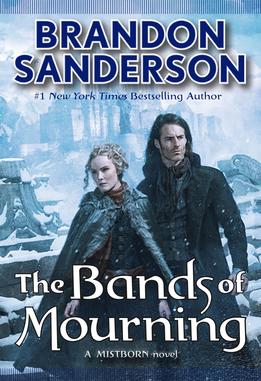
The Bands of Mourning [and mourning we should]

Posted in Books, Travel with tags , , , , , , , , on April 7, 2018 by xi'an

While in Brussels last week, I happened to spot a W.H. Smith bookstore near where I stayed and a “new” book on the Mistborn series, namely one I had not yet read. It was actually published in 2016 and is the continuation of the (homely) Shadows of Self, itself a sequel to Alloy of Law. Sounds like endless regress?! This time and this volume, it truly feels like it…

“But that is the sort of statistical anomaly that plagues my life, so I’ll plan for it nonetheless.”

The characters in the Bands of Mourning are pretty much the same as in Shadows of Self, the story being a continuation in another corner of the Mistborn universe. (Truly at a corner of the map printed at the beginning of the book.) Except for a few ones that in my opinion completely ruin the plot and the appeal of the story.

“The proof,” Marasi said, “will be in the numbers.” She leaned forward. “Do you know how many crimes can be proven by statistics?”

The link to statistics is continued as well, although pretty shallow when considering that almost every situation is dealt with by superpowers that get increasingly boring and predictable. When characters can [spoiler?!] resuscitate from about every possible form of death, one starts looking for another story and another book. But definitely not the next one in the series, The Lost Metal, not yet advertised for sale…

Research section no longer or no more?!

Posted in Statistics, University life with tags , on December 3, 2009 by xi'an

Today was my last meeting of the Research Section Committee of the Royal Statistical Society, a consequence of stepping down as Series B editor. I will miss those meetings (as I will miss being editor), because their main purpose was to handle the papers submitted as Read Papers to the Society. It is one thing to process papers on one’s own with the help of an Associate Editor (about half of the time) and of referees (about 25% of the time), but analysing in a collegial manner a broader and potentially richer paper is altogether a different experience. This focus on the quality and the discutability of the submitted papers explains for the overall high quality of the Read Papers and of the resulting discussions. As mentioned earlier, the new feature of having pre-ordinary meetings organised by the Young Statistician Section of the Royal Statistical Society can only bring more breadth and diversity to the discussions. This makes in my opinion the Royal Statistical Society fairly unique among statistics societies. And this mostly explains why I am so attached to it (rather than my alleged anglophilia!) compared with, say, the French Statistical Society.

This year, the Council of the Royal Statistical Society has decided to reform the structures of the sections towards more efficiency (and lesser costs). The status of the Research Section is therefore pending towards a major change or even its abolition, and, while the “Council regards the organization of Ordinary Meetings and publication of the discussion on the papers as one of the Society’s most highly valued activities”, it may still decide to change the role of the Section, the publishing part being associated with the board of Series B. While this still is under debate, and while the Council of the Royal Statistical Society has the right and legitimacy to operate any reform it sees fit, I,  as a Royal Statistical Society member as well as a (soon) ormer editor, cannot but contend that this “rationalisation” of the way the Section currently operates would be its death. The diversity of the Research Section Committee and the time dedicated by all its members to the analysis of the long papers submitted as Read Papers cannot be replaced by the nomination of a single Read Paper editor. The quality, scope and ultimately appeal of the published discussion paper would inevitably suffer from such a move. The reorganisation of the sections within the Royal Statistical Society also calls for sections to “organise at least one income generating meeting a year”, which seems paradoxical in the case of the Research Section Committee since it organises two to four Ordinary Meetings a year, resulting in high quality discussions that make Series B attractive to (mostly paying) readers! While a positive budgetary balance is a natural aim for any organisation, learned societies should not make business models their primary goal unless they lose their overall purpose…