Archive for supernova

Nature tidbits [21 Aug 2025]

Posted in Books, pictures, University life with tags , , , , , , , , , , , , , , , , on October 16, 2025 by xi'an

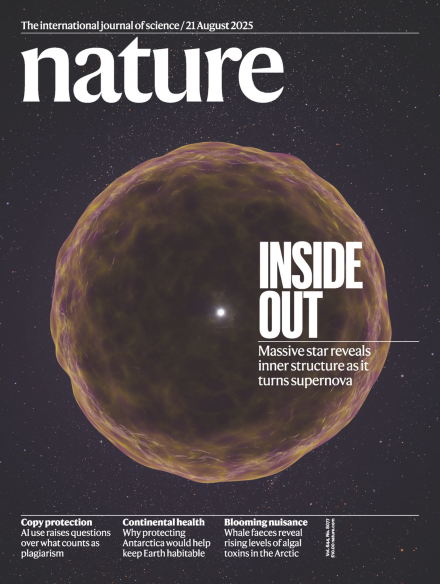
The cover of this Nature issue is a fake!, being an artist’s rendering of a supernova (2021yfj) before it exploded, with the core exhibited as rich in silicon and sulfur. (The heaviest element in stars is iron, resulting from the fusion of the above. When the iron mass exceeds a limit, the star collapse into a neutron star or a black hole.)

On the Trump 2.0 administration’s attack-on-science front, an editorial exposes the irresponsibility of cancelling grants for mRNA studies (which Trump 1.0 supported during the COVID crisis). And a longer article points out the radical switch in managing federal grants, committees moving from scientists to political appointees, searching for “anti-American values”… And another one on the backlash following the report from said administration about climate change and global warming. (As blogged recently.)

At a more conceptual (and international) level, an article questions the usual stand on declining birth rates as being problematic. While acknowledging that public incentives have a highly variable mileage, the article remains vague on how supporting an ageing population while keeping an homogeneous welfare support will prove feasible. A second socio-economic article muses about the lack of a downward curve in the cost of electric cars, despite the drop in battery costs, pointing out the inefficiency of state support that creates profit bubbles for the manufacturers. Stricter policies on combustion vehicles similarly seem inefficient, given the violent reactions of car owners (as in the Gilets Jaunes revolt). The EU has alas recently backed down on its goal of prohibiting new combustion engines by 2035.

In shark contrast, a review paper document the rising probability of a climate catastrophe induced by the melting Antarctica, which could prove of a higher magnitude than the melting Arctic. (Even though the introduction article is rather confusing, mixing this issue with the pollution brought by Antarctic tourism and mentioning indigenous populations that do not exist on the 7th Continent).

And on the (weekly) AI front, the announcement of the downloadable gpt-oss from OpenAI, which I plan to check. And the debate on whether or not AI generated papers can plagiarise, again a poorly focussed article mostly missing the issues of the scientific worth of such papers (and the basic fact that they 100% plagiarise the literature dataset they learned from!).

astroABC: ABC SMC sampler for cosmological parameter estimation

Posted in Books, R, Statistics, University life with tags , , , , , , , , on September 6, 2016 by xi'an

“…the chosen statistic needs to be a so-called sufficient statistic in that any information about the parameter of interest which is contained in the data, is also contained in the summary statistic.”

Elise Jenningsa and Maeve Madigan arXived a paper on a new Python code they developed for implementing ABC-SMC, towards astronomy or rather cosmology applications. They stress the parallelisation abilities of their approach which leads to “crucial speed enhancement” against the available competitors, abcpmc and cosmoabc. The version of ABC implemented there is “our” ABC PMC where particle clouds are shifted according to mixtures of random walks, based on each and every point of the current cloud, with a scale equal to twice the estimated posterior variance. (The paper curiously refers to non-astronomy papers through their arXiv version, even when they have been published. Like our 2008 Biometrika paper.) A large part of the paper is dedicated to computing aspects that escape me, like the constant reference to MPIs. The algorithm is partly automated, except for the choice of the summary statistics and of the distance. The tolerance is chosen as a (large) quantile of the previous set of simulated distances. Getting comments from the designers of abcpmc and cosmoabc would be great.

“It is clear that the simple Gaussian Likelihood assumption in this case, which neglects the effects of systematics yields biased cosmological constraints.”

The last part of the paper compares ABC and MCMC on a supernova simulated dataset. Which is somewhat a dubious comparison since the model used for producing the data and running ABC is not the same as the Gaussian version used with MCMC. Unsurprisingly, MCMC then misses the true value of the cosmological parameters and most likely and more importantly the true posterior HPD region. While ABC SMC (or PMC) proceeds to a concentration around the genuine parameter values. (There is no additional demonstration of how accelerated the approach is.)