Archive for Korean history

human acts (book review)

Posted in Books, Kids, Travel with tags , , , , , , , , , , , , , , , , on October 3, 2025 by xi'an

After reading Han Kang’s The Vegetarian, I downloaded Human Acts which I found utterly impressive, hence the separate book review. This book gives connected snapshots of the democratisation uprising that happened in May 1980 in Gwangju, Korea, protesting a coup d’état, and of the savage repression that followed. With up to 2000 victims. (I was in my first year at the university at the time and cannot remember the news reaching me, despite being politically active, maybe because this was the year of the US Embassy take-over in Tehran and of the boycott of the Moscow Olympics.) The book is organised around the deaths of neighbours and the impact on their relatives until now. The style is strongly original, with bouts of magical realism like the thoughts of a cadaver inside a pile of corpses gathered by the military forces. The stories are all written from a character’s viewpoint, expressing her or his reasoning for joining the uprising and facing a probable death. I found these texts remarkable and highly moving in producing reconstituted motivations from “everyday” people, with no political agenda but an raw urge to recover democracy after decades of dictature. The original title is A boy comes (소년이 온다), which refers to the initial(isation) story, but the later Human Acts title seems quite appropriate, with its many interpretations and the stress on humanity, despite the horror of the repression.

a journal of the conquest, war, famine, and death year [minus two fingers]

Posted in Books, Kids, pictures, Statistics, Travel, University life with tags , , , , , , , , , , , , , , , , , , , , , , , , , , on November 8, 2023 by xi'an

Read The House of Shattered Wings, by Aliette de Bodard, which involves a character with two fingers eventually missing. A British Science Fiction Association Award and for once a rather impressive horror story taking place in an alternative 1900’s Paris partly destroyed by a war between Houses run by fallen angels. With connections with French occupied Annam. The construct is quite original, with some great characters, if over-prone to introspection. Got through as well Trouble on the Thames, by Victor Bridges (!), a British Library thriller classic I bought when visiting the Alan Turing Institute. A light and short spy story from the 1930’s with amusingly outdated dialogues and postures, a nice way to go through a sleepless night. And received as B’Day present  the BD version of Umberto Eco’s Name of the Rose by Milo Manara, a pleasant return to this great book, with fantastic colours and creative miniatures. As usual with Manara, the depiction of the female character is unrealistic and anachronic.

Watched the Korean TV show, Songs of the Bandits, which as a coincidence also involves a character with two fingers eventually missing. While providing an interesting foray into Korean history under Japanese pre-WW II occupation and offering an original scenario among K dramas, with an Eastern Western flavour, the fighting scenes are ridiculous (and gory), while the Japanese occupiers are caricaturesque. The final episode further feels inconclusive.

Made jars and jars of fig jam till early October, as the fig tree was bursting with ripe figs that were mostly escaping marauding birds. As well as more jars of rhubarb jam.

Monty Hall [몬티 홀 문제는]

Posted in Books, pictures, Statistics with tags , , , , on December 5, 2021 by xi'an

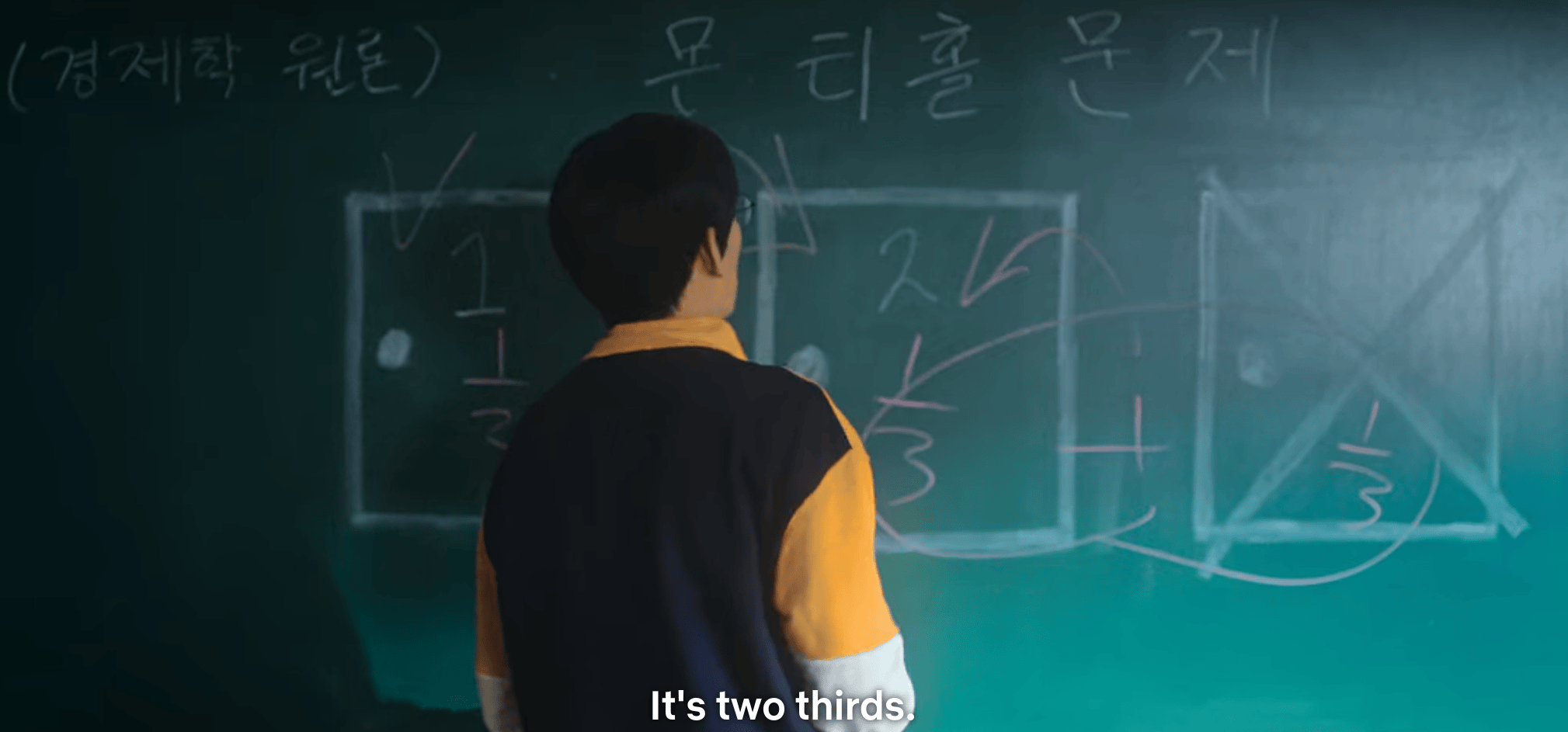
One of the episodes of the K-drama D.P. (for Deserter Pursuit) is entitled the Monty Hall problem and contains a black-board proof of the (correct) change of probability (from one third to two thirds) for the remaining door… Even though the character states that this is based on statistics (!) and that the reason for the inclusion of the scene remains unclear,  within a progressively darker series, depicting the bullying and hazing taking place within a South Korean army unit and the tragic consequences they have on the victims. (Presumably to demonstrate that the deserter was a brilliant student.)

my country

Posted in Books, Kids, pictures, Travel with tags , , , , , , , , , on December 1, 2019 by xi'an

Watching a new Korean drama TV series, called My country: The New Age, which relates to the early years of the Joseon dynasty and the power shifts between the first King, Yi Seung-Gye, later of King Taejo, a former general taking over by assassinating the previous ruler (and making him the last of his dynasty!), and his sons, but involving heavily three young characters growing through these years and making them instrumental to solving these power fights. First, Seo Hwi, the son of the greatest warrior of the (previous) era who was wrongly dishonored, himself a fabulous warrior, who witnessed his father’s suicide and was left alone to protect his sick sister Seo Yeon. Continuously persecuted by Naem Jeon, an eminence grise behind Yi Seung-Gye and definitely the arch-evil character of the series, with Hwi aiming at taking revenge on him, although he comes several times with opportunities to kill him and does not. (The number of violent deaths in the series is staggering!) Second, Han Hui-Jae a rebellious young woman raised in a gisaeng (geisha equivalent) residence by the owner of the place, after the political murder of her mother under Hui-Jae’s eyes. Rising to prominence in the structure which is used to gather information and gain influence through the clients of the place. And in love with Hwi. Third, Nam Seon-Ho, illegitimate son of Naem Jeon, whom he hates for causing the suicide of his low-born mother and who raises him after the death of his legitimate son (it however requires most of the show for Seon-Ho to turn completely against his father). Close friend of Hwi, but also his competitor in the military exams, which he unfairly wins by his father weighting in, and equally in love with Hae. Protector of Yeon when his brother Hwi gets sent to a disciplinary military unit for rebelling against the exam result. With the two never truly and actively fighting one another, as the old friendship keeps Seon-Ho saving Hwi and counter-acting his father’s nefarious moves, even though Seon-Ho pretends to aim only at gaining power. A complex  if classical triangle, with a theatrical (in the sense of formal and unrealistic) organisation of the plot. The most interesting character in the whole show may be Yi Bang-Won, the fifth son of the new king Yi Seung-Gye, who supported him acceding the throne and who strongly resents not being his nominated successor. (Maybe because he has a deeper presence, thank to historical sources. He would eventually become King Taejong.) Very similar in many ways to the Scholar who walks the night, except without a fantastic part. Almost indistinguishable music as well. But still an interesting experience, esp. when watching it in Seoul (which was Hanseong at that time.)