Archive for Philip K. DIck

the 25 SF books to read [according to Eldrith]

Posted in Books with tags , , , , , , , , , , , , , , , , , , , , , , , , , , , on November 13, 2026 by xi'an

For a reason I cannot fathom, I received a link to this list from the World of Eldrith, a blog I had never heard of previously. Highly classical (and male dominated), most of whom I have read:

  1. Dune, by Frank Herbert (1965) [read it a long long time ago, along with the sequels, and liked it very much, if not ranking it first]
  2. The Three-Body Problem, by Liu Cixin (2008) [read it as a massive chore, finding the alien parts terribly clumsy]
  3. Red Mars, by Kim Stanley Robinson (1992)
  4. The Player of Games, by Iain M. Banks (1988) [I read other books in the Culture series, impressive in its complex construction]
  5. Foundation, by Isaac Asimov (1951) [read it a long long time ago, along with the sequels, and liked it very much, esp. the psychohistory concept that appeals to the statistician in me!, even though later volumes temper down its performances]
  6. The Warrior’s Apprentice, by Lois McMaster Bujold (1986) [given my recent distasteful brush with this author, unlikely I try another of her books]
  7. The Hitchhiker’s Guide to the Galaxy, by Douglas Adams (1979) [thanks for all the fish]
  8. The Moon Is a Harsh Mistress, by Robert Heinlein (1966)
  9. The Diamond Age, by Neal Stephenson (1995) [one of the monuments of cyberpunk I read when it appeared]
  10. The Martian, by Andy Weir (2011) [I literally fainted watching the movie, did not want to repeat the experience with the book]
  11. Contact, by Carl Sagan (1985)
  12. Leviathan Wakes, by James S. A. Corey (2011) [space opera style, which I enjoyed in another volume]
  13. Nineteen Eighty-Four, by George Orwell (1949) [does not really belong to the list as it is less SF than a great political manifest served as a dystopia. Just like Animals Farm denounces Stalinism within a Children Tale.]
  14. 2001: A Space Odyssey, by Arthur C. Clarke (1968) [definitely the classic, albeit I prefered Rendez-vous with Rama]
  15. Ender’s Game, by Orson Scott Card (1985) [another classic, although the massive jolt from the final revelation cannot be reproduced on subsequent reads]
  16. The Mote in God’s Eye, by Larry Niven & Jerry Pournelle (1974)
  17. The Time Machine, by H. G. Wells (1895) [again more of a dark allegory than a genuine SF work]
  18. A Canticle for Leibowitz, by Walter M. Miller Jr. (1959) [what a pleasant surprise to see this fantastic, original, book included]
  19. The Day of the Triffids, by John Wyndham (1951)
  20. Accelerando, by Charles Stross (2005)
  21. Last and First Men, by Olaf Stapledon (1930)
  22. From the Earth to the Moon and a Trip Around It, by Jules Verne (1865) [given the many SF books written by Jules Verne, this would not have been my volume of choice]
  23. Neuromancer, by William Gibson (1984) [presumably the top of a list imho, which I first read in its French translation in early 1986—as my first volume in La Découverte SF books]
  24. The Rowan, by Anne McCaffrey (1990)
  25. Blindsight, by Peter Watts (2006)

There are also a few short story collections

As an additional experiment, I also asked Claude to propose a top five list based on this blog entries and it came with

due to my taste for “literary fiction using speculative premises to explore fundamental questions.” Well-done, Claude!

What are the chances of that?

Posted in Books, pictures, Statistics, University life with tags , , , , , , , , , , , , , , , , on May 13, 2022 by xi'an

What are the chances that I review a book with this title, a few months after reviewing a book called What is luck?! This one is written by Andrew Elliott, whose Is that a big number? I reviewed a wee bit earlier… And that the cover of this book involves a particularly unlucky sequence of die as in my much earlier review of Krysz Burdzy’s book? (About 10⁻⁶ less likely than the likeliest draw!)

The (relative) specificity of this book is to try to convey the notions of chance and uncertainty to the general public, more in demonstrating that our intuition is most often wrong by examples and simulations, than in delving into psychological reasons as in Barbara Blatchley’s book. The author advances five dualities that underly our (dysfunctional) relation to chance: individual vs. collective, randomness vs. meaning, foresight vs. insight, uniformity vs. variability, and disruption vs. opportunity.

“News programmes clearly understand that the testimonies of individuals draw better audiences than the summaries of statisticians.” (p. xvii)

Some of the nice features of the book  are (a) the description of a probabilistic problem at the beginning of each chapter, to be solved at the end, (b) the use of simulation experiments, represented by coloured pixels over a grey band crossing the page, including a section on pseudorandom generators [which is less confusing that the quote below may indicate!], (c) taking full advantage of the quincunx apparatus, and (d) very few apologies for getting into formulas. And even a relevant quote of Taleb’s Black Swan about the ludic fallacy. On the other hand, the author spends quite a large component of the book on chance games, exhibiting a ludic tendency! And contemplates biased coins, while he should know better! The historical sections may prove too much for both informed and uninformed readers. (However, I learned that the UK Government had used a form of lottery to pay interests on premium bonds.) And the later parts are less numerical and quantified, even though the author brings in the micromort measurement [invented by Ronald Howard and] favoured by David Spiegelhalter. Who actually appears to have inspired several other sections, like the one on coincidences (which remains quite light in its investigation!). I finished the book rather quickly by browsing though mostly anecdotes and a lesser feel of a unified discourse. I did not find the attempt to link with the COVID pandemic, which definitely resets our clocks on risk, particularly alluring…

“People go to a lot of trouble to generate truly random numbers—sequences that are impossible to predict.” (p.66)

The apparition of the Normal distribution is somewhat overdone and almost mystical, if the tone gets more reasonable by the end of the corresponding chapter.

“…combining random numbers from distributions that really have no business being added together (…) ends up with a statistic that actually fits the normal distribution quite well.” (p.83)

The part about Bayes and Bayesian reasoning does not include any inference, with a rather duh! criticism of prior modelling.

“If you are tempted to apply a group statistic derived from a broad analysis to a more narrow purpose, you run the risk of making an unfair judgement.” (p.263)

The section about Xenakis’ musical creations as a Markov process was most interesting (and novel to me). I also enjoyed the shared cultural entries, esp. literary ones. Like citing the recent Chernobyl TV drama. Or Philip K. Dick’s Do Androids Dream of Electric Sheep? Or yet Monty Python’s Life of Brian. Overall, there is enough trivia and engagement to keep reading the book till its end!

blade runner 2049

Posted in Books, Kids, pictures with tags , , , , , , , , on December 10, 2017 by xi'an

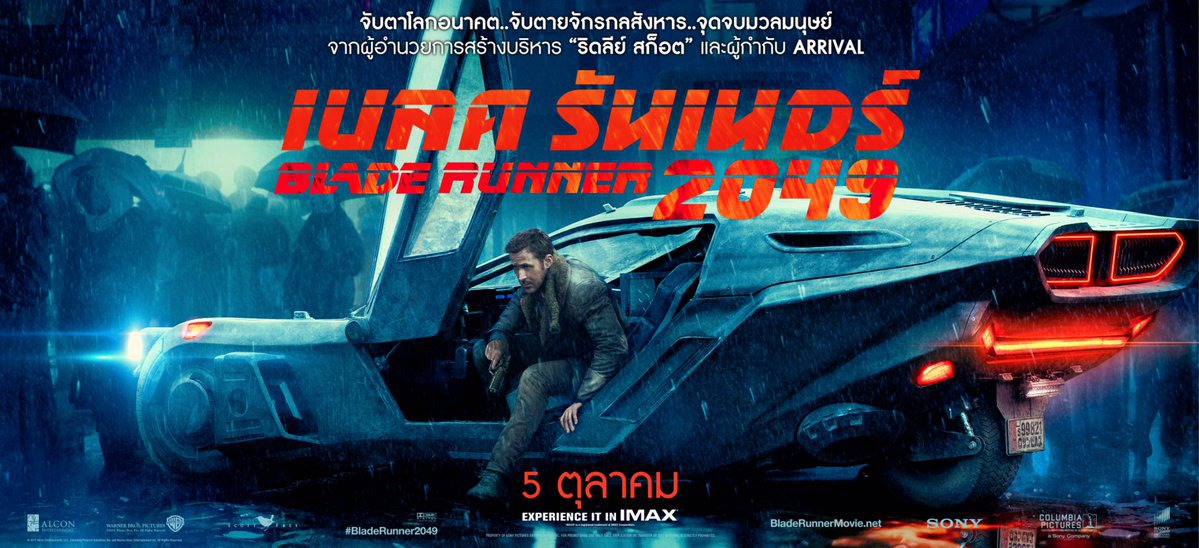
As Blade Runner 2049 was shown at a local cinema in a Nuit du Cinéma special, my daughter and I took the opportunity to see the sequel to Blade Runner, despite the late hour. And both came back quite enthusiastic about it! Maybe the plot stands a bit thin at times, with too many coincidences and the evil ones being too obviously evil, but the rendering of this future of the former future LA of the original Blade Runner is amazingly complex and opening many threads of potential explanations. And many more questions, which is great. With fascinating openings into almost philosophical questions like the impossible frontier between humans and AIs or the similarly impossible definition of self… Besides, the filming, with a multiplicity of (drone) views, the use of light, from blurred white to glaring yellow and back to snow white, the photography, the musical track, almost overwhelming and more complex than Vangelis’ original, are all massively impressive. As for the quintessential question of how the sequel compares with the original film, I do not think it makes much sense: for one thing the sequel would not have been without the original, the filming has evolved with the era, from the claustrophobic and almost steam-punk film by Scott to this post-apocalyptic rendering by Villeneuve, both movies relating to Philip K Dick’s book in rather different ways (if fortunately avoiding sheep and goats!).

blade runner [book review]

Posted in Books, Kids with tags , , , , , , , on November 12, 2017 by xi'an

As the new Blade Runner 2049 film is now out, I realised I have never read the original Philip K Dick novel, Do Androids Dream of Electric Sheep?… So, when I came by it in the wonderful Libreria Marcopolo in Venezia last month, with some time to kill waiting for a free dinner table nearby (and a delicious plate of spaghetti al nero di seppia!), I bought at last the book and read it within a couple evenings. (Plus a trip back from the airport.) While the book is fascinating, both in its construction and in its connection with the first Blade Runner movie, I am somehow disappointed now I have finished it, as I was expecting a somewhat deeper story. [Warning: spoilers to follow!] On the one hand, the post-nuclear California and the hopeless life of those who cannot emigrate to Mars are bleaker and more hopeless than Ridley Scott’s film, with the yearning of Deckard for real animals (rather than his electric sheep) a major focus of the book. And only of the book. For a reason that remains unclear to me, especially because Deckard grows more and more empathic towards androids, and not only towards the ambiguous and fascinating Rachael, while being less and less convinced of his ability to “retire” rogue androids… And of distinguishing between humans and androids. And also because he ends up nurturing a toad he spotted in a deserted location, believing it to be a real animal. The background of the society, its reliance on brainless reality shows and on a religion involving augmented reality, all are great components of the novel, although they feel a bit out-dated fifty years later. (And later than the date the story is supposed to take place.) The human sheltering and helping the fugitive androids is a “chickenhead”, term used in the book for the challenged humans unable to pass the tests for emigrating to Mars. Rather than a robot designer and geek as in the film.

On the other hand, the quasi- or near-humanity of the androids hunted by Deckard is much more better rendered in the film. (Maybe simply because it is a film and hence effortlessly conveys this humanity of actors playing androids. Just like C3PO in Star Wars!) Which connections with expressionisms à la Fritz Lang and noir movies of the 50’s are almost enough to make it a masterpiece. In the book, the androids are much more inconsistent, with repeated hints that they miss some parts of the human experience. There is no lengthy fight between Deckard and the superior (android) Roy. No final existentialist message from the later. And no rescuing of Deckard that makes the android stand ethically (and literally) above Deckard. The only android with some depth is Rachael, albeit with confusing scenes. (If not as confusing as the sequence at the alternative police station that just does not make sense. Unless Deckard himself is an android, a possibility hardly envisioned in the book,.) While Scott’s Blade Runner may seem to hammer its message a wee bit too heavily, it does much better at preserving ambiguity on who is human and who is not, and at the murky moral ground of humans versus androids. In fine, I remain more impacted by the multiple dimensions, perceptions, and uncertainties in Blade Runner.  Than in Philip K Dick’s novel. Still worth reading or re-reading against watching or re-watching these movies…

[Some book covers on this page are taken from a webpage with 23 alternative covers for Do androids dream of electronic sheep?”.]

sex, lies, & brain scans [not a book review]

Posted in Statistics with tags , , , , , , , on February 11, 2017 by xi'an

“Sahakian and Gottwald discuss the problem of “reverse inference” regrettably late in the book.”

In the book review section of Nature [Jan 12, 2017 issue], there was a long coverage of the book sex. lies, & brain scans: How fMRI Reveals What Really Goes on in our Minds, by Barbara J. Sahakian and Julia Gottwald. While I have not read the book (which is not even yet out on amazon), I found some mentions of associating brain patterns with criminal behaviour quite puzzling: “neuroimaging will probably be an imperfect predictor of criminal behaviour”. Actually, much more than puzzling, both frightening with its Minority Report prospects [once again quoted as a movie rather than Philip K. Dick’s novel!], and bordering the irrational, for associating breaking rules with a brain pattern. Of course this is just an impression from reading a book review and the attempts may be restricted to psychological diseases rather than attempt at social engineering and brain policing, but if this is the case, as suggested by the review, it is downright scary!