 On the 25 June edition, an editorial calling Europe to lead on free and open science, while boosting industrial consequences. (By the way, Japan just joined Horizon Europe! While the UK will rejoin Erasmus in 2027, under the headline “Brexit tore apart European science — now the research rifts are healing“, mentioning the financial and visa unsolved issues.) A news article continuing the investigation of how AI impacts or will impact mathematical research, with a FirstProof test evaluating AIs solving new, research-level, maths problems. (But missing Claude Mythos and Google’s Aletheia.) A “comment” from a Chinese academic that science needs humanities, at a time when universities in the UK are closing some humanities departments. And a discussion of the exceptional discovery of a whale necropolis, 7km deep, with fossil remains dating back to 5M years mixed with recent ones. Plus another exciting 10 page paper about genetic sleuthing on population changes at the collapse of the Roman empire, in the Danube-Isar and Rhein-Main areas of present-day Germany. (The attached picture representing posterior estimates of life expectancies of some individuals, obtained by MCMC.) In the Carreers section, a story from a geography researcher whose job offer was rescinded at the last moment, a scary thing that is alas not so rare.
Archive for Genetics
Nature tidbits
Posted in Books, Statistics, University life with tags AI, Brexit, Britain, Danube, fossils, Genetics, Germany, Horizon Europe, humanities, Isar, Japan, LLMs, Main, MCMC, Nature, Rhein, Roman Empire, whales on August 29, 2026 by xi'anthe dark side of Asilomar
Posted in Books, Kids, pictures, Travel with tags Asilomar conference centre, bioweapon, book review, California, DNA, drug company, family trip, Genetics, Monterey, Nature, patent, recombinant DNA, US politics, USSR on March 28, 2025 by xi'an
Stories of your life and Others [book review]
Posted in Books, Kids, University life with tags 1950's, AI, alien intelligence, alternative reality, Amazing Stories, Babel tower, book review, calliagnosia, CHANCE, cover, eugenism, evolutionary biology, Genetics, golem, Kurt Gödel, linguistics, Nature, Pascal's wager, Philosophy of religions, steampunk, Ted Chiang, Victorian society on March 18, 2025 by xi'an Just finished the book Stories of your life and Others by Ted Chiang, which like the later Exhalation I deeply enjoyed. The book was published in 2001, with some of its stories appearing as early as 1990, hence this book review is of little relevance when many reviews and commentaries have been published, including academic reviews. (No chance for CHANCE, then!)
“Perhaps you have not noticed that the lower classes are reproducing at a rate exceeding that of the nobility and gentry (…) Consequently, our nation would eventually drown in coarse dullards.” (p.186)
While the original cover seems to cater to old-fashion science-fictions books and magazine of the 1950’s, like Amazing Stories, the contents are much more philosophical than science-fiction-al, even when the universe (or the physical laws that) Chiang creates relies on elaborate construction based on science. (Same thing happens with Exhalation.) With a take on religions and their logical loopholes that I particularly enjoy, like Hell is the Absence of God, where the central character is no given the choice of Pascal’s wager. And the nonsense of attributing handicaps and hardships to dog’s testing impacted individuals, as well as the involuntary humour in the innocent casualties resulting from angels visiting Earth. Some stories I liked less, like Understand, about a superhuman emerging from drug tests since the end cannot keep up with the premises. But others I really appreciated, from Babel, set in a naïve (very medieval) version of the World, with a flat Earth and a solid sky. To Division by Zero, where a Gödelian mathematician pushes the impossibility theorem to ruin all of mathematics, and to the superb Seventy Two Letters, that mixes cybernetics, Kabbalists’ golem, genetics and eugenics, in a Victorian setting that could make it pass for a steampunk story, but I disagree with this label since the novella somewhat runs backwards by returning to a freedom of choice that trumps eugenic goals, while aligned with the Victorian perception of science. The same with Story of Your Life, about constructing communication channels with a perplexing if peaceful alien race, whose purpose for this attempt is never clear, which is not an issue with enjoying the built-up of an understanding, as well as the disrupted time-frame of the narration. Or even the short (Nature) story, The Evolution of Human Science, which reflects the very real concern that AI could take over research, into directions that would escape human understanding (not a good signal for i!). Leaving hermeneutics (of AI research) to humans. And the final Liking what you see, a clever variation on the issues of “lookism”, the “burden” of beauty, and an imagined condition called calliagnosia that makes people insensitive to beauty or lack thereof in a person.
stops making sense [cover
Posted in Books, pictures with tags amino acid, Blastocrithidia nonstop, codon, cover, Genetics, mRNA, Nature, protein coding on February 22, 2023 by xi'an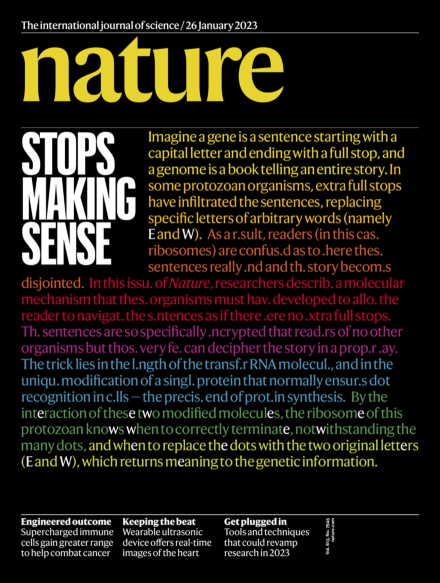
ABC & the eighth plague of Egypt [locusts in forests]
Posted in Books, pictures, Statistics, Travel, University life with tags ABC, ABC-RF, Africa, Bible code, desert locust, evolutionary biology, Exodus, FAO, Genetics, microsatellite markers, PCI Evol Biol, phylogeography, plague, population demography, random forests on April 6, 2021 by xi'an“If you refuse to let them go, I will bring locusts into your country tomorrow. They will cover the face of the ground so that it cannot be seen. They will devour what little you have left after the hail, including every tree that is growing in your fields. They will fill your houses and those of all your officials and all the Egyptians.” Exodus 10:3-6

The present-day distribution of extant species is the result of the interplay between their past population demography (e.g., expansion, contraction, isolation, and migration) and adaptation to the environment (…) The understanding of the key factors driving species evolution gives important insights into how the species may respond to changing conditions, which can be particularly relevant for the management of harmful species, such as agricultural pests.
Meaningful demographic inferences present major challenges. These include formulating evolutionary scenarios fitting species biology and the eco-geographical context and choosing informative molecular markers and accurate quantitative approaches to statistically compare multiple demographic scenarios and estimate the parameters of interest. A further issue comes with result interpretation. Accurately dating the inferred events is far from straightforward since reliable calibration points are necessary to translate the molecular estimates of the evolutionary time into absolute time units (i.e. years). This can be attempted in different ways (…) Nonetheless, most experimental systems rarely meet these conditions, hindering the comprehensive interpretation of results.
The contribution of Chapuis et al. addresses these issues to investigate the recent history of the (…) desert locust (…) Owing to their fast mutation rate microsatellite markers offer at least two advantages: i) suitability for analyzing recently diverged populations, and ii) direct estimate of the germline mutation rate in pedigree samples (…) The main aim of the study is to infer the history of divergence of the two subspecies of the desert locust, which have spatially disjoint distribution corresponding to the dry regions of North and West-South Africa. They first use paleo-vegetation maps to formulate hypotheses about changes in species range since the last glacial maximum. Based on them, they generate 12 divergence models. For the selection of the demographic model and parameter estimation, they apply the recently developed ABC-RF approach (…) Some methodological novelties are also introduced in this work, such as the computation of the error associated with the posterior parameter estimates under the best scenario (…) The best-supported model suggests a recent divergence event of the subspecies of S. gregaria (around 2.6 kya) and a reduction of populations size in one of the subspecies (S. g. flaviventris) that colonized the southern distribution area. As such, results did not support the hypothesis that the southward colonization was driven by the expansion of African dry environments associated with the last glacial maximum (…) The estimated time of divergence points at a much more recent origin for the two subspecies, during the late Holocene, in a period corresponding to fairly stable arid conditions similar to current ones. Although the authors cannot exclude that their microsatellite data bear limited information on older colonization events than the last one, they bring arguments in favour of alternative explanations. The hypothesis privileged does not involve climatic drivers, but the particularly efficient dispersal behaviour of the species, whose individuals are able to fly over long distances (up to thousands of kilometers) under favourable windy conditions (…)
There is a growing number of studies in phylogeography in arid regions in the Southern hemisphere, but the impact of past climate changes on the species distribution in this region remains understudied relative to the Northern hemisphere. The study presented by Chapuis et al. offers several important insights into demographic changes and the evolutionary history of an agriculturally important pest species in Africa, which could also mirror the history of other organisms in the continent (…)
Microsatellite markers have been offering a useful tool in population genetics and phylogeography for decades (…) This study reaffirms the usefulness of these classic molecular markers to estimate past demographic events, especially when species- and locus-specific microsatellite mutation features are available and a powerful inferential approach is adopted. Nonetheless, there are still hurdles to overcome, such as the limitations in scenario choice associated with the simulation software used (e.g. not allowing for continuous gene flow in this particular case), which calls for further improvement of simulation tools allowing for more flexible modeling of demographic events and mutation patterns. In sum, this work not only contributes to our understanding of the makeup of the African biodiversity but also offers a useful statistical framework, which can be applied to a wide array of species and molecular markers.


