Archive for ABC-SMC

Inference in epidemic models w/o likelihoods

Posted in Statistics with tags , , , , , , , , , on July 21, 2010 by xi'an

“We discuss situations in which we think simulation-based inference may be preferable to likelihood-based inference.” McKinley, Cook, and Deardon, IJB

I only became aware last week of the paper Inference in epidemic models without likelihoods by McKinley, Cook and Deardon, published in the International Journal of Biostatistics in 2009. (Anyone can access the paper by becoming a guest, ie providing some information.) The paper is essentially a simulation experiment comparing ABC-MCMC and ABC-SMC with regular data augmentation MCMC. The authors experiment on the tolerance level, the choice of metric and of summary statistics, in an exponential inter-event process modelling. The setting is interesting, in particular because it applies to highly dangerous diseases like the Ebola fever—for which there is no known treatment and which is responsible for a 88% decline in observed chimpanzee populations since 2003!—. The conclusions are overall not highly surprising, namely that repeating simulations of the data points given one simulated parameter does not seem to contribute [much] to an improved approximation of the posterior by the ABC sample, that the tolerance level does not seem to be highly influential, that the choice of the summary statistics and of the calibration factors are important, and that ABC-SMC outperforms ABC-MCMC (MCMC remaining the reference). Slightly more surprising is the conclusion that the choice of the distance/metric influences the outcome. (I failed to read in the paper strong arguments supporting the above sentence stolen from the abstract.)

“There are always doubts that the estimated posterior really does correspond to the true posterior.” McKinley, Cook, and Deardon, IJB

On the “negative” side, this paper is missing the recent literature both on the nonparametric aspects of ABC and on the more adaptive [PMC] features of ABC-SMC, as processed in our Biometrika ABC-PMC paper and in Del Moral, Doucet and Jasra. (Again, this is not a criticism in that the paper got published in early 2009.) I think that using past simulations to build the proposal and the next tolerance and, why not!, the relevant statistics, would further the improvement brought by sequential methods. (The authors were aware of the correction of Sisson et al., and used instead the version of Toni et al. They also mention the arXived notes of Marc Beaumont, which started our prodding into ABC-PRC.) The comparison experiment is based on a single dataset, with fixed random walk variances for the MCMC algorithms, while the prior used in the simulation seems to me to be highly peaked around the true value (gamma rates of 0.1). Some of the ABC scenari do produce estimates that are rather far away from the references given by MCMC, take for instance the CABC-MCMC when the tolerance ε is 10 and R is 100.
Two more handbook chapters

Posted in Books, Statistics with tags , , , , , , , , , on February 16, 2010 by xi'an

As mentioned in my earlier post, I had to write a revised edition to my chapter Bayesian Computational Methods in the Handbook of Computational Statistics (second edition), edited by J. Gentle, W. Härdle and Y. Mori. And in parallel I was asked for a second chapter in a handbook on risk analysis, Bayesian methods and expert elicitation, edited by Klaus Böckner. So, on Friday, I went over the first edition of this chapter of the Handbook of Computational Statistics and added the most recent developments I deemed important to mention, like ABC, as well as recent SMC and PMC algorithms, increasing the length by about ten pages. Simultaneously, Jean-Michel Marin completed my draft for the other handbook and I submitted both chapters, as well as arXived one and then the other.

It is somehow interesting (on a lazy blizzardly Sunday afternoon with nothing better to do!) to look for the differences between those chapters aiming at the same description of important computational techniques for Bayesian statistics (and based on the same skeleton). The first chapter is broader and, with its  60 pages, it functions as a (very) short book on the topic. Given that the first version was written in 2003, the focus is more on latent variables with mixture models being repeatedly used as examples. Reversible jump also stands preeminently. In my opinion, it reads well and could be used as a primary entry for a short formal course on computational methods. (Even though Introducing Monte Carlo Methods with R is presumably more appropriate for a short course.)

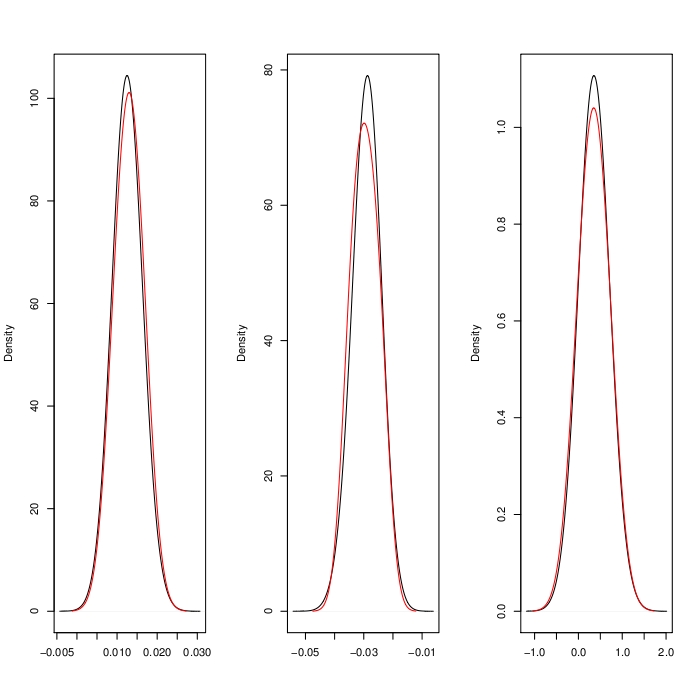
The second chapter started from the skeleton of the earlier version of the first chapter with the probit model as the benchmark example. I worked on a first draft during the last vacations and then Jean-Michel took over to produce this current version, where reversible jump has been removed and ABC introduced with greater details. In particular, we used a very special version of ABC with the probit model, resorting to the distance between the expectations of the binary observables, namely

\sum_{j=1}^n (\Phi(x_j^\text{T} \beta) - \Phi(x_j^\text{T} \hat\beta) )^2,

where \hat\beta is the MLE of \beta based on the observations, instead of the difference between the simulated and the observed binary observables

\sum_{j=1}^n (y_j-y_j^0)^2

which incorporates a useless randomness. With this choice, and when using for \epsilon a .01 quantile, the difference with the true posterior on \beta is very small, as shown by the figure (obtained for the Pima Indian dataset in R). Obviously, this stabilising trick only works in specific situations where a predictive of sorts can be computed.

Trip to Montpellier & StatLearn10

Posted in Statistics, Travel, University life with tags , , , , on January 28, 2010 by xi'an

Today, I went to Montpellier for a meeting of our EMILE ANR team, but when I got to the airport at 6:30 this morning, the fuel providers went on an impromptu strike, which lasted for about one hour! I cannot see the point of such mini-strikes… Anyway, I managed to eventually reach Montpellier and we had a good working session around the ABC paper entitled “An Adaptive Sequential Monte Carlo Method for Approximate Bayesian Computation” by Pierre Del Moral, Arnaud Doucet and Ajay Jasra and discussed in that earlier post and available on-line, if not on arXiv.

Jean-Michel Marin also mentioned to me a workshop taking place in Paris in the next couple of days, called StatLearn10 and focussing on Challenging problems in Statistical Learning (organised by Charles Bouveron and Gilles Celeux). Given that my agenda is already full for those days, I am going to miss the workshop but it sure looked interesting!