Archive for astronomy

running MCMC for too long…

Posted in Books, pictures, Running, Statistics, University life with tags , , , , , , , , on October 20, 2013 by xi'an

Clifton observatory, Clifton, Sept. 24, 2012Here is an excerpt from an email I just received from a young astronomer with whom I have had many email exchanges about the nature and implementation of MCMC algorithms, not making my point apparently:

The acceptance ratio turn to be good if I used (imposed by me) smaller numbers of iterations. What I think I am doing wrong is the convergence criteria. I am not stopping when I should stop.

To which I replied he should come (or Skype) and talk with me as I cannot get into enough details to point out his analysis is wrong… It may be the case that the MCMC algorithm finds a first mode, explores its neighbourhood (hence a good acceptance rate and green signals for convergence), then wanders away, attracted by other modes. It may also be the case the code has mistakes. Anyway, you cannot stop a (basic) MCMC algorithm too late or let it run for too long! (Disclaimer: the picture of an observatory seen from across Brunel’s suspension bridge in Bristol is unrelated to the young astronomer!)

trip to Besançon (and the stars)

Posted in Mountains, pictures, Statistics, Travel, University life with tags , , , , , , , , , on November 26, 2012 by xi'an

Today, I made a quick TGV trip to Besançon, in French Jura, to give a seminar to astronomers and physicists, in connection with the Gaia project I had mentioned earlier. I gave my talk straight out of the train and then we started discussing MCMC and ABC for the astronomy problems my guests face. To my surprise, I discovered that they do run some local form of ABC, using their own statistics and distances to validate simulation from the (uniform) prior on their parameter space. The discussion went far enough to take a peek under the hood, namely to look at some Fortran programs they are running (and make suggestions for acceleration and adaptation). It is quite interesting to see that ABC is actually a natural approach when people face complex likelihoods and that, while they construct appropriate tools, they feel somehow uncertain about the validation of those methods and are unaware of very similar tools in other fields. In addition to this great day of exchange, I had several hours of freedom in the train (and a plug) to work on the bayess package for Bayesian Essentials (not dead yet!). Here are my slides, pot-pourri of earlier talks. (Including the one on cosmology model choice in Vancouver.)

Gaia

Posted in Statistics, University life with tags , , , , , , , , on September 19, 2012 by xi'an

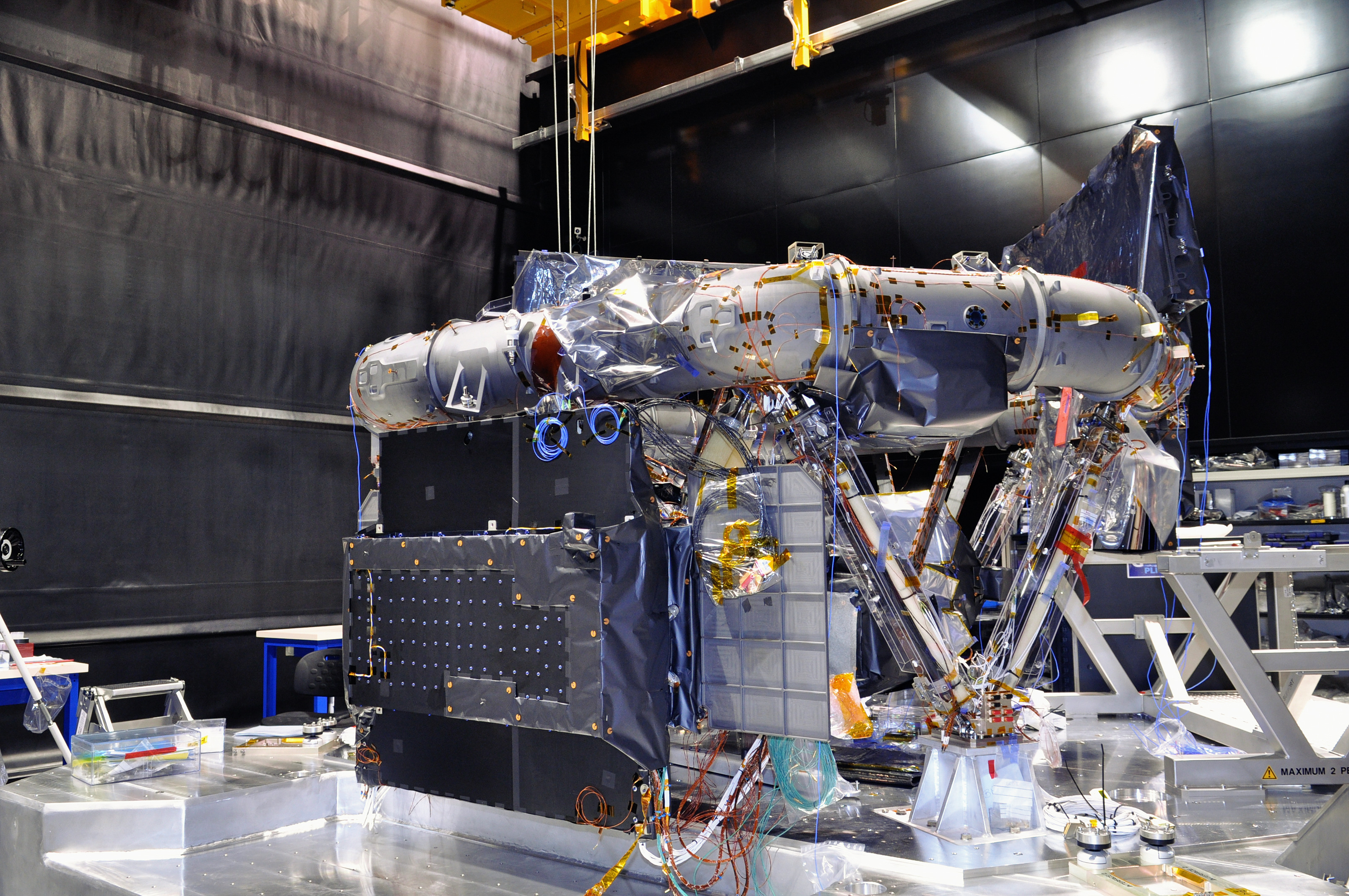
Today, I attended a meeting at the Paris observatory about the incoming launch of the Gaia satellite and the associated data (mega-)challenges. To borrow from the webpage, “To create the largest and most precise three dimensional chart of our Galaxy by providing unprecedented positional and radial velocity measurements for about one billion stars in our Galaxy and throughout the Local Group.” The amount of data that will be produced by this satellite is staggering: Gaia will take pictures of roughly 1Giga pixels that will be processed both on-board and on Earth, transmitting over five years a pentabyte of data that need to be processed fairly efficiently to be at all useful! The European consortium operating this satellite has planned for specific tasks dedicated to data handling and processing, which is a fabulous opportunity for would-be astrostatisticians! (Unsurprisingly, at least half of the tasks are statistics related, either at the noise reduction stage or at the estimation stage.) Another amazing feature of the project is that it will result in open data, the outcome of the observations being open to everyone for analyse… I am clearly looking forward the next meeting to understand better the structure of the data and the challenges simulation methods could help to solve!

CosmoPMC released

Posted in R, Statistics, University life with tags , , , , , , on January 13, 2011 by xi'an

Martin Kilbinger, an astronomer (cosmologist) with whom we had worked on population Monte Carlo for cosmological inference [during the ANR-05-BLAN-0283- 04 ANR ECOSSTAT grant], has made the PMC C codes available on the CosmoPMC webpage. He has also written a CosmoPMC manual that is now available from arXiv. And he very kindly associated me to this publication, even though I never directly contributed to the codes… On a wider perspective, this collaboration between cosmologists and Bayesian and computational statisticians was both fruitful and enjoyable and I hope we can pursue it in the future. A very nice thing about astronomers (among many!) is that they naturally adopt a Bayesian way of thinking about their parameters. This, plus their high math and programming skills, makes the cost of entering a collaboration very low!

Position at Imperial

Posted in Statistics, University life with tags , , , on October 23, 2010 by xi'an

A tantalising (in my opinion!) position of Chair in (Bayesian) Astrostatistics at Imperial College London:

The Astrophysics Group at Imperial College London invites applications for a position in statistical astrophysics at the level of Professor or Reader in the Physics Department. The post is available from 1 September 2011. This position is part of a broader initiative in astrostatistics in collaboration with the Statistics Group of the Mathematics Department. As part of this initiative, the department will appoint two further positions at Lecturer level, one in the Physics Department, one held jointly with the Statistics Group.