Archive for Bayesian lasso

JSM 2024, Portland, Day 3

Posted in pictures, Running, Statistics, Travel, University life with tags , , , , , , , , , , , , , , , , , , , , , , , , , , , , , , , , , , on August 9, 2024 by xi'an

Bayesian contributed session as the first round of the third day (with a choice of five parallel sessions featuring Bayesian topics!!, actually easier to pick than among the following eight parallel sessions of the 10:30 schedule!!!), with a talk by Tahir Ekin on adversarial outlier detection that could connect with our Oceaner(c) privacy concerns. Then one involving spike & slab (a theme to figure prominently in this special day!!) in mixed response models by Sameer Deshpande, seeking a (unBayesian!) MAP for a latent variable model by Monte Carlo EM. Followed by a talk by Yunyi Shen on completely random measures for estimating the (distribution of the) number of species in heterogeneous populations. Next, Valentin Zulj on (frequentist rather than) Bayesian stacking, on estimating optimal weights for model averaging (which should be posterior probabilities in a pure Bayesian mindframe), including a score function that could lead to generalised Bayesian inference on said weights. Finishing with a talk by Chaegeun Song on correcting Bayesian credible sets towards (frequentist, again!!!) exact coverage for classification (which reminded me of my very first paper with George on correcting frequentist confidence for Binomial observations). With which I could not really engage as seeking a specific coverage level did not seem relevant, imho, but I appreciated the wheel plot representation.My second morn session was about modern (what else?!) sampling algorithms, although I spent the first dozen minutes wondering whether or not I had entered the wrong room. Until Tianhao Wang focussed on Thompson sampling for bandits. It did prove far enough from my interest for my (sleep deprived) attention to drift too quickly. Only the talk by Yuchen Wu on a spike & slab (as suits the day!) challenge captured enough this wandering attention. Crossing further into my realm of primary topics by considering a target distribution that is a product of distributions. But I did not get from her presentation how a product measure decomposition was inducing higher efficiency (and did not find answers within the arXived preprint). Unless it exploited specific features of the target, like conditional independence between the components. The last talk was by Brice Huang on sampling low temperature Gibbs measures using stochastic localisation.

After coming upon a row of food trucks across the conference centre and being unfairly attracted by an Ethiopian injera picture into a terrible wrap, I returned for the Skeptical about AI session, just a few minutes late, only to find accessing the session was impossible! Quite sad to miss the presentations and the arguments (even though I had heard a previous talk by Genevera Allen when visiting Rutgers two years ago). As a second best, I then joined the recent (of course!) Advances in Bayesian Computation (aka ABC?!) session with a medley of topics, including a data subset versus data sketching model reduction by Sudipto Saha. Which could have consequences on our privacy strategies. And marginal evidence estimation for the Bayesian Lasso by Christopher Hans while avoiding data completion. And another latent variable model with a sequential variational Bayes approach by Bao Anh Vu, using at one point Cappé et al. (2005) EM-based approximation to the log likelihood gradient. Finishing by a back-to-the-future talk by Luke Duttweiler on MCMC convergence diagnostics. Comparing several chains via proximity maps that themselves require some preliminary knowledge about the MCMC kernel. (Nice title though, “the traceplot thickens”!)The crux of the day was however the 2024 COPSS Award ceremony with several friends featuring among the recipients, Danielle Durante for the Emerging Leaders Award, Regina Liu for the Elizabeth L. Scott Award and Veronika Rockova for the Presidents’ Award. Congrats!!!


on control variates

Posted in Books, Kids, Statistics, University life with tags , , , , , , , , , , , , on May 27, 2023 by xi'an

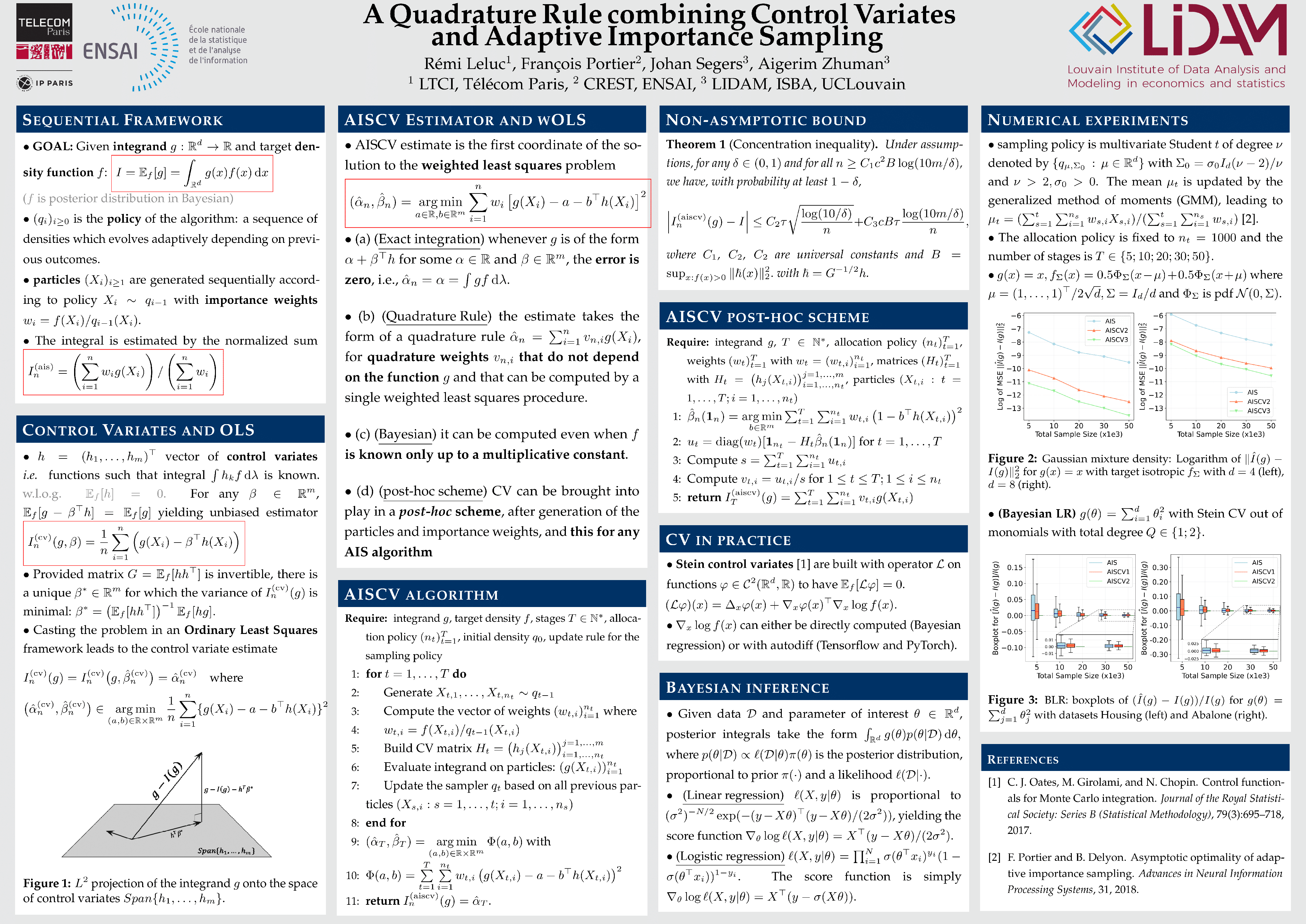
A few months ago, I had to write a thesis evaluation of Rémi Leluc’s PhD, which contained several novel Monte Carlo proposals on control variates and importance techniques. For instance, Leluc et al. (Statistics and Computing, 2021) revisits the concept of control variables by adding a perspective of control variable selection using LASSO. This prior selection is relevant since control variables are not necessarily informative about the objective function being integrated and my experience is that the more variables the less reliable the improvement. The remarkable feature of the results is in obtaining explicit and non-asymptotic bounds.

The author obtains a concentration inequality on the error resulting from the use of control variables, under strict assumptions on the variables. The associated numerical experiment illustrates the difficulties of practically implementing these principles due to the number of parameters to calibrate. I found the example of a capture-recapture experiment on ducks (European Dipper) particularly interesting, not only because we had used it in our book but also because it highlights the dependence of estimates on the dominant measure.

Based on a NeurIPS 2022 poster presentation Chapter 3 is devoted to the use of control variables in sequential Monte Carlo, where a sequence of importance functions is constructed based on previous iterations to improve the approximation of the target distribution. Under relatively strong assumptions of importance functions dominating the target distribution (which could generally be achieved by using an increasing fraction of the data in a partial posterior distribution), of sub-Gaussian tails of an intractable distribution’s residual, a concentration inequality is established for the adaptive control variable estimator.

This chapter uses a different family of control variables, based on a Stein operator introduced in Mira et al. (2016). In the case where the target is a mixture in IRd, one of our benchmarks in Cappé et al. (2008), remarkable gains are obtained for relatively high dimensions. While the computational demands of these improvements are not mentioned, the comparison with an MCMC approach (NUTS) based on the same number of particles demonstrates a clear improvement in Bayesian estimation.

Chapter 4 corresponds to a very recent arXival and presents a very original approach to control variate correction by reproducing the interest rate law through an approximation using the closest neighbor (leave-one-out) method. It requires neither control function nor necessarily additional simulation, except for the evaluation of the integral, which is rather remarkable, forming a kind of parallel with the bootstrap. (Any other approximation of the distribution would also be acceptable if available at the same computational cost.) The thesis aims to establish the convergence of the method when integration is performed by a Voronoi tessellation, which leads to an optimal rate of order n-1-2/d for quadratic error (under conditions of integrand regularity). In the alternative where the integral must be evaluated by Monte Carlo, this optimality disappears, unless a massive amount of simulations are used. Numerical illustrations cover SDEs and a Bayesian hierarchical modeling already used in Oates et al. (2017), with massive gain in both cases.

likelihood-free inference by ratio estimation

Posted in Books, Mountains, pictures, Running, Statistics, Travel, University life with tags , , , , , , , , , , , , , , , on September 9, 2019 by xi'an

“This approach for posterior estimation with generative models mirrors the approach of Gutmann and Hyvärinen (2012) for the estimation of unnormalised models. The main difference is that here we classify between two simulated data sets while Gutmann and Hyvärinen (2012) classified between the observed data and simulated reference data.”

A 2018 arXiv posting by Owen Thomas et al. (including my colleague at Warwick, Rito Dutta, CoI warning!) about estimating the likelihood (and the posterior) when it is intractable. Likelihood-free but not ABC, since the ratio likelihood to marginal is estimated in a non- or semi-parametric (and biased) way. Following Geyer’s 1994 fabulous estimate of an unknown normalising constant via logistic regression, the current paper which I read in preparation for my discussion in the ABC optimal design in Salzburg uses probabilistic classification and an exponential family representation of the ratio. Opposing data from the density and data from the marginal, assuming both can be readily produced. The logistic regression minimizing the asymptotic classification error is the logistic transform of the log-ratio. For a finite (double) sample, this minimization thus leads to an empirical version of the ratio. Or to a smooth version if the log-ratio is represented as a convex combination of summary statistics, turning the approximation into an exponential family,  which is a clever way to buckle the buckle towards ABC notions. And synthetic likelihood. Although with a difference in estimating the exponential family parameters β(θ) by minimizing the classification error, parameters that are indeed conditional on the parameter θ. Actually the paper introduces a further penalisation or regularisation term on those parameters β(θ), which could have been processed by Bayesian Lasso instead. This step is essentially dirving the selection of the summaries, except that it is for each value of the parameter θ, at the expense of a X-validation step. This is quite an original approach, as far as I can tell, but I wonder at the link with more standard density estimation methods, in particular in terms of the precision of the resulting estimate (and the speed of convergence with the sample size, if convergence there is).

ISBA 2016 [#5]

Posted in Mountains, pictures, Running, Statistics, Travel with tags , , , , , , , , , , , , , on June 18, 2016 by xi'an

from above Forte Village, Santa Magherita di Pula, Sardinia, June 17, 2016On Thursday, I started the day by a rather masochist run to the nearby hills, not only because of the very hour but also because, by following rabbit trails that were not intended for my size, I ended up being scratched by thorns and bramble all over!, but also with neat views of the coast around Pula.  From there, it was all downhill [joke]. The first morning talk I attended was by Paul Fearnhead and about efficient change point estimation (which is an NP hard problem or close to). The method relies on dynamic programming [which reminded me of one of my earliest Pascal codes about optimising a dam debit]. From my spectator’s perspective, I wonder[ed] at easier models, from Lasso optimisation to spline modelling followed by testing equality between bits. Later that morning, James Scott delivered the first Bayarri Lecture, created in honour of our friend Susie who passed away between the previous ISBA meeting and this one. James gave an impressive coverage of regularisation through three complex models, with the [hopefully not degraded by my translation] message that we should [as Bayesians] focus on important parts of those models and use non-Bayesian tools like regularisation. I can understand the practical constraints for doing so, but optimisation leads us away from a Bayesian handling of inference problems, by removing the ascertainment of uncertainty…

Later in the afternoon, I took part in the Bayesian foundations session, discussing the shortcomings of the Bayes factor and suggesting the use of mixtures instead. With rebuttals from [friends in] the audience!

This session also included a talk by Victor Peña and Jim Berger analysing and answering the recent criticisms of the Likelihood principle. I am not sure this answer will convince the critics, but I won’t comment further as I now see the debate as resulting from a vague notion of inference in Birnbaum‘s expression of the principle. Jan Hannig gave another foundation talk introducing fiducial distributions (a.k.a., Fisher’s Bayesian mimicry) but failing to provide a foundational argument for replacing Bayesian modelling. (Obviously, I am definitely prejudiced in this regard.)

The last session of the day was sponsored by BayesComp and saw talks by Natesh Pillai, Pierre Jacob, and Eric Xing. Natesh talked about his paper on accelerated MCMC recently published in JASA. Which surprisingly did not get discussed here, but would definitely deserve to be! As hopefully corrected within a few days, when I recoved from conference burnout!!! Pierre Jacob presented a work we are currently completing with Chris Holmes and Lawrence Murray on modularisation, inspired from the cut problem (as exposed by Plummer at MCMski IV in Chamonix). And Eric Xing spoke about embarrassingly parallel solutions, discussed a while ago here.

variational Bayes for variable selection

Posted in Books, Statistics, University life with tags , , , , , , , on March 30, 2016 by xi'an

Lake Agnes, Canadian Rockies, July 2007Xichen Huang, Jin Wang and Feng Liang have recently arXived a paper where they rely on variational Bayes in conjunction with a spike-and-slab prior modelling. This actually stems from an earlier paper by Carbonetto and Stephens (2012), the difference being in the implementation of the method, which is less Gibbs-like for the current paper. The approach is not fully Bayesian in that, not only an approximate (variational) representation is used for the parameters of interest (regression coefficient and presence-absence indicators) but also the nuisance parameters are replaced with MAPs. The variational approximation on the regression parameters is an independent product of spike-and-slab distributions. The authors show the approximate approach is consistent in both frequentist and Bayesian terms (under identifiability assumptions). The method is undoubtedly faster than MCMC since it shares many features with EM but I still wonder at the Bayesian interpretability of the outcome, which writes out as a product of estimated spike-and-slab mixtures. First, the weights in the mixtures are estimated by EM, hence fixed. Second, the fact that the variational approximation is a product is confusing in that the posterior distribution on the regression coefficients is unlikely to produce posterior independence.