 A number of entries of interest [to me] in that Nature issue: from the Capuchin monkeys that break stones in a way that resembles early hominins biface tools, to the persistent association between some sounds and some meanings across numerous languages, to the use of infected mosquitoes in South America to fight Zika, to the call for more maths in psychiatry by the NIMH director, where since prevision is mentioned I presumed stats is included, to the potentially earthshaking green power revolution in Africa, to the reconstruction of the first HIV strains in North America, along with the deconstruction of the “Patient 0” myth, helped by Bayesian phylogenetic analyses, to a cover of the Open Syllabus Project, with Monte Carlo Statistical Methods arriving first [in the Monte Carlo list]….
“Observations should not converge on one model but aim to find anomalies that carry clues about the nature of dark matter, dark energy or initial conditions of the Universe. Further observations should be motivated by testing unconventional interpretations of those anomalies (such as exotic forms of dark matter or modified theories of gravity). Vast data sets may contain evidence for unusual behaviour that was unanticipated when the projects were conceived.” Avi Loeb
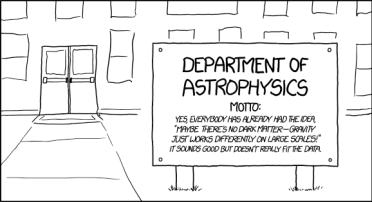 One editorial particularly drew my attention, Good data are not enough, by the astronomer Avi Loeb. as illustrated by the quote above, Loeb objects to data being interpreted and even to data being collected towards the assessment of the standard model. While I agree that this model contains a lot of fudge factors like dark matter and dark energy, which apparently constitutes most of the available matter, the discussion is quite curious, in that interpreting data according to alternative theories sounds impossible and certainly beyond the reach of most PhD students [as Loeb criticises the analysis of some data in a recent thesis he evaluated].
“modern cosmology is augmented by unsubstantiated, mathematically sophisticated ideas — of the multiverse, anthropic reasoning and string theory.
The author argues to always allow for alternative interpretations of the data, which sounds fine at a primary level but again calls for the conception of such alternative models. When discrepancies are found between the standard model and the data, they can be due to errors in the measurement itself, in the measurement model, or in the theoretical model. However, they may be impossible to analyse outside the model, in the neutral way called and wished by Loeb. Designing neutral experiments sounds even less meaningful. Which is why I am fairly taken aback by the call to “a research frontier [that] should maintain at least two ways of interpreting data so that new experiments will aim to select the correct one”! Why two and not more?! And which ones?! I am not aware of fully developed alternative theories and cannot see how experiments designed under one model could produce indications about a new and incomplete model.
“Such simple, off-the-shelf remedies could help us to avoid the scientific fate of the otherwise admirable Mayan civilization.”
Hence I am bemused by the whole exercise, which deepest arguments seem to be a paper written by the author last year and an interdisciplinary centre on black holes also launched recently by the same author.
 Morning of diverse short talks. First one on What are the chances? Explaining ε towards endusers by presenting odds and illustrating the impact of including one potential user’s data. Then one on re-placing DP within CI in terms of causality. And multi-agent models, illustrated by the Cambridge Analytics scandal. I am still not getting the point of the CI perspective which sounds to me like an impossibility theorem. A bit as if Statistics had stopped at “All models are wrong” (as Keynes did, in a way). And a talk on Uses & misuses of DP inference, with nice drawings explaining that publicly available information (eg, smoking causes cancer) may create breaches of privacy (Alice may have cancer). Last talk of the morning on framing effects as privileging data processors and overly technical? Fundamental law of information privacy? Got me wondering about the lack (?) of dynamic perspective so far, in the (simplistic?) sense that DP does not seem to account for potential breaches were a secondary dataset to become available with shared subjects and record linkage. (A bit of a go at GDPR, for the second time within a week.)
 Before, I had a rather nice early morning in woods on top of Okanagan Lake, crossing many white tailed deer, hopefully no ticks!, as well as No trespassing signs. And a quick and c…ool swim in the Lake 20⁰ waters. No sign of the large wildfires raging south in Osoyoos or north in Kalmoops. We had a fantastic lunch break at the nearby Arrowleaf Cellars winery, with a stellar pinot noir, although this rather made the following working session harder to engage with (not mentioning the lingering jetlag)!


