After enjoying very much the first book, Hue & Cry, in the Hew Cullan series by Shirley McKay, I bought the following ones and read Fate & Fortune over the vacation break. If anything, I enjoyed this one even more, as it disclosed other aspects of 16th Century Scotland, still with the oppressive domination of the Kirk, the highly puritan Church of Scotland, over all aspects of everyday life, but also a more rational form of Law, plus the first instances of caitch, imported from France jeu de paume. And the medical approach of the time against an epidemics of syphilis. And the dangerous life of printers at the time, always in danger of arrest and worse. As usual with historical whodunits, it is hard to guess what is genuinely from 1580’s and what has been imported from the present era, but this is a most pleasant (light and short) book to read!
Archive for Edinburgh
Fate & Fortune [book review]
Posted in Books, Travel with tags caitch, Church of Scotland, Edinburgh, hue & cry, real tennis, Scotland, Shirley McKay, St. Andrew on February 10, 2019 by xi'anhue & cry [book review]
Posted in Statistics with tags book review, Church of Scotland, Edinburgh, hue & cry, Scotland, St. Andrew, witchery on December 8, 2018 by xi'an While visiting the Blackwell’s bookstore by the University of Edinburgh last June, I spotted this historical whodunit in the local interest section. Hue & Cry by Shirley McKay. It stayed on a to-read pile by my bed until a few weeks ago when I started reading it and got more and more engrossed in the story. While the style is not always at its best and the crime aspects are somewhat thin, I find the description of the Scottish society of the time (1570’s) fascinating (and hopefully accurate), especially the absolute dominion of the local Church (Kirk) on every aspect of life and the helplessness of women always under the threat of witchcraft accusations. Which could end up with the death penalty, as in thousands of cases. The book reminds me to some extent of the early Susanna Gregory’s books in that it also involves scholars, teaching well-off students with limited intellectual abilities, while bright but poorer students have to work for the college to make up for their lack of funds. As indicated above, the criminal part is less interesting as the main investigator unfolds the complicated plot without much of a hint. And convinces the juries rather too easily in my opinion. An overall fine novel, nonetheless!
the naming of the Dead [book review]
Posted in Statistics with tags Auchterader, book review, Edinburgh, Edinburgh Castle, G8, G8 meeting, George W Bush, Gleneagles, Ian Rankin, ISBA 2018, Rebus, Scotland, Scottish crime novel, the naming of the Dead on July 21, 2018 by xi'an When leaving for ISBA 2018 in Edinburgh, I picked a Rebus book in my bookshelf, book that happened to be The Naming of the Dead, which was published in 2006 and takes place in 2005, during the week of the G8 summit in Scotland and of the London Underground bombings. Quite a major week in recent British history! But also for Rebus and his colleague Siobhan Clarke, who investigate a sacrificial murder close, too close, to the location of the G8 meeting and as a result collide with superiors, secret services, protesters, politicians, and executives, including a brush with Bush ending up with his bike accident at Gleneagles, and ending up with both of them suspended from the force. But more than this close connection with true events in and around Edinburgh, the book is a masterpiece, maybe Rankin’s best, because of the depiction of the characters, who have even more depth and dimensions than in the other novels. And for the analysis of the events of that week. Having been in Edinburgh at the time I started re-reading the book also made the description of the city much more vivid and realistic, as I could locate and sometimes remember some places. (The conclusion of some subplots may be less realistic than I would like them to be, but this is of very minor relevance.)
ABC variable selection
Posted in Books, Mountains, pictures, Running, Statistics, Travel, University life with tags ABC in Edinburgh, ABC model choice, ABC variable selection, Arthur's Seat, BART, Bayesian CART, CART, Edinburgh, ISBA 2018, random forests, Scotland, Susie Bayarri on July 18, 2018 by xi'an Prior to the ISBA 2018 meeting, Yi Liu, Veronika Ročková, and Yuexi Wang arXived a paper on relying ABC for finding relevant variables, which is a very original approach in that ABC is not as much the object as it is a tool. And which Veronika considered during her Susie Bayarri lecture at ISBA 2018. In other words, it is not about selecting summary variables for running ABC but quite the opposite, selecting variables in a non-linear model through an ABC step. I was going to separate the two selections into algorithmic and statistical selections, but it is more like projections in the observation and covariate spaces. With ABC still providing an appealing approach to approximate the marginal likelihood. Now, one may wonder at the relevance of ABC for variable selection, aka model choice, given our warning call of a few years ago. But the current paper does not require low-dimension summary statistics, hence avoids the difficulty with the “other” Bayes factor.
In the paper, the authors consider a spike-and… forest prior!, where the Bayesian CART selection of active covariates proceeds through a regression tree, selected covariates appearing in the tree and others not appearing. With a sparsity prior on the tree partitions and this new ABC approach to select the subset of active covariates. A specific feature is in splitting the data, one part to learn about the regression function, simulating from this function and comparing with the remainder of the data. The paper further establishes that ABC Bayesian Forests are consistent for variable selection.
“…we observe a curious empirical connection between π(θ|x,ε), obtained with ABC Bayesian Forests and rescaled variable importances obtained with Random Forests.”
The difference with our ABC-RF model choice paper is that we select summary statistics [for classification] rather than covariates. For instance, in the current paper, simulation of pseudo-data will depend on the selected subset of covariates, meaning simulating a model index, and then generating the pseudo-data, acceptance being a function of the L² distance between data and pseudo-data. And then relying on all ABC simulations to find which variables are in more often than not to derive the median probability model of Barbieri and Berger (2004). Which does not work very well if implemented naïvely. Because of the immense size of the model space, it is quite hard to find pseudo-data close to actual data, resulting in either very high tolerance or very low acceptance. The authors get over this difficulty by a neat device that reminds me of fractional or intrinsic (pseudo-)Bayes factors in that the dataset is split into two parts, one that learns about the posterior given the model index and another one that simulates from this posterior to compare with the left-over data. Bringing simulations closer to the data. I do not remember seeing this trick before in ABC settings, but it is very neat, assuming the small data posterior can be simulated (which may be a fundamental reason for the trick to remain unused!). Note that the split varies at each iteration, which means there is no impact of ordering the observations.
ISBA 18 tidbits
Posted in Books, Mountains, pictures, Running, Statistics, Travel, University life with tags ABC, ABC in Edinburgh, Bayesian inference, coreset, deep learning, Edinburgh, empirical likelihood, Ironman Edinburgh, ISBA 2018, kilt, marginal likelihood, misspecification, misspecified model, non-local priors, non-parametrics, PAC-Bayesian, posters, Scotland on July 2, 2018 by xi'an
Among a continuous sequence of appealing sessions at this ISBA 2018 meeting [says a member of the scientific committee!], I happened to attend two talks [with a wee bit of overlap] by Sid Chib in two consecutive sessions, because his co-author Ana Simoni (CREST) was unfortunately sick. Their work was about models defined by a collection of moment conditions, as often happens in econometrics, developed in a recent JASA paper by Chib, Shin, and Simoni (2017). With an extension about moving to defining conditional expectations by use of a functional basis. The main approach relies on exponentially tilted empirical likelihoods, which reminded me of the empirical likelihood [BCel] implementation we ran with Kerrie Mengersen and Pierre Pudlo a few years ago. As a substitute to ABC. This problematic made me wonder on how much Bayesian the estimating equation concept is, as it should somewhat involve a nonparametric prior under the moment constraints.
Note that Sid’s [talks and] papers are disconnected from ABC, as everything comes in closed form, apart from the empirical likelihood derivation, as we actually found in our own work!, but this could become a substitute model for ABC uses. For instance, identifying the parameter θ of the model by identifying equations. Would that impose too much input from the modeller? I figure I came with this notion mostly because of the emphasis on proxy models the previous day at ABC in ‘burgh! Another connected item of interest in the work is the possibility of accounting for misspecification of these moment conditions by introducing a vector of errors with a spike & slab distribution, although I am not sure this is 100% necessary without getting further into the paper(s) [blame conference pressure on my time].
Another highlight was attending a fantastic poster session Monday night on computational methods except I would have needed four more hours to get through every and all posters. This new version of ISBA has split the posters between two sites (great) and themes (not so great!), while I would have preferred more sites covering all themes over all nights, to lower the noise (still bearable this year) and to increase the possibility to check all posters of interest in a particular theme…
Mentioning as well a great talk by Dan Roy about assessing deep learning performances by what he calls non-vacuous error bounds. Namely, through PAC-Bayesian bounds. One major comment of his was about deep learning models being much more non-parametric (number of parameters rising with number of observations) than parametric models, meaning that generative adversarial constructs as the one I discussed a few days ago may face a fundamental difficulty as models are taken at face value there.
On closed-form solutions, a closed-form Bayes factor for component selection in mixture models by Fũqene, Steel and Rossell that resemble the Savage-Dickey version, without the measure theoretic difficulties. But with non-local priors. And closed-form conjugate priors for the probit regression model, using unified skew-normal priors, as exhibited by Daniele Durante. Which are product of Normal cdfs and pdfs, and which allow for closed form marginal likelihoods and marginal posteriors as well. (The approach is not exactly conjugate as the prior and the posterior are not in the same family.)
And on the final session I attended, there were two talks on scalable MCMC, one on coresets, which will require some time and effort to assimilate, by Trevor Campbell and Tamara Broderick, and another one using Poisson subsampling. By Matias Quiroz and co-authors. Which did not completely convinced me (but this was the end of a long day…)
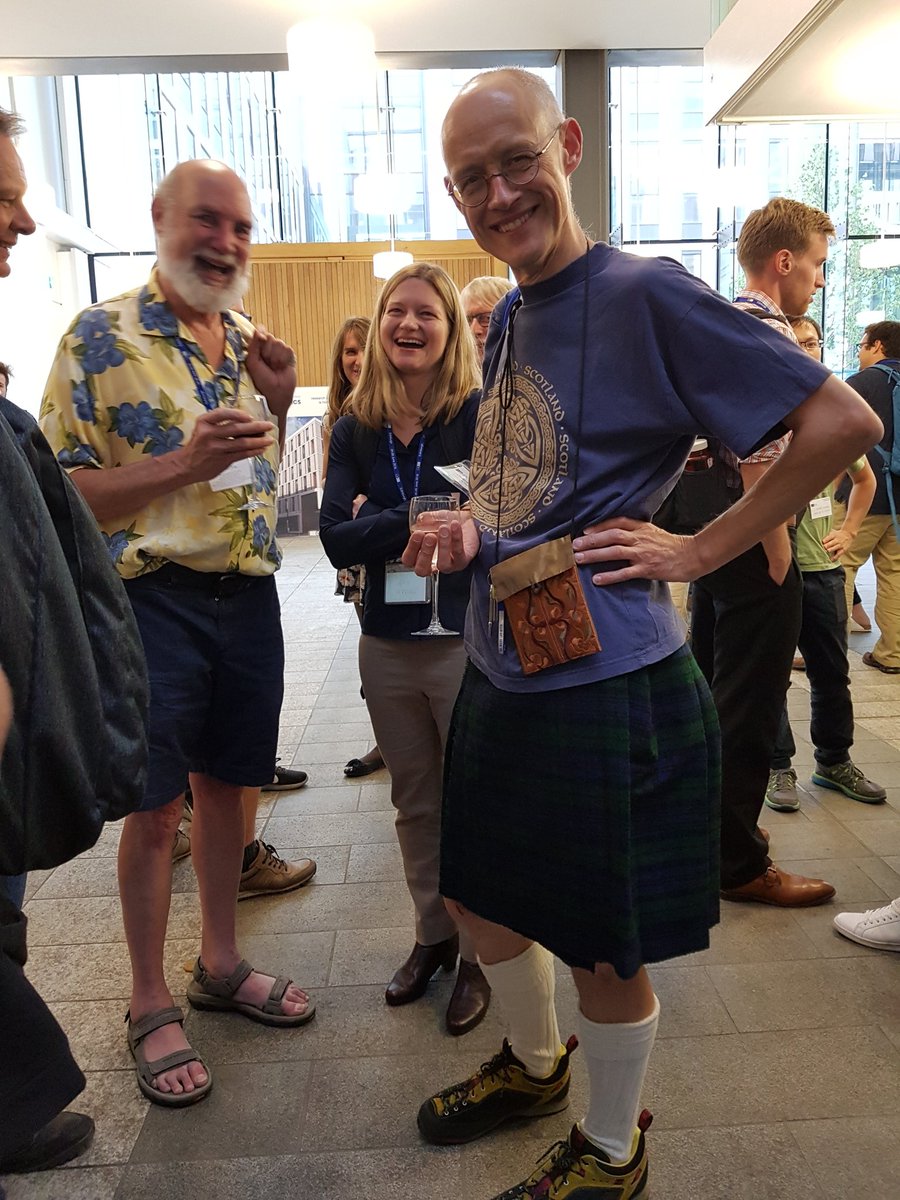
All in all, this has been a great edition of the ISBA meetings, if quite intense due to a non-stop schedule, with a very efficient organisation that made parallel sessions manageable and poster sessions back to a reasonable scale [although I did not once manage to cross the street to the other session]. Being in unreasonably sunny Edinburgh helped a lot obviously! I am a wee bit disappointed that no one else follows my call to wear a kilt, but I had low expectations to start with… And too bad I missed the Ironman 70.3 Edinburgh by one day!