Archive for inference

Monte Carlo methods for Potts models

Posted in pictures, Statistics, University life with tags , , , , on March 10, 2016 by xi'an

poincareThere will be a seminar talk by Mehdi Molkaraie (Pompeu Fabra) next week at Institut Henri Poincaré (IHP), Paris, on his paper with Vincent Gomez.

We consider the problem of estimating the partition function of the ferromagnetic q-state Potts model. We propose an importance sampling algorithm in the dual of the normal factor graph representing the model. The algorithm can efficiently compute an estimate of the partition function when the coupling parameters of the model are strong (corresponding to models at low temperature) or when the model contains a mixture of strong and weak couplings. We show that, in this setting, the proposed algorithm significantly outperforms the state of the art methods.

The talk is at 14:30, March 17. It is part of a trimester program on information and computation theories I was completely unaware of.

causality

Posted in Books, Statistics, University life with tags , , , , , , , , , , on March 7, 2016 by xi'an

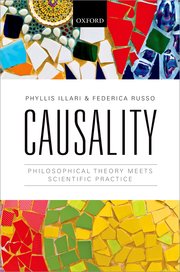
Oxford University Press sent me this book by Phyllis Illari and Frederica Russo, Causality (Philosophical theory meets scientific practice) a little while ago. (The book appeared in 2014.) Unless I asked for it, I cannot remember…

“The problem is whether and how to use information of general causation established in science to ascertain individual responsibility.” (p.38)

As the subtitle indicates, this is a philosophy book, not a statistics book. And not particularly intended for statisticians. Hence, I am not exactly qualified to analyse its contents, and even less to criticise its lack of connection with statistics. But this being a blog post…  I read rather slowly through the book, which exposes a wide range (“a map”, p.8) of approaches and perspectives on the notions of causality, some ways to infer about causality, and the point of doing all this, concluding with a relativistic (and thus eminently philosophical) viewpoint defending a “pluralistic mosaic” or a “causal mosaic” that relates to all existing accounts of causality as they “each do something valuable” (p.258). From a naïve bystander perspective, this sounds like a new avatar of deconstructionism applied to causality.

“Simulations can be very illuminating about various phenomena that are complex and have unexpected effects (…) can be run repeatedly to study a system in different situations to those seen for the real system…” (p.15)

This is not to state that the book is uninteresting, as it provides a wide entry into philosophical attempts at categorising and defining causality, if not into the statistical aspects of the issue. (For instance, the problem whether or not causality can be proven uniquely from a statistical perspective is not mentioned.) Among those interesting points in the early chapters, a section (2.5) about simulation. Which however misses the depth of this earlier book on climate simulations I reviewed while in Monash. Or of the discussions at the interdisciplinary seminar last year in Hanover. I.J. Good’s probabilistic causality is mentioned but hardly detailed. (With the warning remark that one “should not confuse predictability with determinism [and] determinism with causality”, p.82.) Continue reading →

Principles of scientific methods [not a book review]

Posted in Books, pictures, Statistics, University life with tags , , , , , , , , , , on November 11, 2014 by xi'an

Mark Chang, author of Paradoxes in Scientific Inference and vice-president of AMAG Pharmaceuticals, has written another book entitled Principles of Scientific Methods. As was clear from my CHANCE review of Paradoxes in Scientific Inference, I did not find much appeal in this earlier book, even after the author wrote a reply (first posted on this blog and later printed in CHANCE). Hence a rather strong reluctance [of mine] to engage into another highly critical review when I received this new opus by the same author. [And the brainwave cover just put me off even further, although I do not want to start a review by criticising the cover, it did not go that well with the previous attempts!]

After going through Principles of Scientific Methods, I became ever more bemused about the reason(s) for writing or publishing such a book, to the point I decided not to write a CHANCE review on it… (But, having spent some Métro rides on it, I still want to discuss why. Read at your own peril!)

Continue reading →

from statistical evidence to evidence of causality

Posted in Books, Statistics with tags , , , , , , , , , on December 24, 2013 by xi'an

I took the opportunity of having to wait at a local administration a long while today (!) to read an arXived paper by Dawid, Musio and Fienberg on the−both philosophical and practical−difficulty to establish the probabilities of the causes of effects. The first interesting thing about the paper is that it relates to the Médiator drug scandal that took place in France in the past year and still is under trial: thanks to the investigations of a local doctor, Irène Frachon, the drug was exposed as an aggravating factor for heart disease. Or maybe the cause. The case-control study of Frachon summarises into a 2×2 table with a corrected odds ratio of 17.1. From there, the authors expose the difficulties of drawing inference about causes of effects, i.e. causality, an aspect of inference that has always puzzled me. (And the paper led me to search for the distinction between odds ratio and risk ratio.)

“And the conceptual and implementational difficulties that we discuss below, that beset even the simplest case of inference about causes of effects, will be hugely magnified when we wish to take additional account of such policy considerations.”

A third interesting notion in the paper is the inclusion of counterfactuals. My introduction to counterfactuals dates back to a run in the back-country roads around Ithaca, New York, when George told me about a discussion paper from Phil he was editing for JASA on that notion with his philosopher neighbour Steven Schwartz as a discussant. (It was a great run, presumably in the late Spring. And the best introduction I could dream of!) Now, the paper starts from the counterfactual perspective to conclude that inference is close to impossible in this setting. Within my limited understanding, I would see that as a drawback of using counterfactuals, rather than of drawing inference about causes. If the corresponding statistical model is nonindentifiable, because one of the two responses is always missing, the model seems inappropriate. I am also surprised at the notion of “sufficiency” used in the paper, since it sounds like the background information cancels the need to account for the treatment (e.g., aspirin) decision.  The fourth point is the derivation of bounds on the probabilities of causation, despite everything! Quite an interesting read thus!

machine learning [book review]

Posted in Books, R, Statistics, University life with tags , , , , , , , on October 21, 2013 by xi'an

I have to admit the rather embarrassing fact that Machine Learning, A probabilistic perspective by Kevin P. Murphy is the first machine learning book I really read in detail…! It is a massive book with close to 1,100 pages and I thus hesitated taking it with me around, until I grabbed it in my bag for Warwick. (And in the train to Argentan.) It is also massive in its contents as it covers most (all?) of what I call statistics (but visibly corresponds to machine learning as well!). With a Bayesian bent most of the time (which is the secret meaning of probabilistic in the title).

“…we define machine learning as a set of methods that can automatically detect patterns in data, and then use the uncovered patterns to predict future data, or to perform other kinds of decision making under uncertainty (such as planning how to collect more data!).” (p.1)

Apart from the Introduction—which I find rather confusing for not dwelling on the nature of errors and randomness and on the reason for using probabilistic models (since they are all wrong) and charming for including a picture of the author’s family as an illustration of face recognition algorithms—, I cannot say I found the book more lacking in foundations or in the breadth of methods and concepts it covers than a “standard” statistics book. In short, this is a perfectly acceptable statistics book! Furthermore, it has a very relevant and comprehensive selection of references (sometimes favouring “machine learning” references over “statistics” references!). Even the vocabulary seems pretty standard to me. All this makes me wonder why we at all distinguish between the two domains, following Larry Wasserman’s views (for once!) that the difference is mostly in the eye of the beholder, i.e. in which department one teaches… Which was already my perspective before I read the book but it comforted me even further. And the author agrees as well (“The probabilistic approach to machine learning is closely related to the field of statistics, but differs slightly in terms of its emphasis and terminology”, p.1). Let us all unite!

[..part 2 of the book review to appear tomorrow…]