
Archive for ISI
one of our most-cited papers, really?!
Posted in Books, Statistics, University life with tags automated email, citations, effective sample size, ESS, International Statistical Institute, International Statistical Review, ISBA 2024, ISI, ISR, spams, Venice on July 22, 2024 by xi'an
Tanuka Chattopadhyay (26 Jan 1963 – 16 Oct 2023)
Posted in Statistics, Travel, University life with tags applied mathematics, ASI, Astrophysics, astrostatistics, Bangalore, IAU, India, ISI, IUCAA, Kolkata, obit, Pune, Statistics, University of Calcutta, West Bengal on November 25, 2023 by xi'an Most sadly, I learned today that applied mathematics Professor Tanuka Chattopadhyay, from the University of Calcutta, had passed away last month. We had been briefly collaborating after I met her and her husband Asis Chattopadhyay, also Professor of Statistics at the University of Calcutta, following a Franco-Indian workshop in Bangalore. Discussing research directions in astrostatistics in Kolkata and later in Paris, when they visited. We had not been in touch for a few years and I was not aware she was severely ill. Dedicated researcher and mentor, as well as contributing to the administration of the University in many ways, she was versed in classical Indian culture and I will keep the memory of our conversations, esp. the one on New Year’s Ewe in Kolkata.
What follows is an obituary written by Professor Ajit Kembhavi.
Professor Tanuka Chattopadhyay (née Kanjilal), a member of the Astronomical Society of India, passed away on October 16th this year, at the age of 60, after a long and heroic battle with cancer. She was a Professor in the Department of Applied Mathematics of the University of Calcutta. She has been Head of the Department and Dean, Faculty of Science, Calcutta University. At her demise she was Director, Center for Research in Nanoscience and Nanotechnology of the University.Tanuka was from an early age very interested in mathematics. To take that interest further, she joined Presidency College, Kolkata from where she completed her degree in Mathematics with Honours in 1983. For post graduate studies she joined the Department of Applied Mathematics where she got interested in Astrophysics. She later worked for a Ph.D. under the supervision of Professor Baidyanath Basu on Explosion in the central region of the Galaxy, the consequent star formation, formation of molecular clouds and structure of shocks.
Over the years Tanuka worked on a variety of topics. Her earliest papers were on squalls, thunderstorms and convective instability. From these terrestrial considerations her interest soon shifted to molecular clouds, star formation and density waves in the Galaxy. In later years she worked on globular clusters, galaxies with special interest in dwarf and ultra-compact galaxies, Gamma-ray bursts, statistical simulation and computation. In much of her work she used advanced statistical methods to get the most out of available astronomical data. She has published about 50 papers in international journals, and written four books, including Statistical Methods for Astronomical Data Analysis written with her husband Professor Asis Kumar Chattopadhyay, published by Springer and awarded an outstanding publication award in Astrostatistics by the International Astrostatistics Association. Tanuka successfully completed several national and international funded projects and was a frequent visitor to several leading universities in Canada, France and the USA, where she had long collaborations. She supervised a number of Ph.D. students and was a respected teacher and mentor.Tanuka was a Visiting Associate of IUCAA, Pune from 2002 until she passed away. I met her during her first visits to IUCAA, and we soon became friends and collaborators. We were later joined by her husband Asis Chattopadhyay, who is a Professor at the Department of Statistics in the University of Calcutta and was a Pro-Vice Chancellor and Acting Vice Chancellor of the University. Asis soon became a Visiting Associate of IUCAA and the three of us organised a number of workshops in Kolkata and other places on statistical methods and their application to the analysis of astronomical data. Tanuka was a Fellow of West Bengal Academy of Science and member of several organisations including the International Astronomical Union (IAU), Astronomical Society of India, and the International Astrostatistics Association.Using funds obtained under the DST PURSE programme, Tanuka obtained a 14” optical telescope. This was installed in 2015 on the terrace of a building in Rajabazar College and was used for sky watching, as well as carrying our research projects, by students of the Department of Applied Mathematics and other departments of the University. She was also planning to start an outreach programme for school children in Kolkata. Making the telescope available was an exemplary initiative from a person who was a mathematician and a theoretical astrophysicist.In spite of her illness, which stretched over several years, Tanuka remained brave, cheerful and full of spirit, and continued to work very hard. A few months ago, she, Dipankar Banerjee and I were speakers at a meeting celebrating the birth centenary of Professor M. K. Dasgupta. It was impossible for me to then believe that the dynamic speaker was gravely ill, with further treatment not really possible. She talked to me about a visit to IUCAA in December and I was sure she would really come. But about five weeks after the event, she had to be admitted to hospital one night, after having spent the evening attending a meeting in the Vice-Chancellor’s office. She did not return.Tanuka had many interests outside astrophysics. She wrote two Bengali novels Bibashan and Gandhari Santoti. She was completing her first English novel when she passed away, which her family hopes to publish posthumously. She had an artistic nature, had formal training in music and dance and was greatly interested in travel and culture. She was a wonderful wife, mother and mother-in-law, a great hostess and beloved friend, and respected guide and mentor to many. She will be greatly missed.Ajit Kembhavi
IUCAA and Pune Knowledge Cluster
Natural statistical science [#1]
Posted in Books, pictures, Statistics, University life with tags Calyampudi Radhakrishna Rao, data science, India, Indian Statistical Institute, International Prize in Statistics, ISI, Kolkata, Nature, obituary, R.A. Fisher, Rao-Blackwellisation, University of Cambridge on November 22, 2023 by xi'an
astrostat webinar [IAU-IAA]
Posted in pictures, Statistics, University life with tags astroinformatics, astrostatistics, G. Dou, IAA, IAU, International Astronomical Union, International Astrostatistics Association, ISI, mixture analysis, mixtures of distributions, seminar, slideshare, unknown number of components, webinar, Zoom on June 14, 2023 by xi'an Yesterday, I gavea talk on inferring the number of components in a mixture at the international online IAU-IAA Astrostats and Astroinfo seminar. Which generated (uniformly) interesting and relevant questions for astronomical challenges. As pointed out by my Cornell friend Tom Loredo, it is unfortunately clashing with the ISI quadrenial Statistical Challenges in Modern Astronomy meeting help at Penn State.
transformation MCMC
Posted in Books, pictures, Statistics, Travel, University life with tags detailed balance, Indian Statistical Institute, ISI, Kolkata, MCMC, Metropolis-Hastings algorithm, reversible jump MCMC, West Bengal on January 3, 2022 by xi'an For reasons too long to describe here, I recently came across a 2013 paper by Dutta and Bhattacharya (from ISI Kolkata) entitled MCMC based on deterministic transforms, which sounded a bit dubious until I realised the deterministic label apply to the choice of the transformation and not to the Metropolis-Hastings proposal… The core of the proposed method is to make a proposal that simultaneously considers a move and its inverse, namely from x to either x’=T(x,ε) or x”=T⁻¹(x,ε) , where ε is an independent random noise, possibly degenerated to a manifold of lesser dimension. Due to the symmetry the acceptance probability is then a ratio of the target, multiplied by the x-Jacobian of T (as in reversible jump). I tried the method on a mixture of Gamma distributions target (in red) with an Exponential scale change and the resulting sample indeed fitted said target.
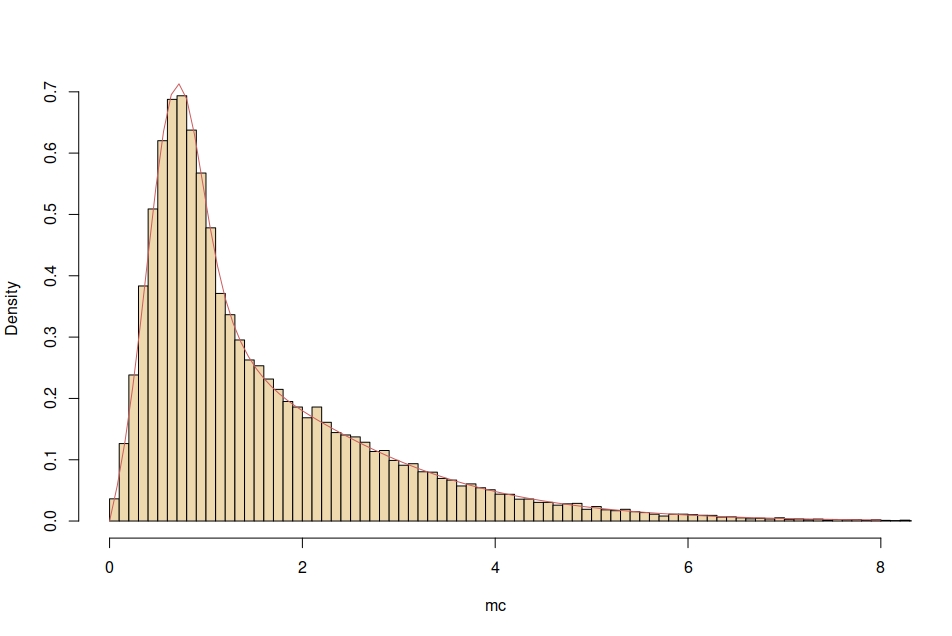 The authors even make an argument in favour of a unidimensional noise, although this amounts to running an implicit Gibbs sampler. Argument based on a reduced simulation cost for ε, albeit the full dimensional transform x’=T(x,ε) still requires to be computed. And as noted in the paper this also requires checking for irreducibility. The claim for higher efficiency found therein is thus mostly unsubstantiated…
“The detailed balance requirement also demands that, given x, the regions covered by the forward and the backward transformations are disjoint.”
The above statement is also surprising in that the generic detailed balance condition does not impose such a restriction.


