Archive for John Maynard Keynes

Keynes and the Society for imprecise probability

Posted in Books, Statistics with tags , , on March 30, 2010 by xi'an

When completing my comments on Keynes’ A Treatise On Probability, thanks to an Og’s reader, I found that Keynes is held in high esteem (as a probabilist) by the members of the Society for Imprecise Probability. The goals of the society are set as

The Society for Imprecise Probability: Theories and Applications (SIPTA) was created in February 2002, with the aim of promoting the research on imprecise probability. This is done through a series of activities for bringing together researchers from different groups, creating resources for information, dissemination and documentation, and making other people aware of the potential of imprecise probability models.

The Society has its roots in the Imprecise Probabilities Project conceived in 1996 by Peter Walley and Gert de Cooman and its creation has been encouraged by the success of the ISIPTA conferences.

Imprecise probability is understood in a very wide sense. It is used as a generic term to cover all mathematical models which measure chance or uncertainty without sharp numerical probabilities. It includes both qualitative (comparative probability, partial preference orderings, …) and quantitative modes (interval probabilities, belief functions, upper and lower previsions, …). Imprecise probability models are needed in inference problems where the relevant information is scarce, vague or conflicting, and in decision problems where preferences may also be incomplete.

The society sees J.M. Keynes as a precursor of the Dempster-Schafer perspective on probability, whose Bayesian version is represented in Peter Walley’s book, Statistical Reasoning with Imprecise Probabilities, due to the mention in Keynes’ A Treatise On Probability thanks to the remark made by Keynes (Chapter XV) that “many probabilities can be placed between numerical limits”. Given that the book does not extrapolate on how to take advantage of this generalisation of probabilities, but instead sees it as an impediment to probabilise the parameter space, I would think this remark is more representative of the general confusion made between true (i.e. model related) probabilities and their (observation based) estimates.

Keynes’ derivations

Posted in Books, Statistics with tags , , , , , on March 29, 2010 by xi'an

Chapter XVII of Keynes’ A Treatise On Probability contains Keynes’ most noteworthy contribution to Statistics, namely the classification of probability distributions such that the arithmetic/geometric/harmonic empirical mean/empirical median is also the maximum likelihood estimator. This problem was first stated by Laplace and Gauss (leading to Laplace distribution in connection with the median and to the Gaussian distribution for the arithmetic mean). The derivation of the densities f(x,\theta) of those probability distributions is based on the constraint the likelihood equation

\sum_{i=1}^n \dfrac{\partial}{\partial\theta}\log f(y_i,\theta) = 0

is satisfied for one of the four empirical estimate, using differential calculus (despite the fact that Keynes earlier derived Bayes’ theorem by assuming the parameter space to be discrete). Under regularity assumptions, in the case of the arithmetic mean, my colleague Eric Séré showed me this indeed leads to the family of distributions

f(x,\theta) = \exp\left\{ \phi^\prime(\theta) (x-\theta) - \phi(\theta) + \psi(x) \right\}\,,

where \phi and \psi are almost arbitrary functions under the constraints that \phi is twice differentiable and f(x,\theta) is a density in x. This means that \phi satisfies

\phi(\theta) = \log \int \exp \left\{ \phi^\prime(\theta) (x-\theta) + \psi(x)\right\}\, \text{d}x\,,

a constraint missed by Keynes.

While I cannot judge of the level of novelty in Keynes’ derivation with respect to earlier works, this derivation therefore produces a generic form of unidimensional exponential family, twenty-five years before their rederivation by Darmois (1935), Pitman (1936) and Koopman (1936) as characterising distributions with sufficient statistics of constant dimensions. The derivation of the distributions for which the geometric or the harmonic means are MLEs then follows by a change of variables, y=\log x,\,\lambda=\log \theta or y=1/x,\,\lambda=1/\theta, respectively. In those different derivations, the normalisation issue is treated quite off-handedly by Keynes, witness the function

f(x,\theta) = A \left( \dfrac{\theta}{x} \right)^{k\theta} e^{-k\theta}

at the bottom of page 198, which is not integrable in x unless its support is bounded away from 0 or \infty. Similarly, the derivation of the log-normal density on page 199 is missing the Jacobian factor 1/x (or 1/y_q in Keynes’ notations) and the same problem arises for the inverse-normal density, which should be

f(x,\theta) = A e^{-k^2(x-\theta)^2/\theta^2 x^2} \dfrac{1}{x^2}\,,

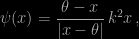
instead of A\exp k^2(\theta-x)^2/x (page 200). At last, I find the derivation of the distributions linked with the median rather dubious since Keynes’ general solution

f(x,\theta) = A \exp \left\{ \displaystyle{\int \dfrac{y-\theta}{|y-\theta|}\,\phi^{\prime\prime}(\theta)\,\text{d}\theta +\psi(x) }\right\}

(where the integral ought to be interpreted as a primitive) is such that the recovery of Laplace’s distribution, f(x,\theta)\propto \exp-k^2|x-\theta| involves setting (page 201)

\psi(x) = \dfrac{\theta-x}{|x-\theta|}\,k^2 x\,,

hence making \psi a function of \theta as well. The summary two pages later actually produces an alternative generic form, namely

f(x,\theta) = A \exp\left\{ \phi^\prime(\theta)\dfrac{x-\theta}{|x-\theta|}+\psi(x) \right\}\,,

with the difficulties that the distribution only vaguely depends on \theta, being then a step function times exp(\psi(x)) and that, unless \phi is properly calibrated, A also depends on \theta.

Given that this part is the most technical section of the book, this post shows why I am fairly disappointed at having picked this book for my reading seminar. There is no further section with innovative methodological substance in the remainder of the book, which now appears to me as no better than a graduate dissertation on the probabilistic and statistical literature of the (not that) late 19th century, modulo the (inappropriate) highly critical tone.

More on Treatise

Posted in Books, Statistics with tags , , , on March 25, 2010 by xi'an

When writing my review of Keynes’ A Treatise On Probability, I found that there is a very detailed review paper by John Aldrich (2008) that covers the beginnings of Keynes as a statistician, entitled “Keynes among the Statisticians” (sic!) and published in the journal History of Political Economy. This review is incredibly helpful in resetting the book in the conditions at the time. I also discovered through this review that Harold Jeffreys reviewed A Treatise On Probability in Nature and that Dennis Lindley wrote an Encyclopedia entry on Keynes, no less…

Quick visit to A Treatise on Probability

Posted in Books, Statistics with tags , , , on March 23, 2010 by xi'an

Following my advanced graduate course at CREST about Jeffreys’ Theory of Probability, and a remark in Taleb’s Fooled by Randomness, I was planning to cover John Maynard Keynes’ A Treatise On Probability this year. After reading the book over the past weeks, and pondering it over the nights at the Frontiers of Statistical Decision Making and Bayesian Analysis conference, I decided it could not provide enough material for a whole two week course. Since I was starting today just getting off the plane from Detroit, I decided to fall back on my earlier course on Jeffreys’ Theory of Probability and to include comments on Keynes’ A Treatise On Probability wherever they fitted… Indeed, I found that most of the book focussed on philosophical foundations of probability that were of no interest for me nor for my students, while the statistics part was not innovative enough. I will eventually write a review of the book listing those drawbacks but the main aspect of Keynes’ statistical perspective is to be highly suspicious of models and thus to favour empirical techniques that are close to modern bootstrap. In particular, Keynes criticises inverse probability techniques and Laplace’s perspective all over the book… This is thus an interesting historical foray but this memoir of Keynes prepared for a Fellowship application does not stand within the influential books of the 20th century for a good reason.