Archive for Laplace succession rule
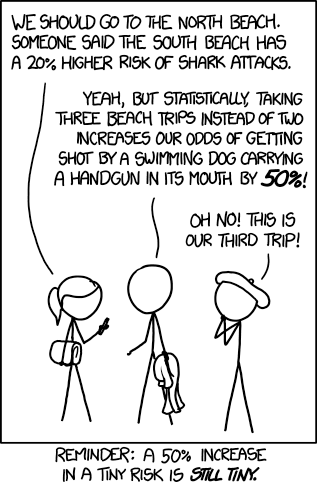
an easy pun on conditional risk[cd]
Posted in Books, Kids, Statistics with tags Bayes theorem, beach, compatible conditional distributions, Laplace succession rule, xkcd on September 22, 2013 by xi'an
Who’s #1?
Posted in Books, Kids, Statistics, University life with tags American football, book reviews, Brad Efron, Condorcet, Jim Albert, Kendall's tau, Laplace succession rule, Markov chains, optimization, Q*bert, ranking, ranking and selection, rating, Spearman footrule, sport statistics, statistics and sports on May 2, 2012 by xi'anFirst, apologies for this teaser of a title! This post is not about who is #1 in whatever category you can think of, from statisticians to climbs [the Eiger Nordwand, to be sure!], to runners (Gebrselassie?), to books… (My daughter simply said “c’est moi!” when she saw the cover of this book on my desk.) So this is in fact a book review of…a book with this catching title I received a month or so ago!
“We decided to forgo purely statistical methodology, which is probably a disappointment to the hardcore statisticians.” A.N. Langville & C.D. Meyer, Who’s #1? The Science of Rating and Ranking (page 225)

This book may be one of the most boring ones I have had to review so far! The reason for this disgruntled introduction to “Who’s #1? The Science of Rating and Ranking” by Langville and Meyer is that it has very little if any to do with statistics and modelling. (And also that it is mostly about American football, a sport I am not even remotely interested in.) The purpose of the book is to present ways of building rating and ranking within a population, based on pairwise numerical connections between some members of this population. The methods abound, at least eight are covered by the book, but they all suffer from the same drawback that they are connected to no grand truth, to no parameter from an underlying probabilistic model, to no loss function that would measure the impact of a “wrong” rating. (The closer it comes to this is when discussing spread betting in Chapter 9.) It is thus a collection of transformation rules, from matrices to ratings. I find this the more disappointing in that there exists a branch of statistics called ranking and selection that specializes in this kind of problems and that statistics in sports is a quite active branch of our profession, witness the numerous books by Jim Albert. (Not to mention Efron’s analysis of baseball data in the 70’s.)
“First suppose that in some absolutely perfect universe there is a perfect rating vector.” A.N. Langville & C.D. Meyer, Who’s #1? The Science of Rating and Ranking (page 117)
The style of the book is disconcerting at first, and then some, as it sounds written partly from Internet excerpts (at least for most of the pictures) and partly from local student dissertations… The mathematical level is highly varying, in that the authors take the pain to define what a matrix is (page 33), only to jump to Perron-Frobenius theorem a few pages later (page 36). It also mentions Laplace’s succession rule (only justified as a shrinkage towards the center, i.e. away from 0 and 1), the Sinkhorn-Knopp theorem, the traveling salesman problem, Arrow and Condorcet, relaxation and evolutionary optimization, and even Kendall’s and Spearman’s rank tests (Chapter 16), even though no statistical model is involved. (Nothing as terrible as the completely inappropriate use of Spearman’s rho coefficient in one of Belfiglio’s studies…)
“Since it is hard to say which ranking is better, our point here is simply that different methods can produce vastly different rankings.” A.N. Langville & C.D. Meyer, Who’s #1? The Science of Rating and Ranking (page 78)
I also find irritating the association of “science” with “rating”, because the techniques presented in this book are simply tricks to turn pairwise comparison into a general ordering of a population, nothing to do with uncovering ruling principles explaining the difference between the individuals. Since there is no validation for one ordering against another, we can see no rationality in proposing any of those, except to set a convention. The fascination of the authors for the Markov chain approach to the ranking problem is difficult to fathom as the underlying structure is not dynamical (there is not evolving ranking along games in this book) and the Markov transition matrix is just constructed to derive a stationary distribution, inducing a particular “Markov” ranking.
“The Elo rating system is the epitome of simple elegance.” A.N. Langville & C.D. Meyer, Who’s #1? The Science of Rating and Ranking (page 64)
An interesting input of the book is its description of the Elo ranking system used in chess, of which I did not know anything apart from its existence. Once again, there is a high degree of arbitrariness in the construction of the ranking, whose sole goal is to provide a convention upon which most people agree. A convention, mind, not a representation of truth! (This chapter contains a section on the Social Network movie, where a character writes a logistic transform on a window, missing the exponent. This should remind Andrew of someone he often refer to in his blog!)
“Perhaps the largest lesson is not to put an undue amount of faith in anyone’s rating.” A.N. Langville & C.D. Meyer, Who’s #1? The Science of Rating and Ranking (page 125)
In conclusion, I see little point in suggesting reading this book, unless one is interested in matrix optimization problems and/or illustrations in American football… Or unless one wishes to write a statistics book on the topic!
Frequency vs. probability
Posted in Statistics with tags E.T. Jaynes, Kolmogorov, Laplace succession rule, Lebesgue integration, measure theory, probability theory, The Bayesian Choice, urn models on May 6, 2011 by xi'an“Probabilities obtained by maximum entropy cannot be relevant to physical predictions because they have nothing to do with frequencies.” E.T. Jaynes, PT, p.366
“A frequency is a factual property of the real world that we measure or estimate. The phrase `estimating a probability’ is just as much an incongruity as `assigning a frequency’. The fundamental, inescapable distinction between probability and frequency lies in this relativity principle: probabilities change when we change our state of knowledge, frequencies do not.” E.T. Jaynes, PT, p.292
A few days ago, I got the following email exchange with Jelle Wybe de Jong from The Netherlands:
Q. I have a question regarding your slides of your presentation of Jaynes’ Probability Theory. You used the [above second] quote: Do you agree with this statement? It seems to me that a lot of ‘Bayesians’ still refer to ‘estimating’ probabilities. Does it make sense for example for a bank to estimate a probability of default for their loan portfolio? Or does it only make sense to estimate a default frequency and summarize the uncertainty (state of knowledge) through the posterior? Continue reading
Re-reading An Essay towards solving a Problem in the Doctrine of Chances
Posted in Books, Statistics with tags Bayes theorem, Laplace succession rule, Richard Price, Thomas Bayes on May 2, 2011 by xi'an
“We ought to estimate the chance that the probability for the happening of an event perfectly unknown, should lie between any two named degrees of probability, antecedently to any experiment made about it.” Letter of R. Price to J. Canton, Nov. 10, 1763
On a lazy and sunny Sunday afternoon, I re-read Thomas Bayes’ 1763 Essay. (It is available in LaTex, courtesy of Peter Lee.) The major part of the Essay is actually written by Richard Price, Bayes’ contribution being from page 376 to page 399. Most of the introduction by Price (in the form of a letter to John Canton) rephrases Bayes’ findings, but he stresses that Bayes set a “sure foundation for all our reasonings concerning past facts”. In the spirit of the time, he cannot prevent from relating the uncovering of “fixt laws according to which events happened” to the “existence of the Deity”. He also perceives Bayes’ rule as “solving the converse problem” from De Moivre’s Laws of Chances. At last, he stresses that, although chance should relate to past events, while probability relates to future events, the distinction should not impact conditional probability.
“Given the number of times in which an unknown event has happened and failed; Required the chance that the probability of its happening in a single trial lies somewhere between any two degrees of probability that can be named.” Th. Bayes
The Essay itself consists in (a) a “brief demonstration of the general laws of chance”, (b) the derivation of Bayes’ posterior distribution for the uniform-binomial problem, (c) the computation of the posterior probability of an arbitrary interval. The first part is a rewording of De Moivre’s Laws of Chance, in particular recalling the definition of a conditional probability. Maybe the definition of the probability is worth quoting
5. The probability of any event is the ratio between the value at which an expectation depending on the happening of the event ought to be computed and the value of the thing expected upon it’s happening.
because it actually defines a probability as a by-product of the expected number of occurrences within a binomial experiment. (There is therefore nothing frequentist in this definition!) The main part (and the huge novelty) in the Essay is the derivation of the Beta posterior. Surprisingly, the setup is introduced very abruptly (in that nowhere before were those balls mentioned!):
Postulate. 1. Suppose the square table or plane ABCD to be so made and levelled, that if either of the balls o or W be thrown upon it, there shall be the same probability that it re{\st}s upon any one equal part of the plane as another, and that it must necessarily rest somewhere upon it.
and then the derivation starts with a two-page derivation that the prior (uniform) cdf is the uniform cdf. The next result is Prop. 8 [388] that gives the joint probability that the binomial probability is between f and b and that the binomial experiment gives x=p:
the probability the point o should fall between f and b, any two points named in the line AB, and withall that the event M should happen p times and fail q in p+q trials, is the ratio of fghikmb, the part of the figure BghikmA intercepted between the perpendiculars fg, bm raised upon the line AB, to CA the square upon AB.
where the curve is y=xp(1-x)q.

The next proposition is then Bayes’ rule, still expressed in terms of surface ratio as above,
The same things supposed, I guess that the probability of the event M lies somewhere between 0 and the ratio of Ab to AB, my chance to be in the right is the ratio of Abm to AiB.
but clearly set within the Beta(p+1,q+1) distribution [in modern terms]. Bayes then inserts a scholium where he tries to justify the use of the uniform prior, however I do not see the validity of the reasoning since he seems to argue in favour of a uniform distribution on the marginal distribution of the binomial experiment:
I have no reason to think that, in a certain number of trials, it should rather happen any one possible number of times than another.
The last part of the Essay per se is about deriving a closed form formula for the Beta integral, a feat achieved in Rule I. [399]


in slightly more modern notations. The 18 remaining pages are written by Richard Price, who first reproduces Bayes’ approximations to the above integral with improvements of his own, then illustrates the performances of such approximations in specific cases, with the astounding fact that the probability covered by the approximation is centred at the MLE:

and not at the Bayes posterior mean. This could be extrapolated as one of the earliest confidence sets, except of course that the probability is over the parameter space. I note that Price also derives [409-410] as a consequence of Bayes’ calculations what is now know as Laplace’s succession rule…! Besides the derivation of the posterior distribution itself, which must be a considerable feat for the time, the attention to computational issues is highly commendable, as it would become a constant theme of Bayesian studies for centuries!!!
The reflection principle
Posted in Books, Statistics with tags Laplace succession rule, Le Monde, mathematical puzzle, reflection principle, William Feller on February 7, 2010 by xi'anIn the weekend magazine of Le Monde, there always is one mathematical puzzle that often is easy to solve but sometimes is harder (like the puzzles involving arcane triangular geometry!) and occasionally just impossible (because the puzzle is missing one crucial assumption). The puzzle of this week is a direct application of the reflection principle exposed in Chapter III of Feller’s An Introduction to Probability Theory and Its Applications, Vol. 1, which is my favourite probability book. (More precisely, the answer is (almost) given in problem 1, page 95 of this book.)
Given a sequence of 


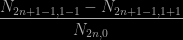

being the number of paths of length 


This has a potential connection with Laplace’s succession rule, but I cannot make it straight away because the underlying events of not visiting -1 are not independent…
If you want to check this by simulation, a simple R program is
Nsim=10^6; n=4
cont=0;gain=0
while (gain<Nsim){
vale=cumsum(sample(c(-1,1),2*n,rep=TRUE))
gain=gain+(vale[2*n]==0)
cont=cont+(vale[2*n]==0)*(min(vale)>-1)
}
print(cont/Nsim)
If you have never read An Introduction to Probability Theory and Its Applications, Vol. 1, you should consider doing it: it makes for a very pleasant read, while making combinatorics enjoyable and it also constitutes a wealth of problems that I use extensively when teaching at Polytechnique.


