 In the March 2016 issue of JASA that currently sits on my desk, there is a paper by Liang, Jim, Song and Liu on the adaptive exchange algorithm, which aims at handling posteriors for sampling distributions with intractable normalising constants. The concept behind the algorithm is the exchange principle initiated by Jesper Møller and co-authors in 2006, where an auxiliary pseudo-observation is simulated for the missing constants to vanish in a Metropolis-Hastings ratio. (The name exchangeable was introduced in a subsequent paper by Iain Murray, Zoubin Ghahramani and David MacKay, also in 2006.)
The crux of the method is to run an iteration as [where y denotes the observation]
- Proposing a new value θ’ of the parameter from a proposal q(θ’|θ);
- Generate a pseudo-observation z~ƒ(z|θ’);
- Accept with probability
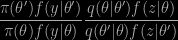
which has the appeal to cancel all normalising constants. And the repeal of requiring an exact simulation from the very distribution with the missing constant, ƒ(.|θ). Which means that in practice a finite number of MCMC steps will be used and will bias the outcome. The algorithm is unusual in that it replaces the exact proposal q(θ’|θ) with an unbiased random version q(θ’|θ)ƒ(z|θ’), z being just an augmentation of the proposal. (The current JASA paper by Liang et al. seems to confuse augment and argument, see p.378.)
To avoid the difficulty in simulating from ƒ(.|θ), the authors draw pseudo-observations from sampling distributions with a finite number m of parameter values under the [unrealistic] assumption (A⁰) that this collection of values provides an almost complete cover of the posterior support. One of the tricks stands with an auxiliary [time-heterogeneous] chain of pseudo-observations generated by single Metropolis steps from one of these m fixed targets. These pseudo-observations are then used in the main (or target) chain to define the above exchange probability. The auxiliary chain is Markov but time-heterogeneous since the probabilities of accepting a move are evolving with time according to a simulated annealing schedule. Which produces a convergent estimate of the m normalising constants. The main chain is not Markov in that it depends on the whole history of the auxiliary chain [see Step 5, p.380]. Even jointly the collection of both chains is not Markov. The paper prefers to consider the process as an adaptive Markov chain. I did not check the rather intricate in details, so cannot judge of the validity of the overall algorithm; I simply note that one condition (A², p.383) is incredibly strong in that it assumes the Markov transition kernel to be Doeblin uniformly on any compact set of the calibration parameters. However, the major difficulty with this approach seems to be in its delicate calibration. From providing a reference set of m parameter values scanning the posterior support to picking transition kernels on both the parameter and the sample spaces, to properly cooling the annealing schedule [always a fun part!], there seems to be [from my armchair expert’s perspective, of course!] a wide range of opportunities for missing the target or running into zero acceptance problems. Both examples analysed in the paper, the auto-logistic and the auto-normal models, are actually of limited complexity in that they depend on a few parameters, 2 and 4 resp., and enjoy sufficient statistics, of dimensions 2 and 4 as well. Hence simulating (pseudo-)realisations of those sufficient statistics should be less challenging than the original approach replicating an entire vector of thousands of dimensions.


