After reaching the train station only to discover the whole line had gone on strike after an attack, I managed to grab a cab that took me to the airport. The cabbie was certainly one of the worst gossips I had to endure in a cab, but he drove fast enough so that I eventually got to the airport earlier! There, I had the very good surprise of being upgraded to business class, which does make an immense difference for a nine hour flight, in particular because I could use my computer the whole trip and I thus revised the MCMC history paper with George Casella.
Archive for Monte Carlo
Upgraded!
Posted in Statistics, Travel with tags MCMC, Monte Carlo, simulation on July 4, 2009 by xi'anRandom generators
Posted in Statistics with tags Monte Carlo, R, simulation, testing on June 9, 2009 by xi'anA post on Revolutions discussed physical random generators against standard computer-based generators. It is interesting in that it reveals how “common sense” can get things wrong in this area. First, there is an almost atavistic misgiving that a sequence produced by a function

—the second sequence corresponding to several seeds used in parallel, as possible with R RNGkind—cannot be a “true” random generator when F and G are standard functions. The criticism truly applies to the object, namely the sequence produced, that can be exactly reconstructed if F and G are known, but not to its uses in Monte Carlo simulation. When F (or G) is unknown, the null hypothesis

cannot be defaulted [rejected] by a statistical test, no matter how long the sequence is, no matter which aspect of uniformity is being tested. (Note that the post mentions randomness in many occurrences without precising this is about uniformity.) The difficulty with pseudo-random generators is rather that they are used for continuous distributions while being represented by a finite number of digits, i.e. with a certain precision. So a statistical test is bound to fail if you look far enough in the digits without adapting the random generator for an higher precision. The second criticism about standard random generators is related with this point, namely that exploring the sequence of values in a finite set with a deterministic function is necessarily periodic. This is correct, but using several seeds in parallel multiplies the size of the finite set to such an extent that it becomes irrelevant for all but purely abstract purposes! The third misconception is that “truly” random is better (“more random“!) than pseudo-random and that, if physical generators are available on a computer, this is much better than R runif. This is a wrong perception in that “truly” random generators are producing flows of numbers that are indeed unpredictable and “random”, but that the law of the random phenomenon cannot be exactly asserted. The example provided in the post of the dicing machine is typical: it produces a sequence of millions of dice values a day—R sample does the same in 0.012 seconds—but there is no reason the dice are exactly well-balanced and the outcome is perfectly uniform over 1,2,3,4,5,6…
Book sales
Posted in Books, Statistics with tags Bayesian statistics, Monte Carlo, R, textbook on May 13, 2009 by xi'an Springer-Verlag sent me its annual report about book sales this week and I am quite pleased at how well The Bayesian Choice
 first printing of the second edition in 2001. (This does not include the crate of the very first printing of the paperback lost by the carrier! If you ever see one, let me know!!!) Similarly, the 2004 edition of Monte Carlo Statistical Method with George Casella is doing quite well, with more than 6000 copies sold so far and close to 1000 for last year. I am not certain what the trend will be once the R book with George is published, but I think they will overall aim at different audiences. Last and not
  least, Bayesian Core (published in 2007) is also faring well with 1987 copies sold to this point, which is rather comforting when considering it came right at the same time as Jim Albert’s Bayesian Computation with R, which is a direct competitor.The next step is in writing a second edition of Bayesian Core adapted to the “Use R” series, including a specific R package, but I think this will have to wait till next year.
Batch mean variance estimators for MCMC
Posted in Statistics with tags MCMC, Monte Carlo, simulation on May 1, 2009 by xi'anGalin Jones and James Flegal posted on arXiv a new version of their batch mean convergence assessment paper. As posted earlier, I think this is a very interesting approach to MCMC convergence assessment and stopping rule, and I have included their method in the Convergence Assessment chapter of EnteR Monte Carlo Statistical Methods. The stopping rule studied in the paper is of the form
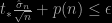
where 


where ![a_n=b_n=[n^{1/2}]](https://s0.wp.com/latex.php?latex=a_n%3Db_n%3D%5Bn%5E%7B1%2F2%7D%5D&bg=000000&fg=B0B0B0&s=0&c=20201002)
“ABC in Paris”: Program now available
Posted in Statistics, University life with tags ABC, Bayesian statistics, Genetics, Monte Carlo, simulation, workshop on April 30, 2009 by xi'an The program of the “ABC in Paris” meeting of June 26 is now posted on the meeting webpage. It is fairly intense, with only three short breaks over the day, but this allows for 14 speakers to give a broad overview of the activity in this are of ABC methods. Most of the abstracts are available on the webpage and they are also related to papers available on arXiv.


