Archive for Nature

bothsidesism in Nature

Posted in Books, Kids, Running with tags , , , , , , , , , , on July 24, 2026 by xi'an

In its 21 May issue, Nature prints two columns back to back, “Can the ‘steroid Olympics’ show the sporting community how to support athletes better?” by April Henning and “The Enhanced Games miss the point: science can clean up sport“, by Kim Wolff. They are both about the so-called “Enhanced Games” that were to take place a few days later, on 24 May, in Las Vegas (where else?!), with competitions in swimming, athletics, and weightlifting, and no drug test. With only one World record unofficially broken at the event. (Fortunately no one died. So far.)

The first column argues that those games are exposing how many elite athletes are struggling with financial, physical and psychological issues. And how the current anti-doping system, built around the agency WADA (whose French branch is located in the town next to mine) is getting it wrong… The second one is warning about the impact of this deregulation on athletes’ welfare and integrity. Especially when the impact of most drugs on health is unknown, esp. in the long run (!). The author is thus calling for improved anti-doping protocols, rather than a return to the 1980’s GDR State-sanctioned doping. I find it terrible that Nature brings those two opposite points with no balancing towards the reasonable one, while no scientific argument in favour of live testing came out of the first column. Terrible.

arXiv, not AIrXiv!

Posted in Books, University life with tags , , , , , , , on July 18, 2026 by xi'an


As reported in Nature of 28 May, arXiv is now enforcing a ban of researchers (who hardly qualify as “authors”!) submitting articles produced by LLMs with demonstrably insufficient human input, e.g. those with hallucinated (fake) references—easy to detect. The ban is one-year long and, besides, subsequent submissions must first be accepted by a genuine academic journal. Be warned!

perfect randomness?

Posted in Books, Statistics, University life with tags , , , , , , , , on July 17, 2026 by xi'an

The New York Times (of 09 June) pointed me to a Nature paper of 27 May 2026 that I had most curiously missed! It is called Experimental randomness amplification and it presents a technique aimed at integrally correcting the bias in quantum random bit generators. Independently from the device used. This is quite interesting, even though I am definitely missing a lot.

“…randomness amplification protocols make use of a Bell test. Bell tests consist of measurements performed on entangled systems. Their purpose is to prove that, under natural locality assumptions, there cannot exist any variables that determine the outcomes of these measurements” Kulikov et al.

Not so perfect then, if relying on a test, a statistical test, cannot provide or prove certainty about the improved predictability of the random generator… The core of the method is described as follows:

“Any source of random bits B1 … Bn can be characterized by a pair of parameters (μ, ε). Like any realistic device, the source may fail with some probability ε, in which case nothing is guaranteed about the randomness of B1 … Bn (…) [Adopting] the Santha–Vazirani (SV) model5, considering an adversary attempting to predict the output bit Bi of the source, we say the source is a μ-SV source if  Pguess(Bi∣E)≤½+μ  holds for all i. Here E denotes any (potentially quantum) side information that is available before the bit Bi is produced (…) and Pguess(Bi∣E) denotes the probability of guessing Bi, given access to E (…) The case μ = 0 corresponds to a perfectly random (unbiased) source, while larger values of μ (…) bias μ quantifies the predictive power of a potential adversary, [with] the assumption that a source is (μ, ε)-random [can] be falsified by a statistical test that yields an observed bias μobs larger than μ. Therefore, if μobs satisfies μobs < μ, we say that the test result is compatible with the (μ, ε)-randomness assumption (…) In this work, we demonstrate that, for any input source with μ ≤ 0.75%, our experimental set-up (…) yields completely unbiased output randomness (…) The residual increase of the failure probability, ε, can in principle be made arbitrarily small at the cost of consuming more input randomness (…) To achieve this, we use two spatially separated sources of randomness [and] treat their concatenated outputs (…) as a single μ-SV source” Kulikov et al.

An assumption of importance in the proof (which I did not check!) is that both (independent) sources of randomness share the same bias μ, furthermore assumed to be constant over time, which should be a concern with physical devices. I also do not understand why a mere concatenation of the outputs saves the day, but quickly browsing the complete paper (aka supplementary information) I found that the final output K is via a two-process extractor that involves several n x n binary matrices even though it achieves a O(n log n) runtime. The NYT article reports that it took nine hours to generate 45 million bits, yes bits… Last remark about checking for pure, uniform, randomness in the experiment by relying on Marsaglie’s Diehard set of tests:

“we generate a random bitstring K consisting of m = 45,025,658 bits, starting from 5,368,709,120 low-quality random bits (…) chosen such that a failure probability of the protocol as low as ε = 10−12 is guaranteed  (…) provided that the bias μ (…) is below 0.75%. Although it is fundamentally impossible to verify the unpredictability of a bitstring by analysing the string itself, we (…) run the NIST statistical test suite and the Diehard batteries of statistical tests [and] the result passes all the tests for which the string is sufficiently long.” Kulikov et al.

Nature tidbits [18 June]

Posted in Books, Kids, pictures, Travel with tags , , , , , , , , , , , , , , , , , , , , , , , , , , , , on July 13, 2026 by xi'an


A personal tribune (by a Vatican advisor) on why scientists should learn from the Pope’s AI message, not the first time Nature caters to religious views! Not that his (Leon’s) concerns about unregulated AI and the abdication of States in that matter are misplaced. But it seems unlikely (as the author concedes in his conclusion) that the Catholic Church or his leader will manage to make a dent on the spiraling impact of AIs. As suggested in the next tribune, a coordinated approach at a massive increase of taxes on tech companies (unsurprisingly resisted by the Orange Menace) is more likely to happen. And yet another tribune on AI and math(ematician)s, related to the recent Leiden Declaration on Artificial Intelligence and Mathematics, following several entries in the previous issue.

An introductory (general public) article as to why cancer occurrences in young people is rising so quickly in the US, with no single explanation. Environmental factors are certainly to blame, like the consumption of ultra–processed foods, but the article does not say much, adding to the uncertainty.

A rather unhelpful representation of human migration in 2023, appart from showing a majority of migrations are local (to the continental scale). Connected to an article of 10 June I missed. Partly based on a deep learning model to achieve a country-level granularity.

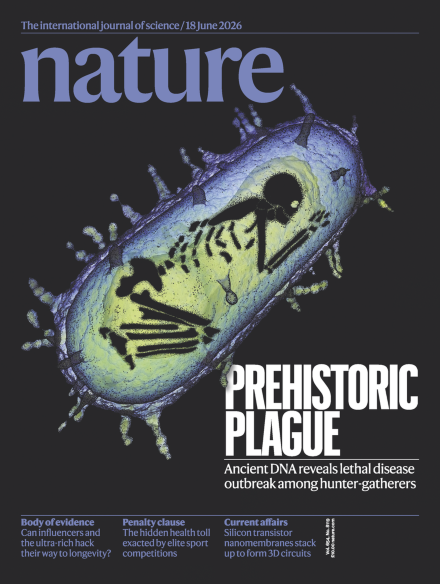
A research article (and the cover) on a plague outbreak near Lake Baikal—over which I could have flown when reading this issue, except that flights to Japan now contour the territories of the invader of Ukraine—that occurred about 5,500 years ago and impacted a community of hunter-gatherers, In a sparsely populated area, marmots being the likely primary vectors, and a close phylogenetic proximity to current strains.

“too dangerous to release” [a correct prediction]

Posted in Books, Travel with tags , , , , , , , , , , , , on July 9, 2026 by xi'an

Nature of 26 May had a long report on how the Mythos model is deemed to be too dangerous by its conceptor, Anthropic, to be publicly released, but instead shared with a limited number of organisations of their own choice. The argument being that Mythos was able to spot security flaws in every operating system and web browser on the market. But, sooner or later, the AI will prove accessible to a hacker who manages to penetrate one of these organisations, won’t it?! As pointed out by Nature’s writers, the natural question is why should firms be left to decide on who gets access to their software and how dangerous they are. The same writers also muse about governments imposing prohibitions on the firms, including outside their country. Which is exactly what happened a few weeks later on 12 June with the Trump administration “suspend[ing] all access to both Fable 5 and Mythos 5 by any foreign national, whether inside or outside the United States” with little factual argumentation. Another illustration of the short-sighted, knee-jerk, inconsistent, policies of that joke of an administration that does not address the real issue.