Archive for NUTS

mostly Monte Carlo [13/03]

Posted in Statistics, Travel, University life with tags , , , , , , , , , , , , , , , , , , on March 10, 2026 by xi'an

A new episode of our mostly Monte Carlo seminar, very soon coming near you (if in Paris):

On Friday 13/02/26, from 3-5pm at PariSanté Campus

15h00: Pierre Del Moral (INRIA, Bordeaux)

On the Kantorovich contraction of Markov semigroup

We present a novel operator theoretic framework to study the contraction properties of Markov semigroups with respect to a general class of Kantorovich semi-distances, which notably includes Wasserstein distances. This rather simple contraction cost framework combines standard Lyapunov techniques with local contraction conditions. Our results can be applied to both discrete time and continuous time Markov semigroups, and we illustrate their wide applicability in the context of (i) Markov transitions on models with boundary states, including bounded domains with entrance boundaries, (ii) operator products of a Markov kernel and its adjoint, including two-block-type Gibbs samplers, (iii) iterated random functions and (iv) diffusion models, including overdampted Langevin diffusion with convex at infinity potentials.

16h00: Bob Carpenter (Flatiron Institute, New York)

GIST, WALNUTS, and Continuous Nutpie: mass-matrix and step-size adaptation for Hamiltonian Monte Carlo

I will introduce Gibbs self tuning (GIST), our new technique for coupling tuning parameters and conditionally Gibbs-sampling them per iteration in Hamiltonian Monte Carlo. Then I will turn to the within-orbit adaptive NUTS (WALNUTS) sampler, which adapts the step size every leapfrog step in order to conserve the Hamiltonian. Empirical evaluations on varying multi-scale target distributions, including Neal’s funnel and the Stock-Watson stochastic volatility time-series model, demonstrate that WALNUTS achieves substantial improvements in sampling efficiency and robustness. I will review the Nutpie mass-matrix adaptation scheme, which is designed to minimize Fisher divergence by estimating the mass matrix as the geometric midpoint (aka barycenter) between the inverse covariance of the draws and the covariance of the scores of the draws. Then I will describe a continuously adapting version that adapts per iteration by continuously discounting the past rather than updating in fixed blocks. I will also show how the Adam optimizer outperforms dual averaging for step-size adaptation. I will conclude by considering a lock-free multi-threading implementation that automatically monitors adaptation and sampling for convergence for automatic stopping.

venISBA⁴⁻

Posted in Books, pictures, Statistics, Travel, University life with tags , , , , , , , , , , , , , , , , , , , , , , , on July 8, 2024 by xi'an

As I was released all of a sudden from the Ospedale Civile di Venezia around noon, I managed to attend the last session of ISBA 2024 (after stopping by my airbnb for an emergency coffee next to the hospital and stopping for showering, changing clothes, and eating something more substantial than the contents of IV bags).

My first of these last talks was about coresets by Trevor Campbell, for reducing sample sizes while keeping the likelihood roughly the same (and making me wondering if possibly getting some privacy on the side??) Original algorithm almost completely blind to the data, but a new version by subsample-optimize (KL distance to the posterior) version bringing huge improvements (although I missed the practical details on how the algorithm is reaching this minimum), namely a KL distance of order O(1), i.e., not growing in the sample size. Then, in the same session, a talk by Aikihiko Nakamura on mixing and PDMP, resulting in the novel bouncy Hamiltonian dynamics, which proves time reversible and volume preserving, with no U turns and the time within a given general Hamiltonian value being itself generated w/o rejection. (I am quite sorry to have missed other PDMP talks during the conference, eg, Paul Fearnhead’s, as well as the last poster session…) And I finally jumped rooms to listen to Sam Power on hybrid slice sampling with an MCMC extension to avoid simulating from the Uniform conditional. Reminding me of nested sampling, which also faces this difficulty of sampling from a possibly complex set. This was the end of a wonderful (if shortened by my personal issue) meeting. Next round, see you in Nagoya, Japan (on the Tōkaidō road!).


As a final word about this ISBA 2024 conference in Ca’Foscari, on many levels, I want to most warmly thank my friend Roberto Casarin for his investment and dedication for making the event running so efficiently, in an ideal environment for a meeting of this (800+) size that kept to the Aristotelian unities, especially keeping people together on a unique site without feeling crowded (and very few falling in a Venice canal). And many thanks as well to the local organisers (discounting my nominal inclusion in that group!), the Ca’Foscari staff, and all the students involved in the event!

on control variates

Posted in Books, Kids, Statistics, University life with tags , , , , , , , , , , , , on May 27, 2023 by xi'an

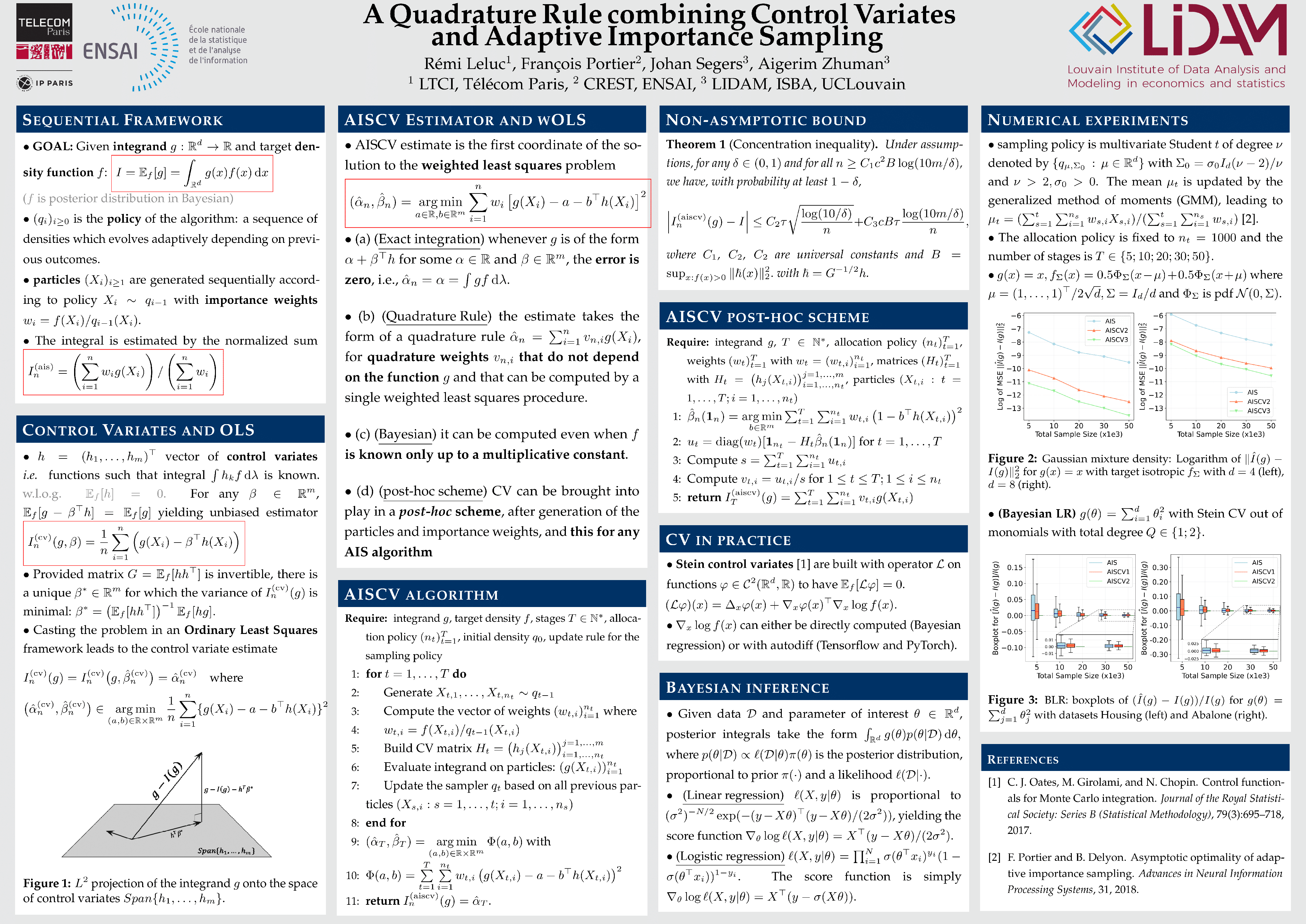
A few months ago, I had to write a thesis evaluation of Rémi Leluc’s PhD, which contained several novel Monte Carlo proposals on control variates and importance techniques. For instance, Leluc et al. (Statistics and Computing, 2021) revisits the concept of control variables by adding a perspective of control variable selection using LASSO. This prior selection is relevant since control variables are not necessarily informative about the objective function being integrated and my experience is that the more variables the less reliable the improvement. The remarkable feature of the results is in obtaining explicit and non-asymptotic bounds.

The author obtains a concentration inequality on the error resulting from the use of control variables, under strict assumptions on the variables. The associated numerical experiment illustrates the difficulties of practically implementing these principles due to the number of parameters to calibrate. I found the example of a capture-recapture experiment on ducks (European Dipper) particularly interesting, not only because we had used it in our book but also because it highlights the dependence of estimates on the dominant measure.

Based on a NeurIPS 2022 poster presentation Chapter 3 is devoted to the use of control variables in sequential Monte Carlo, where a sequence of importance functions is constructed based on previous iterations to improve the approximation of the target distribution. Under relatively strong assumptions of importance functions dominating the target distribution (which could generally be achieved by using an increasing fraction of the data in a partial posterior distribution), of sub-Gaussian tails of an intractable distribution’s residual, a concentration inequality is established for the adaptive control variable estimator.

This chapter uses a different family of control variables, based on a Stein operator introduced in Mira et al. (2016). In the case where the target is a mixture in IRd, one of our benchmarks in Cappé et al. (2008), remarkable gains are obtained for relatively high dimensions. While the computational demands of these improvements are not mentioned, the comparison with an MCMC approach (NUTS) based on the same number of particles demonstrates a clear improvement in Bayesian estimation.

Chapter 4 corresponds to a very recent arXival and presents a very original approach to control variate correction by reproducing the interest rate law through an approximation using the closest neighbor (leave-one-out) method. It requires neither control function nor necessarily additional simulation, except for the evaluation of the integral, which is rather remarkable, forming a kind of parallel with the bootstrap. (Any other approximation of the distribution would also be acceptable if available at the same computational cost.) The thesis aims to establish the convergence of the method when integration is performed by a Voronoi tessellation, which leads to an optimal rate of order n-1-2/d for quadratic error (under conditions of integrand regularity). In the alternative where the integral must be evaluated by Monte Carlo, this optimality disappears, unless a massive amount of simulations are used. Numerical illustrations cover SDEs and a Bayesian hierarchical modeling already used in Oates et al. (2017), with massive gain in both cases.

robustified Hamiltonian

Posted in Books, Statistics, University life with tags , , , , , , , , , on April 1, 2022 by xi'an

In Gregynog, last week, Lionel Riou-Durant (Warwick) presented his recent work with Jure Vogrinc on Metropolis Adjusted Langevin Trajectories, which I had also heard in the Séminaire Parisien de Statistique two weeks ago. Starting with a nice exposition of Hamiltonian Monte Carlo, highlighting its drawbacks. This includes the potentially damaging impact of poorly tuning the integration time. Their proposal is to act upon the velocity in the Hamiltonian through Langevin (positive) damping, which also preserves the stationarity.  (And connects with randomised HMC.) One theoretical in the paper is that the Langevin diffusion achieves the fastest mixing rate among randomised HMCs. From a practical perspective, there exists a version of the leapfrog integrator that adapts to this setting and can be implemented as a Metropolis adjustment. (Hence the MALT connection.) An interesting feature is that the process as such is ergodic, which avoids renewal steps (and U-turns). (There are still calibration parameters to adjust, obviously.)

general perspective on the Metropolis–Hastings kernel

Posted in Books, Statistics with tags , , , , , , , , , , , , , on January 14, 2021 by xi'an

[My Bristol friends and co-authors] Christophe Andrieu, and Anthony Lee, along with Sam Livingstone arXived a massive paper on 01 January on the Metropolis-Hastings kernel.

“Our aim is to develop a framework making establishing correctness of complex Markov chain Monte Carlo kernels a purely mechanical or algebraic exercise, while making communication of ideas simpler and unambiguous by allowing a stronger focus on essential features (…) This framework can also be used to validate kernels that do not satisfy detailed balance, i.e. which are not reversible, but a modified version thereof.”

A central notion in this highly general framework is, extending Tierney (1998), to see an MCMC kernel as a triplet involving a probability measure μ (on an extended space), an involution transform φ generalising the proposal step (i.e. þ²=id), and an associated acceptance probability ð. Then μ-reversibility occurs for

\eth(\xi)\mu(\text{d}\xi)= \eth(\phi(\xi))\mu^{\phi}(\text{d}\xi)

with the rhs involving the push-forward measure induced by μ and φ. And furthermore there is always a choice of an acceptance probability ð ensuring for this equality to happen. Interestingly, the new framework allows for mostly seamless handling of more complex versions of MCMC such as reversible jump and parallel tempering. But also non-reversible kernels, incl. for instance delayed rejection. And HMC, incl. NUTS. And pseudo-marginal, multiple-try, PDMPs, &c., &c. it is remarkable to see such a general theory emerging a this (late?) stage of the evolution of the field (and I will need more time and attention to understand its consequences).