Archive for philosophy of sciences

Contextual Integrity for Differential Privacy #1 [23w5106]

Posted in Books, Mountains, pictures, Statistics, University life with tags , , , , , , , , , , , , , , , on August 2, 2023 by xi'an


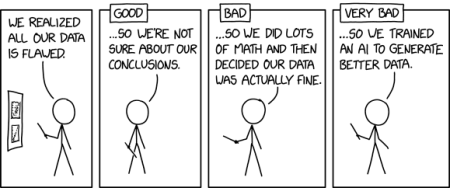
Very relaxed beginning to the workshop, with [xkcd illustrated] tutorials on CI and DP, plus informal discussions to find a common ground over the week. Helped by the beautiful surroundings of the UBC Okanagan campus. Tutorial on the fundamentals of differential privacy, with a long room discussion on the meaning(s) of the definition, for instance exhibiting the minimax nature of the thing, placing all bad events at the same level. Any Bayesian version? Still unclear [to me] how one can inverse-engineer (ε,δ) into the probability of identifying one data entry. More questions about the nature of noise in DP algorithms. Again lacking [for me] the impact on identifying one data entry. Plus notions like Laplace privacy-accuracy sound parameterisation dependent. Exponential mechanism, that involves a score function (protecting privacy?) that ends up resembling a Gibbs posterior in the “safe Bayes” perspective. Interesting distinction about which agent provides randomness as impacting the privacy.
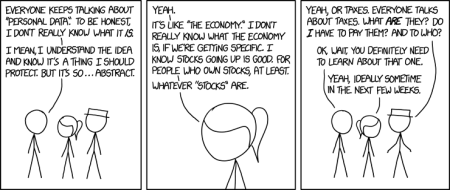
As for contextual integrity, presented by Helen Nissenbaum at the origin of the concept, it is complicated by a strongly subjective handling of notions, first and foremost privacy, as inevitably the case in philosophy and ethics.

severe testing or severe sabotage? [not a book review]

Posted in Books, pictures, Statistics, University life with tags , , , , , , , , , on October 16, 2018 by xi'an

Last week, I received this new book of Deborah Mayo, which I was looking forward reading and annotating!, but thrice alas, the book had been sabotaged: except for the preface and acknowledgements, the entire book is printed upside down [a minor issue since the entire book is concerned] and with some part of the text cut on each side [a few letters each time but enough to make reading a chore!]. I am thus waiting for a tested copy of the book to start reading it in earnest!


La déraisonnable efficacité des mathématiques

Posted in Books, pictures, Statistics, University life with tags , , , , , , , , , , , on May 11, 2017 by xi'an

Although it went completely out of my mind, thanks to a rather heavy travel schedule, I gave last week a short interview about the notion of mathematical models, which got broadcast this week on France Culture, one of the French public radio channels. Within the daily La Méthode Scientifique show, which is a one-hour emission on scientific issues, always a [rare] pleasure to listen to. (Including the day they invited Claire Voisin.) The theme of the show that day was about the unreasonable effectiveness of mathematics, with the [classical] questioning of whether it is an efficient tool towards solving scientific (and inference?) problems because the mathematical objects pre-existed their use or we are (pre-)conditioned to use mathematics to solve problems. I somewhat sounded like a dog in a game of skittles, but it was interesting to listen to the philosopher discussing my relativistic perspective [provided you understand French!]. And I appreciated very much the way Céline Loozen the journalist who interviewed me sorted the chaff from the wheat in the original interview to make me sound mostly coherent! (A coincidence: Jean-Michel Marin got interviewed this morning on France Inter, the major public radio, about the Grothendieck papers.)

machine learning and the future of realism

Posted in Books, Kids, Statistics, University life with tags , , , , , , , , on May 4, 2017 by xi'an

Giles and Cliff Hooker arXived a paper last week with this intriguing title. (Giles Hooker is an associate professor of statistics and biology at Cornell U, with an interesting blog on the notion of models, while Cliff Hooker is a professor of philosophy at Newcastle U, Australia.)

“Our conclusion is that simplicity is too complex”

The debate in this short paper is whether or not machine learning relates to a model. Or is it concerned with sheer (“naked”) prediction? And then does it pertain to science any longer?! While it sounds obvious at first, defining why science is more than prediction of effects given causes is much less obvious, although prediction sounds more pragmatic and engineer-like than scientific. (Furthermore, prediction has a somewhat negative flavour in French, being used as a synonym to divination and opposed to prévision.) In more philosophical terms, prediction offers no ontological feature. As for a machine learning structure like a neural network being scientific or a-scientific, its black box nature makes it much more the later than the former, in that it brings no explanation for the connection between input and output, between regressed and regressors. It further lacks the potential for universality of scientific models. For instance, as mentioned in the paper, Newton’s law of gravitation applies to any pair of weighted bodies, while a neural network built on a series of observations could not be assessed or guaranteed outside the domain where those observations are taken. Plus, would miss the simple square law established by Newton. Most fascinating questions, undoubtedly! Putting the stress on models from a totally different perspective from last week at the RSS.

As for machine learning being a challenge to realism, I am none the wiser after reading the paper. Utilising machine learning tools to produce predictions of causes given effects does not seem to modify the structure of the World and very little our understanding of it, since they do not bring explanation per se. What would lead to anti-realism is the adoption of those tools as substitutes for scientific theories and models.

principles or unprincipled?!

Posted in Books, Kids, pictures, Statistics, Travel with tags , , , , , , , on May 2, 2017 by xi'an

A lively and wide-ranging discussion during the Bayes, Fiducial, Frequentist conference was about whether or not we should look for principles. Someone mentioned Terry Speed (2016) claim that it does not help statistics in being principled. Against being efficient. Which gets quite close in my opinion to arguing in favour of a no-U-turn move to machine learning—which requires a significant amount of data to reach this efficiency, as Xiao-Li Meng mentioned—. The debate brought me back to my current running or droning argument on the need to accommodate [more] the difference between models and reality. Not throwing away statistics and models altogether, but developing assessments that are not fully chained to those models. While keeping probabilistic models to handle uncertainty. One pessimistic conclusion I drew from the discussion is that while we [as academic statisticians] may set principles and even teach our students how to run principled and ethical statistical analyses, there is not much we can do about the daily practice of users of statistics…