Archive for population genetics

a bootstrap likelihood approach to Bayesian computation

Posted in Books, R, Statistics, University life with tags , , , , , , , , on October 16, 2014 by xi'an

This paper by Weixuan Zhu, Juan Miguel Marín [from Carlos III in Madrid, not to be confused with Jean-Michel Marin, from Montpellier!], and Fabrizio Leisen proposes an alternative to our 2013 PNAS paper with Kerrie Mengersen and Pierre Pudlo on empirical likelihood ABC, or BCel. The alternative is based on Davison, Hinkley and Worton’s (1992) bootstrap likelihood, which relies on a double-bootstrap to produce a non-parametric estimate of the distribution of a given estimator of the parameter θ. Including a smooth curve-fitting algorithm step, for which not much description is available from the paper.

“…in contrast with the empirical likelihood method, the bootstrap likelihood doesn’t require any set of subjective constrains taking advantage from the bootstrap methodology. This makes the algorithm an automatic and reliable procedure where only a few parameters need to be specified.”

The spirit is indeed quite similar to ours in that a non-parametric substitute plays the role of the actual likelihood, with no correction for the substitution. Both approaches are convergent, with similar or identical convergence speeds. While the empirical likelihood relies on a choice of parameter identifying constraints, the bootstrap version starts directly from the [subjectively] chosen estimator of θ. For it indeed needs to be chosen. And computed.

“Another benefit of using the bootstrap likelihood (…) is that the construction of bootstrap likelihood could be done once and not at every iteration as the empirical likelihood. This leads to significant improvement in the computing time when different priors are compared.”

This is an improvement that could apply to the empirical likelihood approach, as well, once a large enough collection of likelihood values has been gathered. But only in small enough dimensions where smooth curve-fitting algorithms can operate. The same criticism applying to the derivation of a non-parametric density estimate for the distribution of the estimator of θ. Critically, the paper only processes examples with a few parameters.

In the comparisons between BCel and BCbl that are produced in the paper, the gain is indeed towards BCbl. Since this paper is mostly based on examples and illustrations, not unlike ours, I would like to see more details on the calibration of the non-parametric methods and of regular ABC, as well as on the computing time. And the variability of both methods on more than a single Monte Carlo experiment.

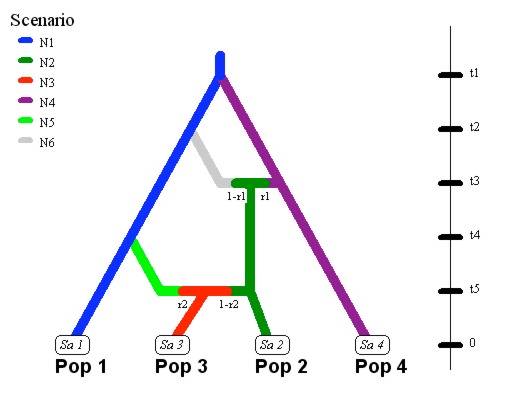
I am however uncertain as to how the authors process the population genetic example. They refer to the composite likelihood used in our paper to set the moment equations. Since this is not the true likelihood, how do the authors select their parameter estimates in the double-bootstrap experiment? The inclusion of Crakel’s and Flegal’s (2013) bivariate Beta, is somewhat superfluous as this example sounds to me like an artificial setting.

In the case of the Ising model, maybe the pre-processing step in our paper with Matt Moores could be compared with the other algorithms. In terms of BCbl, how does the bootstrap operate on an Ising model, i.e. (a) how does one subsample pixels and (b)what are the validity guarantees?

A test that would be of interest is to start from a standard ABC solution and use this solution as the reference estimator of θ, then proceeding to apply BCbl for that estimator. Given that the reference table would have to be produced only once, this would not necessarily increase the computational cost by a large amount…

Bayesian introductions at IXXI

Posted in Mountains, Statistics, Travel, University life with tags , , , , , , on October 28, 2013 by xi'an

Ten days ago I did a lighting-fast visit to Grenoble for a quick introduction to Bayesian notions during a Bayesian day organised by Michael Blum. It was supported by IXXI, Rhône Alpes Complex Systems Institute, a light structure that favors interdisciplinary research to model complex sytems such as biological or social systems, technological networks… This was an opportunity to recycle my Budapest overview from Bayes 250th to Bayes 2.5.0. (As I have changed my email signature initial from X to IX, I further enjoyed the name IXXI!) More seriously, I appreciated (despite the too short time spent there!) the mix of perspectives and disciplines represented in this introduction, from Bayesian networks and causality in computer science and medical expert systems, to neurosciences and the Bayesian theory of mind, to Bayesian population genetics. And hence the mix of audiences. The part about neurosciences and social representations on others’ mind reminded me of the discussion with Pierre Bessières we had a year ago on France Culture. Again, I am quite sorry and apologetic for having missed part of the day and opportunities for discussions, simply because of a tight schedule this week…

Albert Jacquard (1925-2013)

Posted in Books, Statistics with tags , , , , , , on September 21, 2013 by xi'an

Albert Jacquard passed away last week. He was a humanist, engaged in the defence of outcasts (laissés pour compte) like homeless and illegal immigrants. He had a regular chronicle of two minutes on France Culture that I used to listen to (when driving at that time of the day). In the obituaries published in the recent days, this side of the character was put forward, while very little was said about his scientific legacy. He was a statistician, first at INSEE, then at INED. After getting a PhD in genetics from Stanford in 1968, he got back to INED as a population geneticist, writing in 1978 his most famous book, Éloge de la Différence, against racial theories, which is the first in a long series of vulgarisation and philosophical books. Among his scientific books, he wrote the entry on Probabilités in the popular vulgarisation series “Que Sais-Je?”, with more than 40,000 copies sold and used by generations of students. (Among its 125 pages, the imposed length for a  “Que Sais-Je?”, the book includes Bayes theorem and, more importantly, the Bayesian approach to estimating unknown probabilities!)

inference in Kingman’s coalescent with pMCMC

Posted in Books, Statistics, University life with tags , , , , , , , on May 22, 2013 by xi'an

As I was checking the recent stat postings on arXiv, I noticed the paper by Chen and Xie entitled inference in Kingman’s coalescent with pMCMC.  (And surprisingly deposited in the machine learning subdomain.) The authors compare a pMCMC implementation for Kingman’s coalescent with importance sampling (à la Stephens & Donnelly), regular MCMC and SMC.  The specifics of their pMCMC algorithm is that they simulate the coalescent times conditional on the tree structure and the tree structure conditional on the coalescent times (via SMC). The results reported in the paper consider up to five loci and agree with earlier experiments showing poor performances of MCMC algorithms (based on the LAMARC software and apparently using independent proposals).  They show similar performances between importance sampling and pMCMC. While I find this application of pMCMC interesting, I wonder at the generality of the approach: when I was introduced to ABC techniques, the motivation was that importance sampling was deteriorating very quickly with the number of parameters. Here it seems the authors only considered one parameter θ. I wonder what happens when the number of parameters increases. And how pMCMC would then compare with ABC.

efficient learning in ABC

Posted in Statistics with tags , , , , , , on October 11, 2012 by xi'an

Jean-Michel Marin just posted on arXiv a joint paper of ours, Efficient learning in ABC algorithms. This paper, to which elaboration [if not redaction] I contributed to, is one of the chapters of Mohammed Sedki’s thesis. (Mohammed is about to defend this thesis, currently with reviewers. A preliminary version of this paper was presented at ABC in London and it is in revision with Statistics and Computing. Hence missing the special issue!)

The paper builds on the sequential ABC scheme of Del Moral et al. (2012), already discussed in this post, where the tolerance level at each step is adapted from the previous iterations as a quantile of the distances. (The quantile level is based on a current effective sample size.) In a “systematic” step, the particles that are closest to the observations are preserved and duplicated, while those farther away are sampled randomly. The resulting population of particles is then perturbed by an adaptive (random walk) kernel and the algorithm stops when the tolerance level does not decrease any longer or when the acceptance rate of the Metropolis step is too low. Pierre Pudlo and Mohammed Sedki experimented a parallel implementation of the algorithm, with an almost linear improvement in the number of cores. It is less clear the same would work on a GPU because of the communication requirements. Overall, the new algorithm brings a significant improvement in computing time when compared with earlier versions, mainly because the number of simulations from the model is minimised. (It was tested on a rather complex population scenario retracing the invasion of honeybees in Europe (in connection with the previous post!)