
Archive for Portland
A river runs through it [jatp]
Posted in Books, Mountains, pictures, Running, Travel with tags dusk, evening light, hiking trail, jatp, JSM 2024, Mount Hood, Norman MacLean, Oeeg, open water swimming, Oregon, Pacific North West, Portland, salmon, Salmon River, Spanish moss, sunset, USA, Welches on August 21, 2024 by xi'an
pinot noir, Domaine Serene
Posted in Travel, Wines with tags JSM 2024, Oregon, Oregon wines, Pacific North West, pinot noir, Portland, wildfire, Willamette River on August 20, 2024 by xi'an
JSM 2024, Portland, miniday 4
Posted in Books, pictures, Running, Statistics, Travel, University life with tags AI, American Statistical Association, ASA, Bayesian decision theory, Bayesian nonparametrics, Bayesian privacy, BIRS, British Columbia, classification, contextual integrity, data science, differential privacy, draw bridge, ERC, federated learning, generalised Bayesian inference, Joint Statistical Meeting, JSM 2024, Kelowna, Ocean, open water swimming, Oregon, Pacific North West, Portland, Seattle, United States of America, University of Washington, Willamette River on August 11, 2024 by xi'an
Final (half)day at JSM is always a sad thing as most people have left, people are busy dismantling booths and packing boxes, and the few remaining participants are fidgety and sitting on their suitcases (there may have been more suitcases than people in the main area that day!), cafés are minimally staffed or simply closed. Hence not the best time-slot to deliver one’s talk! Still, a few dozen people attended our session. The session topic was Bridge the Gap: Differential Privacy and Statistical Analysis, organised by Bei Jiang whom I met last summer in Kelowna, at a BIRS workshop on privacy. Where I spoke on setting up a complete decision-theoretic framework, as developed (and still in development) within our Ocean group, esp. Joshua Bon, Stan du Ché, and Judith Rousseau. (Rather than on the original plan of talking about convergence versus privacy, as a criticism of differential privacy.) The other talks were by Shurong Li, strongly set with differential privacy when record linkage is present, and Xuan Bi on a fully decentralised federated learning with local exchanges of global gradients that limit privacy leaks. (With a mention of gossip learning I hadn’t seen previously!)

I enjoyed even more the session due to Naisyin Wang giving a discussion on the three talks, in closes the particular because I had not seen her in years, if a few times since she was my teaching assistant in Cornell in a Bayesian decision theory class I was building on the spot (with Linda Zhao as a student!). Which nicely closes the loop given the topic of my talk, of which she was quite supportive! While calling for debiasing post-processing and wondering about a two-dimensional decision theoretic perspective rather than a unidimensional one under hard privacy constraints.

On the way out, after parting from the few friends remaining in the convention centre, I spotted the nearby (steel) bridge being raised, although I could not see the boat responsible for it. I had been unaware of this possibility while running over and under it, as well as swimming thrice under it. And we left Portland in the early afternoon, heading for Seattle and a celebration of Adrian Raftery’s career.
JSM 2024, Portland, Day 3
Posted in pictures, Running, Statistics, Travel, University life with tags AI, American Statistical Association, Arianna Rosenbluth, ASA, bandits, Bayesian lasso, Bayesian model averaging, Bayesian model choice, Bayesian nonparametrics, classification, Committee of Presidents of Statistical Societies, completely random measures, convergence diagnostics, COPSS Presidents' Award, data science, David Blackwell, EM algorithm, generalised Bayesian inference, Gibbs measure, Ising model, jISBA, Joint Statistical Meeting, JSM 2024, missing species problem, Monte Carlo EM, Mount Hood National Forest, open water swimming, Oregon, Portland, Rutgers University, spike-and-slab prior, stochastic localization, Thompson sampling, United States of America, Willamette River on August 9, 2024 by xi'an
Bayesian contributed session as the first round of the third day (with a choice of five parallel sessions featuring Bayesian topics!!, actually easier to pick than among the following eight parallel sessions of the 10:30 schedule!!!), with a talk by Tahir Ekin on adversarial outlier detection that could connect with our Oceaner(c) privacy concerns. Then one involving spike & slab (a theme to figure prominently in this special day!!) in mixed response models by Sameer Deshpande, seeking a (unBayesian!) MAP for a latent variable model by Monte Carlo EM. Followed by a talk by Yunyi Shen on completely random measures for estimating the (distribution of the) number of species in heterogeneous populations. Next, Valentin Zulj on (frequentist rather than) Bayesian stacking, on estimating optimal weights for model averaging (which should be posterior probabilities in a pure Bayesian mindframe), including a score function that could lead to generalised Bayesian inference on said weights. Finishing with a talk by Chaegeun Song on correcting Bayesian credible sets towards (frequentist, again!!!) exact coverage for classification (which reminded me of my very first paper with George on correcting frequentist confidence for Binomial observations). With which I could not really engage as seeking a specific coverage level did not seem relevant, imho, but I appreciated the wheel plot representation. My second morn session was about modern (what else?!) sampling algorithms, although I spent the first dozen minutes wondering whether or not I had entered the wrong room. Until Tianhao Wang focussed on Thompson sampling for bandits. It did prove far enough from my interest for my (sleep deprived) attention to drift too quickly. Only the talk by Yuchen Wu on a spike & slab (as suits the day!) challenge captured enough this wandering attention. Crossing further into my realm of primary topics by considering a target distribution that is a product of distributions. But I did not get from her presentation how a product measure decomposition was inducing higher efficiency (and did not find answers within the arXived preprint). Unless it exploited specific features of the target, like conditional independence between the components. The last talk was by Brice Huang on sampling low temperature Gibbs measures using stochastic localisation.
After coming upon a row of food trucks across the conference centre and being unfairly attracted by an Ethiopian injera picture into a terrible wrap, I returned for the Skeptical about AI session, just a few minutes late, only to find accessing the session was impossible! Quite sad to miss the presentations and the arguments (even though I had heard a previous talk by Genevera Allen when visiting Rutgers two years ago). As a second best, I then joined the recent (of course!) Advances in Bayesian Computation (aka ABC?!) session with a medley of topics, including a data subset versus data sketching model reduction by Sudipto Saha. Which could have consequences on our privacy strategies. And marginal evidence estimation for the Bayesian Lasso by Christopher Hans while avoiding data completion. And another latent variable model with a sequential variational Bayes approach by Bao Anh Vu, using at one point Cappé et al. (2005) EM-based approximation to the log likelihood gradient. Finishing by a back-to-the-future talk by Luke Duttweiler on MCMC convergence diagnostics. Comparing several chains via proximity maps that themselves require some preliminary knowledge about the MCMC kernel. (Nice title though, “the traceplot thickens”!) The crux of the day was however the 2024 COPSS Award ceremony with several friends featuring among the recipients, Danielle Durante for the Emerging Leaders Award, Regina Liu for the Elizabeth L. Scott Award and Veronika Rockova for the Presidents’ Award. Congrats!!!


deep Bayes factor
Posted in Books, pictures, Statistics, University life with tags ABC, Bayes factor, Bayesian asymptotics, Bayesian foundations, bridge sampling, Charlie Geyer, classification, COPSS Presidents' Award, Dickey-Savage ratio, fractional Bayes factor, intrinsic Bayes factor, JSM 2024, nested sampling, noise contrasting estimation, Portland, posterior predictive, testing of hypotheses on August 8, 2024 by xi'an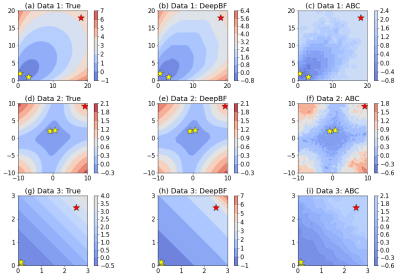 A recently arXived paper proposes an alternative approach to computing Bayes factors via deep learning, Deep Bayes Factors written by Jungeum Kim (presenting her work at JSM this very morning) and Veronika Ročková (whom I have known from her PhD years and whose COPSS Award we very gladly celebrated yesterday!). Which is obviously of interest to me, given my repeated visits to the challenge.
“we introduce Deep Bayes Factor (DeepBF), a neural classifier trained on simulated datasets to learn a mapping whose functional constitutes a Bayes factor estimator.”
Their approach is directly connected with various classification approaches to ABF, incl. the mythical inverse logistic version of Geyer (1994) and noise contrastive estimation of Gutmann and Hyvärinen (2010) (as well as our forested version). Which is called the likelihood-ratio trick here.
“Viewing the Bayes factor through the lens of binary classification aligns with Pudlo et al. (2016), who recast ABC model selection as a classification problem. They employ random forests to select a model by a majority vote. Instead, we focus on binary classification where the purpose is to learn marginal likelihood ratios. Contrary to the method in Pudlo et al. (2016), our strategy circumvents a secondary learning phase for gauging model posterior estimates, delivering results in only one stage.”
The authors‘ solution stands with learning a classifier from simulated data from both models (and a basic log ratio utility), along iterations updating D from the gradient of the utility, the associated Bayes factor being the ratio D/(1-D) derived from the estimated classifier. There is a cost in producing new samples from the (same) predictives at each iteration (and I wonder if some recycling would be helpful, as well as reducing the sample size for the simpler model). In one of the remarks, the authors point out that “in the effort to see the best ABC performance, we intentionally use the full data Y as a summary statistic”, a remark that I find surprising given the overall consensus that the Bayes factor itself [when based on the full data] is close to optimal.
The method is overall consistent (in the data size n) under classical Bayesian asymptotics, sometimes even when the Bayes factor estimator is inconsistent, naturally expands to pseudo Bayes factors like intrinsic and fractional Bayes factors, also mileage varies in terms of numerical stability.
In the Bayesian model criticism section, the notion of opposing the actual dataset to a simulated one relates very much to Geyer’s (1994) solution. As well as to GANs, as noted in the paper. I did not look closely at the numerical comparisons in the experimental section, but they sound rich enough.


