Archive for random walk

an elegant sampler

Posted in Books, Kids, R, University life with tags , , , , , , , on January 15, 2020 by xi'an

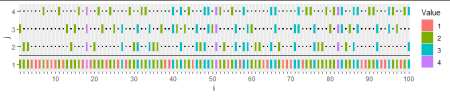
Following an X validated question on how to simulate a multinomial with fixed average, W. Huber produced a highly elegant and efficient resolution with the compact R code

tabulate(sample.int((k-1)*n, s-n) %% n + 1, n) + 1

where k is the number of classes, n the number of draws, and s equal to n times the fixed average. The R function sample.int is an alternative to sample that seems faster. Breaking the outcome of

sample.int((k-1)*n, s-n)

as nonzero positions in an n x (k-1) matrix and adding a adding a row of n 1’s leads to a simulation of integers between 1 and k by counting the 1’s in each of the n columns, which is the meaning of the above picture. Where the colour code is added after counting the number of 1’s. Since there are s 1’s in this matrix, the sum is automatically equal to s. Since the s-n positions are chosen uniformly over the n x (k-1) locations, the outcome is uniform. The rest of the R code is a brutally efficient way to translate the idea into a function. (By comparison, I brute-forced the question by suggesting a basic Metropolis algorithm.)

riddle on a circle

Posted in Books, Kids, R, Travel with tags , , , , , , , on December 22, 2019 by xi'an

The Riddler’s riddle this week provides another opportunity to resort to brute-force simulated annealing!

Given a Markov chain defined on the torus {1,2,…,100} with only moves a drift to the right (modulo 100) and a uniformely random jump, find the optimal transition matrix to reach 42 in a minimum (average) number of moves.

Which I coded in my plane to Seattle, under the assumption that there is nothing to do when the chain is already in 42. And the reasoning that there is not gain (on average) in keeping the choice between right shift and random jump random.

dure=min(c(41:0,99:42),50)
temp=.01
for (t in 1:1e6){
  i=sample((1:100)[-42],1)
  dura=1+mean(dure)
  if (temp*log(runif(1))<dure[i]-dura) dure[i]=dura
  if(temp*log(runif(1))<dure[i]-(dura<-1+dure[i*(i<100)+1])) 
    dure[i]=dura 
  temp=temp/(1+.1e-4*(runif(1)>.99))}

In all instances, the solution is to move at random for any position but those between 29 and 41, for an average 13.64286 number of steps to reach 42. (For values outside the range 29-42.)

subset sampling

Posted in Statistics with tags , , , , , , , , on July 13, 2018 by xi'an

A paper by Au and Beck (2001) was mentioned during a talk at MCqMC 2018 in Rennes and I checked Probabilistic Engineering Mechanics for details. There is no clear indication that the subset simulation advocated therein is particularly effective. The core idea is to obtain the probability to belong to a small set A by a cascading formula, namely the product of the probability to belong to A¹, then the conditional probability to belong to A² given A¹, &tc. When the subsets A¹, A², …, A constitute a decreasing embedded sequence. The simulation conditional on being in one of the subsets A^i is operated by a random-walk Metropolis-within-Gibbs scheme, with an additional rejection when the value is not in the said subset. (Surprisingly, the authors re-establish the validity of this scheme.) Hence the proposal faces similar issues as nested sampling, except that the nested subsets here are defined quite differently as they are essentially free, provided they can be easily evaluated. Each of the random walks need be scaled, the harder a task because this depends on the corresponding subset volume. The subsets A^i themselves are rarely defined in a natural manner, except when being tail events. And need to be calibrated so that the conditional probability of falling into each remains large enough, the cost of free choice. The Markov chain on the previous subset A^i can prove useful to build the next subset A^{i+1}, but there is no general principle behind this remark. (If any, this is connected with X entropy.) But else, the past chains are very much wasted, compared with, say, an SMC treatment of the problem. The paper also notices that starting a Markov chain in the set A^{i+1} means there is no burnin time and hence that the probability estimators are thus unbiased. (This creates a correlation between successive Markov chains, but I think it could be ignored if the starting point was chosen at random or after a random number of extra steps.) The authors further point out that the chain may fail to be ergodic, if the proposal distribution lacks energy to link connected regions of the current subset A^i. They suggest using multiple chains with multiple starting points, which alleviates the issue only to some extent, as it ultimately depends on the spread of the starting points. As acknowledged in the paper.

cyclic riddle [not in NYC!]

Posted in Kids, R, Running, Travel with tags , , , , , , , , , , on December 29, 2017 by xi'an

In the riddle of this week on fivethirtyeight, the question is to find the average number of rounds when playing the following game: P=6 players sitting in a circle each have B=3 coins and with probability 3⁻¹ they give one coin to their right or left side neighbour, or dump the coin to the centre. The game ends when all coins are in the centre. Coding this experiment in R is rather easy

situz=rep(B,P)
r=1
while (max(situz)>0){
 unz=runif(P)
 newz=situz-(situz>0)
 for (i in (1:P)[unz<1/3]) 
  newz[i%%P+1]=newz[i%%P+1]+(situz[i]>0)
 for (i in (1:P)[unz>2/3])
  newz[i-1+P*(i==1)]=newz[i-1+P*(i==1)]+(situz[i]>0)
 situz=newz
 r=r+1}

resulting in an average of 15.58, but I cannot figure out (quickly enough) an analytic approach to the problem. (The fit above is to a Gamma(â-1,ĝ) distribution.)

In a completely unrelated aparté (aside), I read earlier this week that New York City had prohibited the use of electric bikes. I was unsure of what this meant (prohibited on sidewalks? expressways? metro carriages?) so rechecked and found that electric bikes are simply not allowed for use anywhere in New York City. Because of the potential for “reckless driving”. The target is apparently the high number of delivery e-bikes, but this ban sounds so absurd that I cannot understand it passed. Especially when De Blasio has committed the city to the Paris climate agreement after Trump moronically dumped it… Banning the cars would sound much more in tune with this commitment! (A further aparté is that I strongly dislike e-bikes, running on nuclear power plants,  especially when they pass me on sharp hills!, but they are clearly a lesser evil when compared with mopeds and cars.)

splitting a field by annealing

Posted in Kids, pictures, R, Statistics with tags , , , , , , , , on October 18, 2017 by xi'an

A recent riddle [from The Riddle] that I pondered about during a [long!] drive to Luxembourg last weekend was about splitting a square field into three lots of identical surface for a minimal length of separating wire… While this led me to conclude that the best solution was a T like separation, I ran a simulated annealing R code on my train trip to AutransValence, seemingly in agreement with this conclusion.I discretised the square into n² units and explored configurations by switching two units with different colours, according to a simulated annealing pattern (although unable to impose connectivity on the three regions!):

partz=matrix(1,n,n)
partz[,1:(n/3)]=2;partz[((n/2)+1):n,((n/3)+1):n]=3
#counting adjacent units of same colour 
nood=hood=matrix(4,n,n)
for (v in 1:n2) hood[v]=bourz(v,partz)
minz=el=sum(4-hood)
for (t in 1:T){
  colz=sample(1:3,2) #picks colours
  a=sample((1:n2)[(partz==colz[1])&(hood<4)],1)
  b=sample((1:n2)[(partz==colz[2])&(hood<4)],1) 
  partt=partz;partt[b]=colz[1];partt[a]=colz[2] 
#collection of squares impacted by switch 
  nood=hood 
  voiz=unique(c(a,a-1,a+1,a+n,a-n,b-1,b,b+1,b+n,b-n)) 
  voiz=voiz[(voiz>0)&(voiz<n2)] 
  for (v in voiz) nood[v]=bourz(v,partt) 
  if (nood[a]*nood[b]>0){
    difz=sum(nood)-sum(hood)
    if (log(runif(1))<difz^3/(n^3)*(1+log(10*rep*t)^3)){
      el=el-difz;partz=partt;hood=nood     
      if (el<minz){ minz=el;cool=partz}
  }}}

(where bourz computes the number of neighbours), which produces completely random patterns at high temperatures (low t) and which returns to the T configuration (more or less):if not always, as shown below:Once the (a?) solution was posted on The Riddler, it appeared that one triangular (Y) version proved better than the T one [if not started from corners], with a gain of 3% and that a curved separation was even better with an extra gain less than 1% [solution that I find quite surprising as straight lines should improve upon curved ones…]